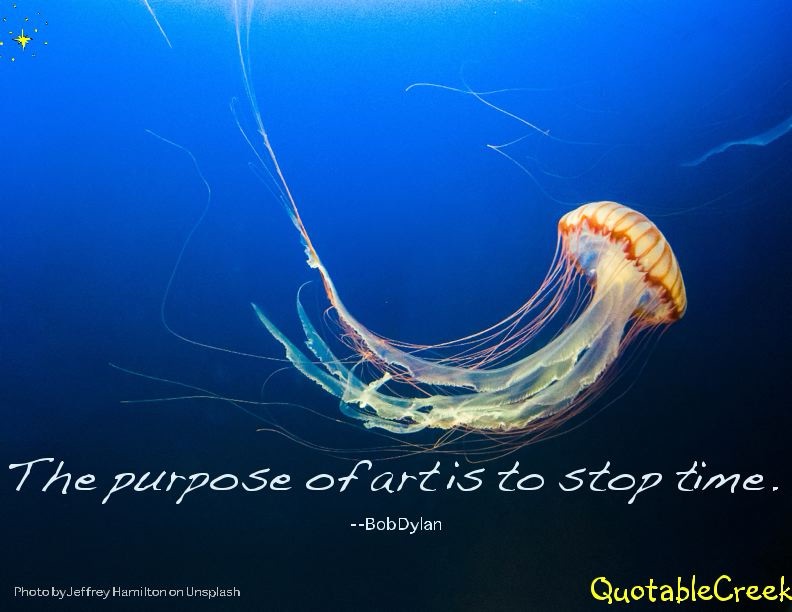
We are caught in the steady, persistent, ruthless flow of time. And yet there are moments when we can step out of time to pause, focus, and gain perspective. The arts do that. As you admire a piece of art, whether photograph, painting, novel, poem, film, dance and so on, we are grounded in detail. We can observe intricacy. We pause in the captured emotion and can rest there awhile. We are transported.
When the cares of the world become too great, we can pause and admire the detail in a jelly fish, the sweetness in bird song, or read soothing words such as these by Wendell Barry:
The Peace of Wild Things
When despair for the world grows in me
and I wake in the night at the least sound
in fear of what my life and my children’s lives may be,
I go and lie down where the wood drake
rests in his beauty on the water, and the great heron feeds.
I come into the peace of wild things
who do not tax their lives with forethought
of grief. I come into the presence of still water.
Toni Morrison had a gift for complexity and nuance in her writing. Multi-dimensional characters and lots of gray area rule the day in her work.
I found it interesting to hear this perspective from her:
I just think goodness is more interesting. Evil is constant. You can think of different ways to murder people, but you can do that at age five. But you have to be an adult to consciously, deliberately be good — and that’s complicated.
It’s an age-old question whether people are inherently good, whether altruism is learned or instinctive, whether selflessness develops naturally.
But there definitely is an intentionality to doing good, choosing kindness, forgiving, welcoming, holding your tongue. And as we grow older and cast off our childish ways, we learn the wisdom of restraint and forbearance.
And we learn the power of good because often we are on the receiving end of it and know how much it matters.
And then when it’s our turn, we want to pass it on.
What are the things you love, the things you hate, the things that keep you up at night? What are your favorite smells, sounds, tastes, sights, things to touch? How are you inhabiting that body you’ve been given and finding joy?
Whatever your combination of answers to these questions is, it is uniquely your own. It is what makes you, you.
For each of us, that answer will be different, but all part of the same global struggle for individualism. Here is George Bernard Shaw’s answer to some of these questions:
So long as I remain alive and well, I shall continue to feel strongly about prose style, to love the surface of the earth, and to take a pleasure in solid objects and scraps of useless information.
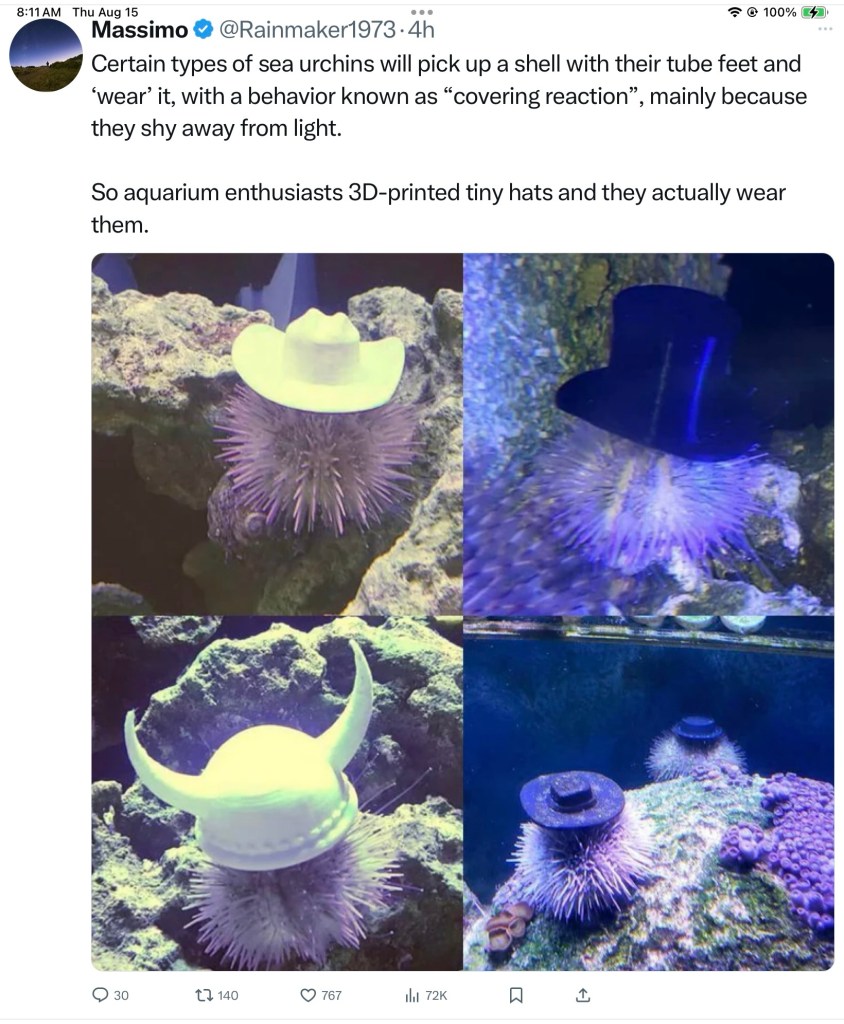
It doesn’t matter how old we get. There is always something that captures our attention and imagination, and, maybe even, holds us rapt in awe. Often it’s in nature, but sometimes it’s in human inventiveness. Or, maybe, a combination of the two.
This is something that captured my attention recently and held my fascination. First in amusement, then in wonder, and, finally, awe.
Humans are complicated creatures. Sometimes we feel emotions and have no idea why. And perhaps that is for good reason because much of what affects us is hidden. Consider, for example, subliminal advertising. People would go to the movies and watch reels that had ‘Buy Popcorn’ hidden in a few frames, not enough to consciously notice, but enough so that people watching got the sudden urge for popcorn. Or perhaps you’ve been watching a show where the characters are sharing a cup of coffee and, suddenly, felt an urge for a cup of Joe. Model homes are designed and staged in such a way that you can easily imagine yourself living there and stepping into the life reflected in the art and photographs of that fictional happy family, if only you buy the house.
Or consider the influence of color. Pink has been associated with a calming effect and has been used in drunk tanks and visiting team locker rooms in an effort to sway human behavior.And it works so well that now the Western Athletic Conference has a rule that the lockers rooms can be painted any color, including pink, but both teams must have the same color.
It behooves us to pay attention to what we are paying attention to. Are our emotions being stirred up? Take a minute and consider why. Is someone trying to manipulate us in some way? It happens often in advertising and politics. Being aware of the ways we can be influenced, and opening our eyes to those manipulations, helps keep us in the driver’s seats of our own lives.
How broad is your focus? On your own needs and wants, or broader? It seems that a broad focus, on others as much or more than ourselves increases empathy and happiness.
As Daniel Goleman said:
Self-absorption in all its forms kills empathy, let alone compassion. When we focus on ourselves, our world contracts as our problems and preoccupations loom large. But when we focus on others, our world expands. Our own problems drift to the periphery of the mind and so seem smaller, and we increase our capacity for connection – or compassionate action.
Does this seem true as you think about the people in your life?
The other thing that happens when you turn your concern to others is the whole world opens up. There is so much to learn, to do, to care about. So many places to put your time and efforts. So many people to love and help.
Joy is a fascinating emotion. It often springs up in us at surprising times. There is something of a wellspring vibe to it, as if it bubbles up in us with little bearing to our circumstance in life or particular experience. As C. S. Lewis notes,
“I call it Joy. ‘Animal-Land’ was not imaginative. But certain other experiences were… The first is itself the memory of a memory. As I stood beside a flowering currant bush on a summer day there suddenly arose in me without warning, and as if from a depth not of years but of centuries, the memory of that earlier morning at the Old House when my brother had brought his toy garden into the nursery. It is difficult to find words strong enough for the sensation which came over me; Milton’s ‘enormous bliss’ of Eden (giving the full, ancient meaning to ‘enormous’) comes somewhere near it. It was a sensation, of course, of desire; but desire for what?…Before I knew what I desired, the desire itself was gone, the whole glimpse… withdrawn, the world turned commonplace again, or only stirred by a longing for the longing that had just ceased… In a sense the central story of my life is about nothing else… The quality common to the three experiences… is that of an unsatisfied desire which is itself more desirable than any other satisfaction. I call it Joy, which is here a technical term and must be sharply distinguished both from Happiness and Pleasure. Joy (in my sense) has indeed one characteristic, and one only, in common with them; the fact that anyone who has experienced it will want it again… I doubt whether anyone who has tasted it would ever, if both were in his power, exchange it for all the pleasures in the world. But then Joy is never in our power and Pleasure often is.” The Shape of My Early Life
Joy is distinct from pleasure and happiness. It is an abundance, a bliss, an immeasurable gratitude for the privilege of being. It isn’t meant to be ignored, but embraced, relished, cherished. Not as a byproduct of some other experience, but in itself.
As Mary Oliver says,
“If you suddenly and unexpectedly feel joy,
don’t hesitate.
Give in to it.
There are plenty of lives and whole towns destroyed or about to be.
We are not wise, and not very often kind.
And much can never be redeemed.
Still life has some possibility left.
Perhaps this is its way of fighting back,
that sometimes something happened better than all the riches or power in the world.
It could be anything, but very likely you notice it in the instant when love begins.
Anyway, that’s often the case.
Anyway, whatever it is,
don’t be afraid of its plenty. Joy is not made to be a crumb.
Swan, Poems and Prose Poems
If you should be lucky enough to feel joy bubbling up, savor it. Don’t hesitate.
It’s so interesting to think about all the different ways we can show up in this world. On stage, as in this quote. Or behind the scenes.
What motivates you to get out there and shine your light?
What do you think of the phrase ‘The world is your oyster’? Full of possibilities, and maybe a pearl. Treasure! But also something born inside the oyster as a result of grit or sand, an irritant, inside the oyster, around which the oyster builds the pearl.
Life is full of irritants, and pearls, runways and behind the scenes. It’s a big complicated world.
There is a sort of magic in reading a book. Someone, maybe long dead, has perhaps expressed deep feelings or new thoughts or complex theories, writing out of their aloneness, and connecting with someone they have never met and may never meet.
And yet the impact of that shared space over a book can be life-changing. It can help you feel less alone in this big world. It can help you feel empathy for others in a way you may never have experienced without the book. It can open your heart and mind in new and wonderful ways.
Do you find yourself making the same mistakes repeatedly? Maybe even sabotaging relationships or failing to meet your goals? Is it possible you are getting in your own way?
In this insightful article, Tim Hoch identifies 10 ways you may be making your life harder than it needs to be:
1. You ascribe intent.
Another driver cut you off. Your friend never texted you back. Your co-worker went to lunch without you. Everyone can find a reason to be offended on a steady basis. So what caused you to be offended? You assigned bad intent to these otherwise innocuous actions. You took it as a personal affront, a slap in the face.
Happy people do not do this. They don’t take things personally. They don’t ascribe intent to the unintentional actions of others.
2. You’re the star of your own movie.
It is little wonder that you believe the world revolves around you. After all, you have been at the very center of every experience you have ever had.
You are the star of your own movie. You wrote the script. You know how you want it to unfold. You even know how you want it to end.
Unfortunately you forgot to give your script to anyone else. As a result, people are unaware of the role they are supposed to play. Then, when they screw up their lines, or fail to fall in love with you or don’t give you a promotion, your movie is ruined.
Lose your script. Let someone else star once in awhile. Welcome new characters. Embrace plot twists.
3. You fast forward to apocalypse.
I have a bad habit of fast forwarding everything to its worst possible outcome and being pleasantly surprised when the result is marginally better than utter disaster or jail time. My mind unnecessarily wrestles with events that aren’t even remotely likely. My sore throat is cancer. My lost driver’s license fell into the hands of an al-Qaeda operative who will wipe out my savings account.
Negativity only breeds more negativity. It is a happiness riptide. It will carry you away from shore and if you don’t swim away from it, will pull you under.
4. You have unrealistic and/or uncommunicated expectations.
Among their many shortcomings of your family and friends is the harsh reality that they cannot read your mind or anticipate your whims.
Did your boyfriend forget the six and a half month anniversary of your first movie date? Did your girlfriend refuse to call at an appointed hour? Did your friend fail to fawn over your tribal tattoo?
Unmet expectations will be at the root of most of your unhappiness in life. Minimize your expectations, maximize your joy.
5. You are waiting for a sign.
I have a friend who won’t make a decision without receiving a “sign.” I suppose she is waiting on a trumpeted announcement from God. She is constantly paralyzed by a divinity that is either heavily obscured or frustratingly tardy. I’m not disavowing that fate or a higher power plays a role in our lives. I’m just saying that it is better to help shape fate than be governed by it.
6. You don’t take risks.
Two words: Live boldly. Every single time you are offered a choice that involves greater risk, take it. You will lose on many of them but when you add them up at the end of your life you’ll be glad you did.
7. You constantly compare your life to others.
A few years ago I was invited to a nice party at a big warehouse downtown. I was enjoying the smooth jazz, box wine and crustless sandwiches. What more could a guy want? Later in the evening I noticed a steady parade of well-heeled people slide past and disappear into another room. I peeked and saw a large party with beautiful revelers dancing and carrying on like Bacchus. Suddenly my gig wasn’t as fun as it had been all because it didn’t appear to measure up to the party next door- a party I didn’t even know existed until just moments before.
I do this frequently. Those people are having more fun. Mary has a bigger boat. Craig gets all the lucky breaks. Ted has more money. John is better looking.
Stop it.
Always remember what Teddy Roosevelt said: “Comparison is the thief of joy.”
8. You let other people steal from you.
If you had a million dollars in cash under your mattress, you would check it regularly and take precautions to insure it is safe. The one possession you have that is more important than money is time. But you don’t do anything to protect it. In fact you willingly give it to thieves. Selfish people, egotistical people, negative people, people who won’t shut up. Treat your time like Fort Knox. Guard it closely and give it only to those who deserve and respect it.
9. You can’t/won’t let go.
These are getting a little harder aren’t they? That’s because sometimes you have to work at happiness. Some hurdles are too difficult to clear by simply adjusting your point of view or adopting a positive mindset.
Do you need to forgive someone? Do you need to turn your back on a failed relationship? Do you need to come to terms with the death of a loved one?
Life is full of loss. But, in a sense, real happiness would not be possible without it. It helps us appreciate and savor the things that really matter. It helps us grow. It can help us help others grow.
Closure is a word for people who have never really suffered. There’s no such thing. Just try to “manage” your loss. Put it in perspective. You will always have some regret and doubt about your loss. You may always second guess yourself. If only you had said this, or tried that.
You’re not alone. Find someone who understands and talk to that person. Reach out for support. If all else fails, try #10 below.
10. You don’t give back.
One way to deal with loss is to immerse yourself in doing good. Volunteer. Get involved in life.
It doesn’t even have to be a big, structured thing. Say a kind word. Encourage someone. Pay a visit to someone who is alone. Get away from your self-absorption.
When it comes down to it, there are two types of people in this world. There are givers and there are takers. Givers are happy. Takers are miserable. What are you?
Do any of these fit? You may need to get out of your own way.