Many trees these days looks dead. And yet spring will come. Bulbs planted long ago under frigid ground are even now pushing out sprouts working their way to the surface. Spring will come.
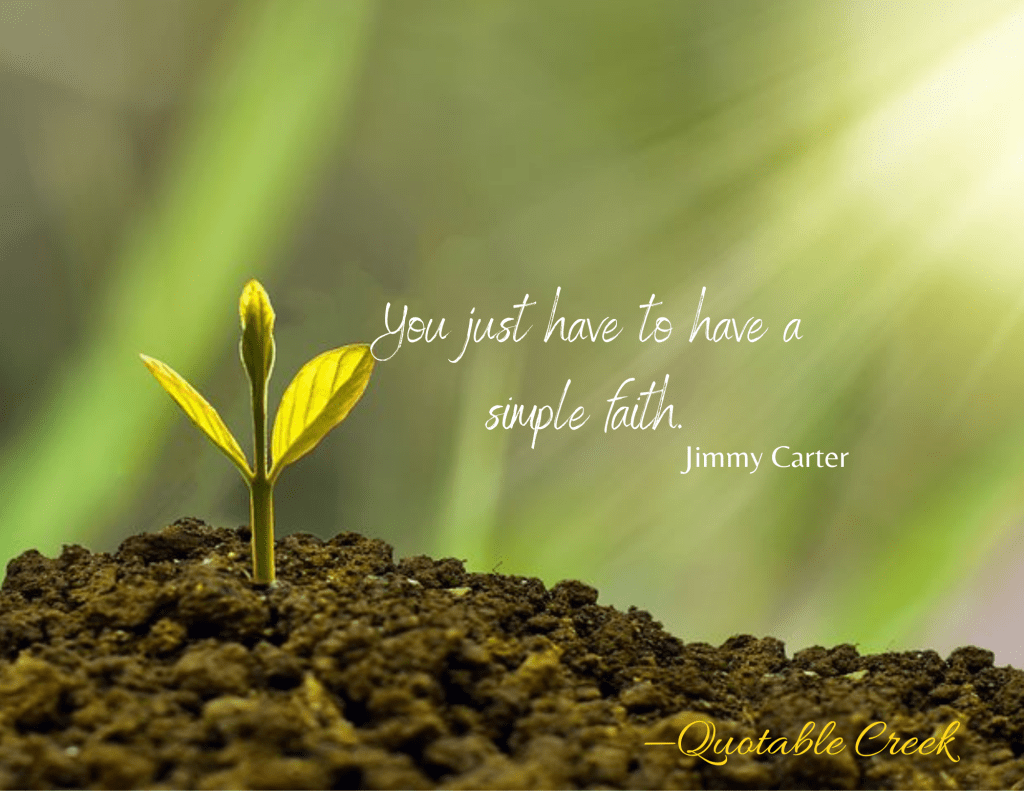
Believing in spring is a bit like an act of faith. Things look bleak and dead, yet we hope for new life and regeneration. Renewal. what was broken can be mended. What was lost can be found. Those who have given up can find hope.
As we hear news that former President Carter is receiving hospice care, I pray his faith sustains and comforts him and his family, and that they find peace. In his words:
God is not my personal valet. God does not build a protective fence around my life, keep me from trouble, fulfill my personal desires, or guarantee my success. However, through prayer God offers me comfort, reassurance, satisfaction, courage, hope, and peace.”
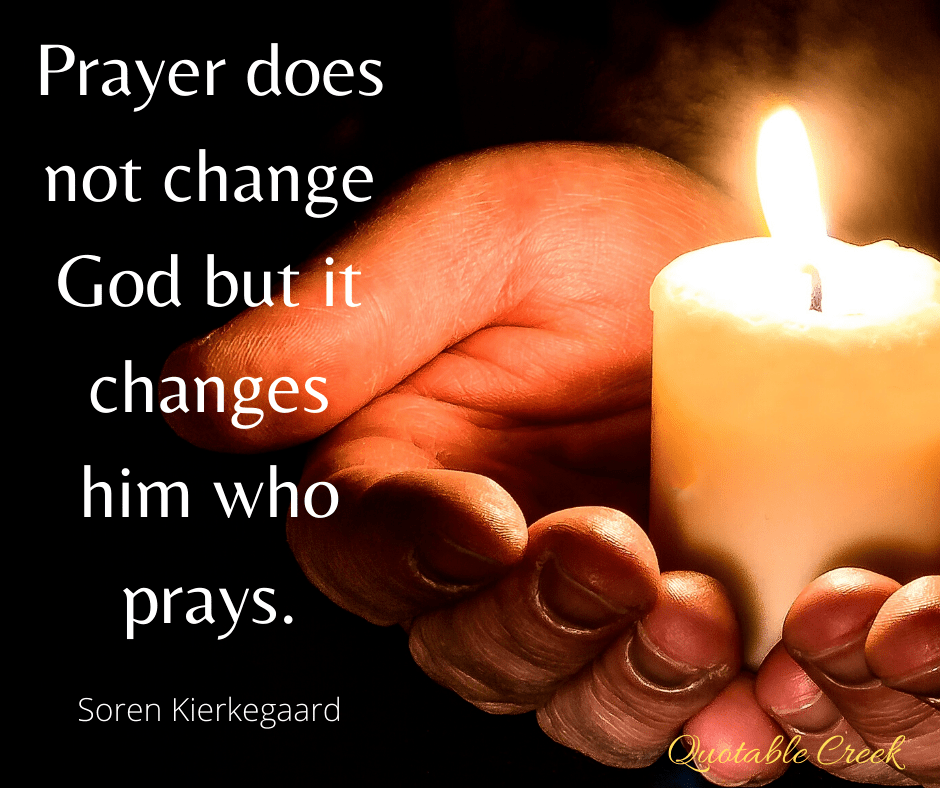
There are as many ways to pray as there are people praying. But what is it, exactly? Maybe it’s easier to answer what it isn’t: a flamboyant show, a chance to pose and preen publicly, a subterfuge, a droning recitation of memorized but not considered words.
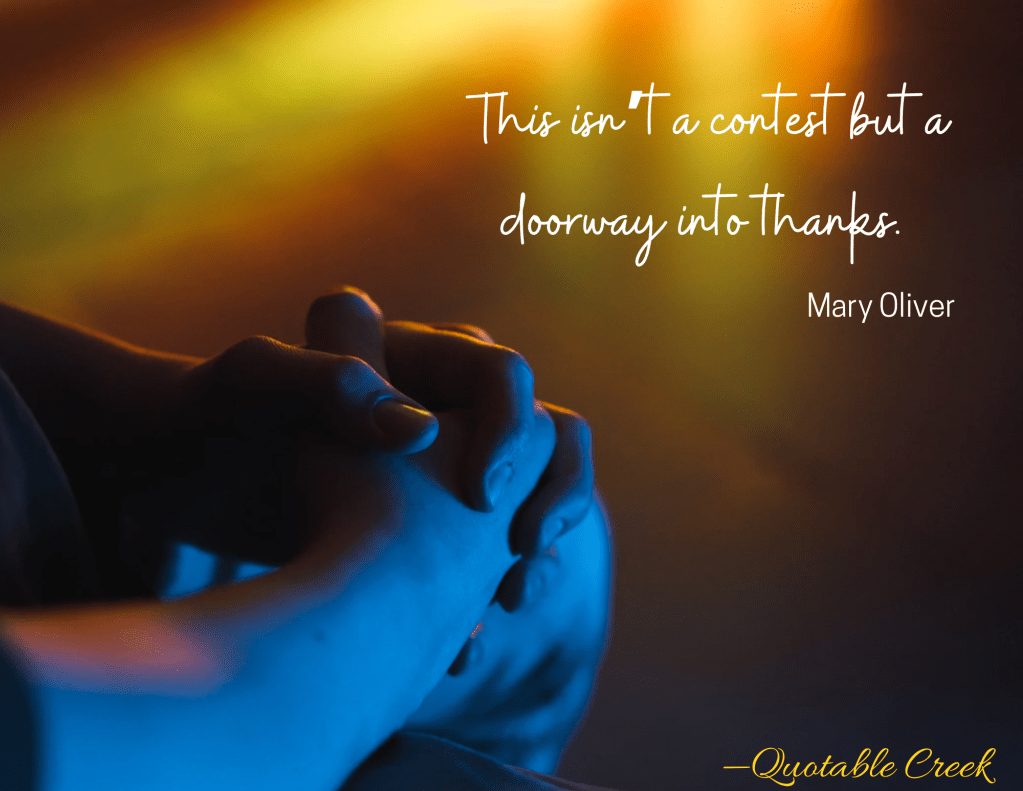
What prayer actually is, though, is more complicated: a bridge between ourselves and the mysterious, a chance to become small, and yet fully individual, in a vastness, an experience of awe. Mary Oliver’s definition above in her poem Praying is lovely: a doorway into thanks. Consider the whole poem:
Praying
It doesn’t have to be
The blue iris, it could be
Weeds in a vacant lot, or a few
Small stones; just
Pay attention, then patch
A few words together and don’t try
To make them elaborate,
This isn’t a contest but the doorway
Into thanks, and a silence in
Which another voice may speak.
Pay attention; see the beauty around you; give thanks. Rinse and repeat.
In 2016, Pope Francis sainted Mother Teresa. She was a beloved paragon of a selfless life, ministering to the poor and dying, shining a light on the importance of the little things and the love of family. After her death, her diaries showed her struggles with doubt. Once feeling clearly called to her mission, in the last several decades of her life she felt God’s absence. She said,
Lord, my God, who am I that You should forsake me? The Child of your Love–and now become as the most hated one–the one–You have thrown away as unwanted–unloved. I call, I cling, I want–and there is no One to answer–no One on Whom I can cling–no, No One.–Alone … Where is my Faith–even deep down right in there is nothing, but emptiness & darkness–My God–how painful is this unknown pain–I have no Faith–I dare not utter the words & thoughts that crowd in my heart–& make me suffer untold agony.
So many unanswered questions live within me afraid to uncover them–because of the blasphemy–If there be God –please forgive me–When I try to raise my thoughts to Heaven–there is such convicting emptiness that those very thoughts return like sharp knives & hurt my very soul.–I am told God loves me–and yet the reality of darkness & coldness & emptiness is so great that nothing touches my soul. Did I make a mistake in surrendering blindly to the Call of the Sacred Heart?
And on until her death, she felt God’s absence, rather than his presence. And yet she persisted doing the work to which she had been called, living a life of faith.
Some may call her a hypocrite to have an outward smile of peace and an inner crisis of faith, but isn’t her struggle every one’s struggle? Who among us doesn’t struggle with doubt? Don’t we all rely on faith when our paths grow dark and twisting?
St. Teresa of Calcutta inspires us to hang on during the dark nights of the soul, to continue to walk the walk, to be faithful and steadfast, and to shine light in the dark places. She can aptly be considered the Patron Saint of Doubters.
From Shari:
During dark times, it is easy to lose our way. What are some ways you have kept going even during a crisis of faith?
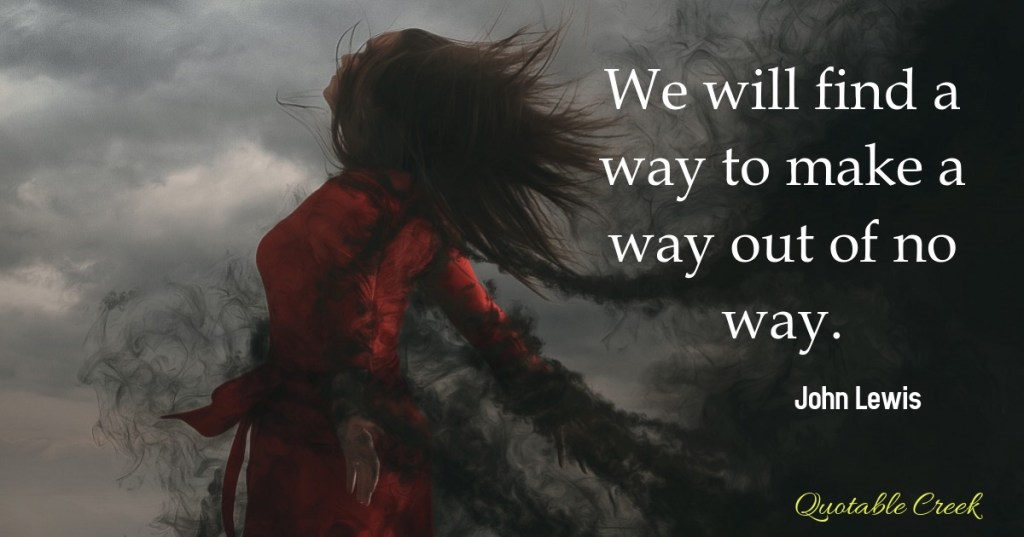
John Lewis was an American hero. His whole life was a testament to fighting the good fight and trying to make the world a better, more egalitarian place even in the most dire of circumstances. Today, he is laid to rest, but he left us words, every one ringing with truth, to give us light and help us find our way without him:
“While my time here has now come to an end, I want you to know that in the last days and hours of my life you inspired me. You filled me with hope about the next chapter of the great American story when you used your power to make a difference in our society. Millions of people motivated simply by human compassion laid down the burdens of division. Around the country and the world you set aside race, class, age, language and nationality to demand respect for human dignity.
“That is why I had to visit Black Lives Matter Plaza in Washington, though I was admitted to the hospital the following day. I just had to see and feel it for myself that, after many years of silent witness, the truth is still marching on.
“Emmett Till was my George Floyd. He was my Rayshard Brooks, Sandra Bland and Breonna Taylor. He was 14 when he was killed, and I was only 15 years old at the time. I will never ever forget the moment when it became so clear that he could easily have been me. In those days, fear constrained us like an imaginary prison, and troubling thoughts of potential brutality committed for no understandable reason were the bars.
“Though I was surrounded by two loving parents, plenty of brothers, sisters and cousins, their love could not protect me from the unholy oppression waiting just outside that family circle. Unchecked, unrestrained violence and government-sanctioned terror had the power to turn a simple stroll to the store for some Skittles or an innocent morning jog down a lonesome country road into a nightmare. If we are to survive as one unified nation, we must discover what so readily takes root in our hearts that could rob Mother Emanuel Church in South Carolina of her brightest and best, shoot unwitting concertgoers in Las Vegas and choke to death the hopes and dreams of a gifted violinist like Elijah McClain.
“Like so many young people today, I was searching for a way out, or some might say a way in, and then I heard the voice of Dr. Martin Luther King Jr. on an old radio. He was talking about the philosophy and discipline of nonviolence. He said we are all complicit when we tolerate injustice. He said it is not enough to say it will get better by and by. He said each of us has a moral obligation to stand up, speak up and speak out. When you see something that is not right, you must say something. You must do something. Democracy is not a state. It is an act, and each generation must do its part to help build what we called the Beloved Community, a nation and world society at peace with itself.
“Ordinary people with extraordinary vision can redeem the soul of America by getting in what I call good trouble, necessary trouble. Voting and participating in the democratic process are key. The vote is the most powerful nonviolent change agent you have in a democratic society. You must use it because it is not guaranteed. You can lose it.
“You must also study and learn the lessons of history because humanity has been involved in this soul-wrenching, existential struggle for a very long time. People on every continent have stood in your shoes, though decades and centuries before you. The truth does not change, and that is why the answers worked out long ago can help you find solutions to the challenges of our time. Continue to build union between movements stretching across the globe because we must put away our willingness to profit from the exploitation of others.
“Though I may not be here with you, I urge you to answer the highest calling of your heart and stand up for what you truly believe. In my life I have done all I can to demonstrate that the way of peace, the way of love and nonviolence is the more excellent way. Now it is your turn to let freedom ring.
“When historians pick up their pens to write the story of the 21st century, let them say that it was your generation who laid down the heavy burdens of hate at last and that peace finally triumphed over violence, aggression and war. So I say to you, walk with the wind, brothers and sisters, and let the spirit of peace and the power of everlasting love be your guide.”
May his words hold true in our hearts, and let us live up to the example he set. Let us go forward in the spirit of peace with everlasting love as our guide. Let this be our solemn vow. Now is the time.
So much of life feels like it is beyond our ability to understand. Philosophers and theologians can argue over how many angels can dance on the head of a pin or whether our futures are predestined. Or, even, whether God is dead, or, for that matter, ever lived, or, if alive, plays any hand in the events of the day.
Where is God when we suffer or when the whole world suffers? Is there any comfort in the argument that suffering happens because God gives us free will so has to let the natural consequences of things we’ve set in motion happen? That just kind of sucks, particularly when we are the well-behaved kids kept in at recess because of the misbehavior of some lone miscreant. What kind of global sense of the divine is that? Where is the comfort?
And, yet, there are moments, aren’t there? Moments when things fall into place, and we see the interconnection of living things, and feel lost in the mystery but at home there, too? Moments that sweep us into awe and gratitude and marvel? Moments where we can see the divine in the creation? In each other? Moments when we wonder how we got so lucky to be here, now, in this place and time, with these former strangers now beloved, with this life to live and all the options that offers?
We can look back at our lives and recognize the little junction points when we took a turn or met someone who became precious to us. A coincidence that we were both there in that same place and time. A coincidence that we got to talking and felt a connection, so kept talking, until that stranger became now a friend. Or a coincidence that led us to make a choice that brought us on a path to greater insight, understanding, and communion. What explains that? Those little coincidences that led us to the lives we have?
Lenny Duncan calls those coincidences ‘God staying anonymous’, and perhaps that is comforting. Perhaps the notion of a benevolent God putting people and experiences in our path to lead us forward gives us a sense of hope. Perhaps that is God working to draw us close. Perhaps it is our job to keep those flames of hope burning.
Duncan explains: “Church, I love you because you are the answer to the question ‘Is God real?’ You are the resounding yes thundering in our hearts. You are the triumphant roar affirming that God is real, powerful, and still able to perform miracles, here and now. In this time in our history, when the world seems like it is on the precipice, you are the gentle hymn that will pull us back from the abyss. You, Church, are the resounding call the entire world is bending its ear to hear as the first straining notes float over the mountaintop. You are slowly beginning to look at these hard truths, more and more each day. You are the dance of providence that lays itself out as series of coincidences, bringing even the least likely into communion with the divine. But we know coincidences are God’s way of staying anonymous. It’s our job to point out that God is the agent of change we all experience.”
And in any crisis, there will be people who step up out of a sense of the greater good and many of those suffering will tell you that God was there with them in that suffering, not from afar as if on a cloud looking down, but right there in their very fiber, in their own breath and the beating of their heart. God with us. Emmanuel. Not just in the coincidences, though certainly there, but in it all. And even when things are well beyond our comprehension and the complexities of the universe and even our own lives confound us, that is comforting. Emmanuel.
Many are on the front lines of this pandemic, either working in health care or in essential jobs to keep the world moving, while others of us are on the sidelines waiting. We worry about ourselves, but also about our friends and family members on the front lines. Will they be safe? What are the right words to encourage them and let them know we love them?
In this interesting article, health care worker Dorothy E. Novick suggests Ring Theory as a way to modulate our expressions of concern. It works like this:
“I came across an article about “Ring Theory,” written by Susan Silk and Barry Goldman. In this construct, we imagine a person who is suffering, like Margi, sitting in a small circle surrounded by concentric rings. Her dearest relatives sit in the circle closest to her. Best friends sit in the next larger circle. More friends and colleagues occupy the next one. And so on.
“According to Ring Theory, a person in any given circle should send love and compassion inward, to those in smaller circles, and process personal grief outward, to those in larger circles. To Margi and her mother, I should have said, “I love you, and I’ll do everything I can to support you.” And only when talking to others should I have said, “Her suffering feels impossible to bear.
“Comfort in, grief out.
“Ring Theory works for supporting health-care providers during the trauma of covid-19. We are grappling with a complex duality of mission plus terror. We are proud of what we can contribute and passionate about our patients’ well-being. But we are frightened — for our safety, for our patients, for the spouses and children we might expose.”
When we speak with people working in positions of danger, practicing Ring Theory makes good sense. Our comfort, praise, and admiration gives those heroes strength and helps them continue. Our hysteria or forwarding doomsday articles simply doesn’t. In all of this, we should strive to do no harm and let our words offer comfort.
Novick relates a message she received that helped give her comfort, a message that gives us a good example for how we can show up for people in dangerous positions right now:
The message read, “I am holding you in my heart being on the front lines of these difficult times. The professional skill, kindness, support and tenacity you give your patients and your medical community I am sure is a comfort in this darkness. Sending much love, appreciation and admiration.
“My heart rate slowed and my skin warmed over as I read the message. Then I pulled my mask over my face and opened the door to the next patient room.”
That, right there, is the power of the right words at the right time. We each have that power to do good right now.
In a grieving, struggling world, we pray. Full of humility, we fall to our knees. Gobsmacked by the fragility of life and the interconnectedness of all creation, we lift our eyes to the Lord and join voices around the world to offer thanks, plead for mercy, and reach for hope.
Never before has it been more obvious that we belong to each other and are all in this together.
We are each called to new challenges today. To make a difference, to protect the community, to keep our hope alive. Over the last few weeks, we have seen stories of both tremendous generosity and simple acts of kindness. And of compassion and resolve from leaders such as this from Queen Elizabeth.
As we move forward, Queen Elizabeth’s challenge to act in a way which will make us proud years from now rings true. How we respond to these times defines us. Consider the acts of this little boy working to secure PPE for his local hospital.
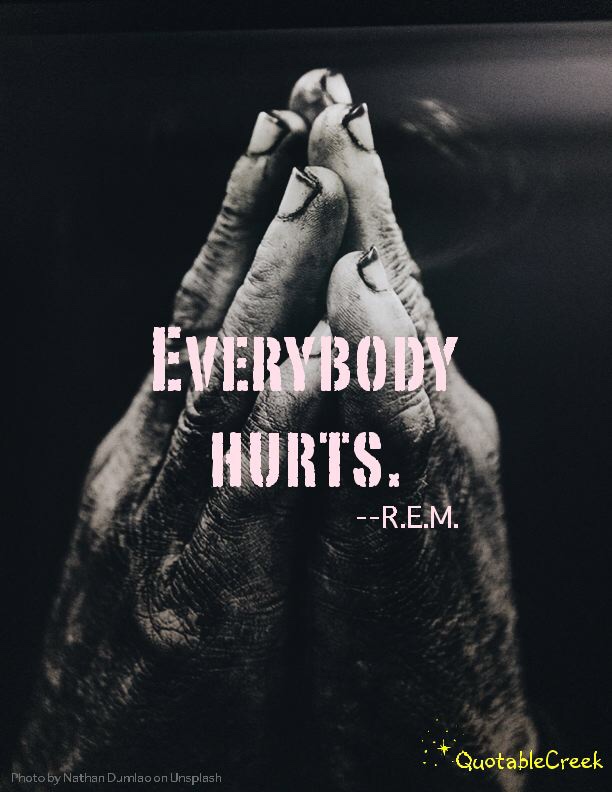
Please take a moment to watch Father Ray Kelly sing Everybody Hurts and remember that we need to reach out to each other. We are each other’s comfort and hope.
Lyrics
When your day is long And the night The night is yours alone When you’re sure you’ve had enough Of this life Well hang on Don’t let yourself go ‘Cause everybody cries And everybody hurts sometimes
Sometimes everything is wrong Now it’s time to sing along When your day is night alone (hold on) (Hold on) if you feel like letting go (hold on) If you think you’ve had too much Of this life Well, hang on
Cause everybody hurts Take comfort in your friends Everybody hurts Don’t throw your hand Oh, no Don’t throw your hand If you feel like you’re alone No, no, no, you’re not alone
If you’re on your own In this life The days and nights are long When you think you’ve had too much Of this life To hang on
Well, everybody hurts sometimes Everybody cries And everybody hurts sometimes And everybody hurts sometimes So, hold on, hold on Hold on, hold on Hold on, hold on Hold on, hold on



 QuotableCreek.com