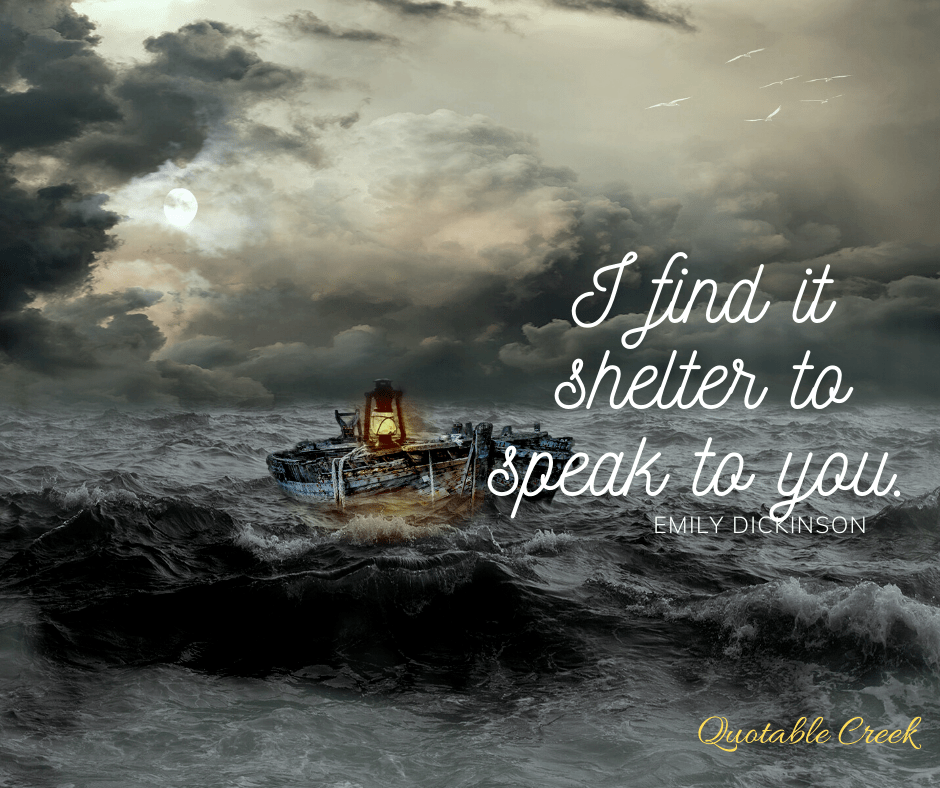
Of all the compliments you could receive, perhaps the best is that you feel like shelter. That, in all the storms and chaos that swirl around us, talking to you feels like safety. Not in the sense of being a yes man or echo chamber, or even in the sense of being able to do anything to stop the storm, but in the sense of home.
“I find it shelter when I speak to you,” says Emily Dickinson. What might we do and say to make someone feel that way? Shelter implies that the storm is still swirling, the elements are still fierce, but talking to you is a respite from that and an entry into something welcoming and safe. A place where you are known, and heard, and cared for. A place of comfort.
Certainly there are plenty of people making themselves someone’s storm. Wouldn’t it be wonderful to be someone’s shelter instead?
What can you do in this increasingly chaotic and exhausting world for someone to find it shelter when they talk with you?
Have you ever been lost? Perhaps in a crowd when you look up and realize all the people you know are gone, and, despite the crowd, you are alone. Or maybe driving when nothing is familiar, and you are getting farther and farther from your destination. Or maybe you’ve been lost emotionally, confronted with too many choices and unsure of which way to move forward.
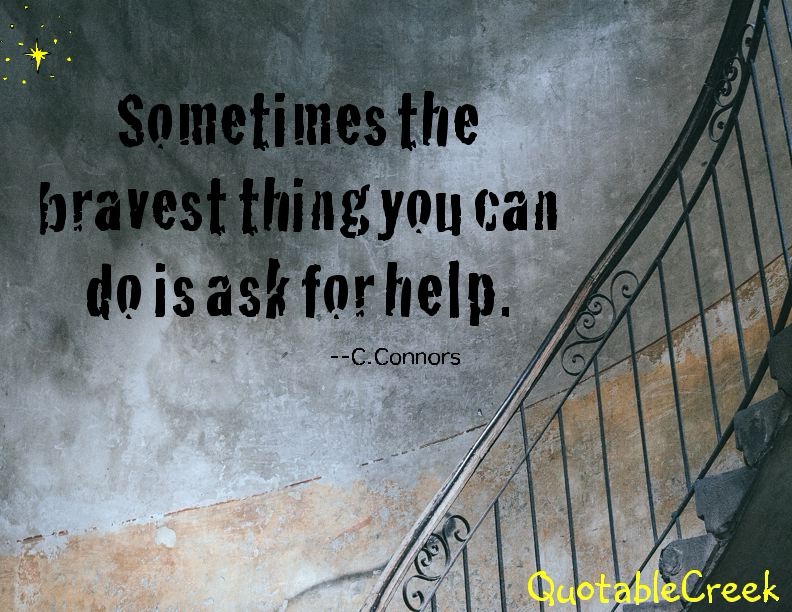
In most of these scenarios, when we are deeply and profoundly lost, we need help. There is someone who knows where you are and where you are trying to be and can help point out the way for you. Or someone who can make an announcement over the PA that they are holding on to a lost child. Or someone who can help you walk through your choices and make the best decision.
There are times when asking for help is our best option. And despite all our tendencies to want to solve the problem ourselves or keep the problem hidden from the world or to tough it out, seeking help is a brave and rewarding choice.
If you are feeling lost, do not be afraid to ask for help. And for a heart-warming video that demonstrates how rewarding it is both to be found and to help someone who is lost, go here to see a baby bird stuck in a PVC pipe and separated from its parents get reunited through the help of a young man who finds the experience one of the most meaningful he has ever lived.
None of us knows what the future holds. But we do know the values we hold dear—honesty, integrity, love, compassion, empathy, respect, tolerance. As we raise our children, we instill these values. As adults, we model these values whether we win or lose, succeed or fail, sink or swim. Watching us, they learn, and, as they go forward into their futures, they will bring these values to their own decisions. If each of us does this, we will leave the world a better brighter place for our having been here.
How do we read the news and not get overwhelmed or angry, disconnected or depressed? How do we keep showing up with compassion and grace in a world where there is so much hate? How do we keep ourselves on the right path through the midst of it all? How do we continue to show up from a place of compassion, forgiveness, and grace? how do we keep our hearts from growing hard?
In this thoughtful letter, Rabbi Yael Levy shares his insights on how to pray with the news:
The 17th of the Hebrew month Tammuz initiates a three-week period of mourning that leads to Tisha b’Av, which is the day that marks the destruction of the Temples in Jerusalem in 586 BCE and 70 CE.
Tradition teaches that the Temple was destroyed because hatred became the operating principle in the community. The scorn, contempt and disdain that characterized daily interactions caused the Divine Presence to flee and leave the Temple vulnerable to attack.
These next three weeks ask us to reflect on the hatred that we allow to take root in our hearts. The wisdom of the tradition acknowledges that hatred can sometimes feel energizing and “so right,” but allowing it to fill our bodies and guide our actions leads to destruction.
Many years ago I was taught the practice of praying with the news. I have shared it over the years and always find myself returning to it during this season.
In this practice, each time we read or listen to a news report that enrages us, we turn our attention to those harmed by what is happening and pray for their healing and well-being. Doing so encourages us to acknowledge feelings of anger, grief and despair, and at the same time it turns our attention toward connection and compassion. Praying with the news can help us learn to bear witness to devastation and mayhem, while keeping our hearts soft, our minds calm, and our actions clear.
I am struggling mightily with this practice these days in the wake of continued violence and oppression in this country and throughout the world. Hatred can sometimes feel like such a welcome harbor. Not only does it feel so right, it can also act as a shield, creating the illusion that I don’t have to acknowledge the grief and heartbreak I am experiencing.
I need practices to help quiet the rage and fear, to loosen the constriction of hatred and to help me be with overwhelming grief. I need practices to help me return to compassion, love, joy and possibility. I find praying with the news both painful and helpful. It keeps me connected, allows sorrow, and grounds me in care and love.
When we were kids, we didn’t worry too much about whether we were the best at coloring or pretend or sports. We did things because they were fun and filled us with joy. Later, somehow, we became worried about whether we should continue when we were never going to be competitive in it. We worried about how we looked, whether we would be mocked. Perhaps our parents decided lessons were a waste because we weren’t the stand out they had hoped we would be. The fun of it got lost and gave way to the competition in it.
That’s a shame. Author Kurt Vonnegut had an epiphany about this that changed his life:
When I was 15, I spent a month working on an archeological dig. I was talking to one of the archeologists one day during our lunch break and he asked those kinds of ‘getting to know you’ questions you ask young people: Do you play sports? What’s your favorite subject? And I told him, no I don’t play any sports. I do theater, I’m in choir, I play the violin and piano, I used to take art classes.
“And he went wow. That’s amazing! And I said, ‘Oh no, but I’m not any good at any of them.’
“And he said something then that I will never forget and which absolutely blew my mind because no one had ever said anything like it to me before: ‘I don’t think being good at things is the point of doing them. I think you’ve got all these wonderful experiences with different skills, and that all teaches you things and makes you an interesting person, no matter how well you do them.’
“And that honestly changed my life. Because I went from a failure, someone who hadn’t been talented enough at anything to excel, to someone who did things because I enjoyed them. I had been raised in such an achievement-oriented environment, so inundated with the myth of Talent, that I thought it was only worth doing things if you could ‘win’ at them.
That’s such a liberating mind shift. Doing things for the joy of them! Not the achievement in them. Not the value to your college application. Not the resume value or the competition.
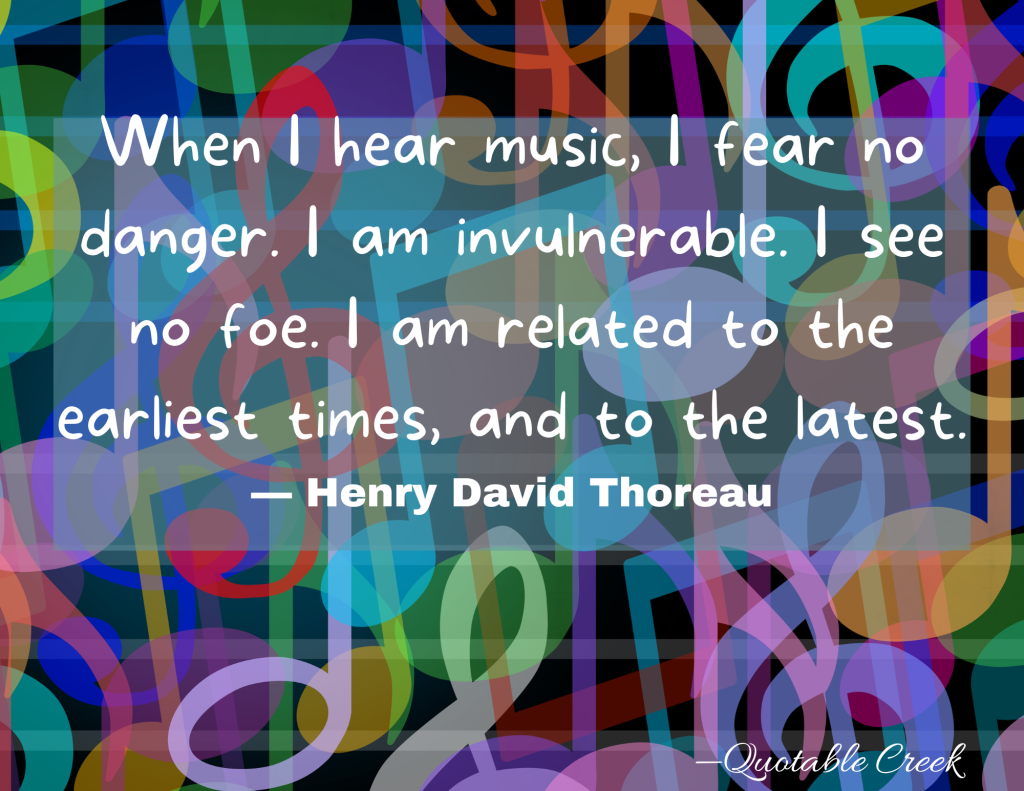
I’ve got something on the horizon that scares me. It’s unavoidable, so the only way out is through. But sometimes to keep from spinning out of control, I find a song that grounds me in the moment. Feet firm, breath in and out, listening to the music and reengaging with the beat of life. For me, right now, this song comforts me. I hope it brings you comfort, too.
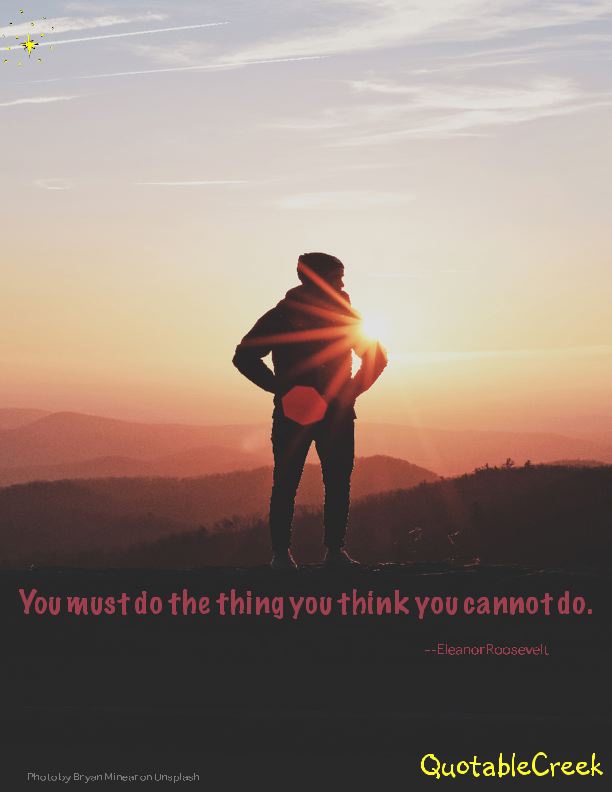
Standing up to fear changes a person. It helps you to put matters in perspective. Where once fear loomed over you, insurmountable, now you can honor the courage it took to move past it into unfamiliar territory.
Eleanor Roosevelt was a courageous woman. Despite her husband’s attempts to placate the South, she regularly bucked segregation and was a vocal proponent of civil rights. She was able to call out racism and force others to see it for what it was:
By 1939, ER decided to attack the hypocritical way in which the nation dealt with racial injustice. She wanted her fellow citizens to understand how their guilt in “writing and speaking about democracy and the American way without consideration of the imperfections within our system with regard to its treatment . . . of the Negro” encouraged racism. Americans, she told Ralph Bunche in an interview for Gunnar Myrdal’s American Dilemma, wanted to talk “only about the good features of American life and to hide our problems like skeletons in the closet.” Such withdrawal only fueled violent responses; Americans must therefore recognize “the real intensity of feeling” and “the amount of intimidation and terrorization” racism promotes and act against such “ridiculous” behavior.
You can’t clearly see a problem before you if you are too scared to look at it and call it out for what it is. Where are the injustices in your immediate orbit? Are there people being treated unfairly? How can you add your voice to help identify the problem and move toward healing? These problems are right here, close to home.
As Eleanor Roosevelt said:
Where after do human rights begin? In small places, close to home– so close and so small that they cannot be seen on any map of the world. Yet they are the world of the individual person: The neighborhood he lives in; the school or college he attends; the factory, farm or office where he works. Such are the places where every man, woman, and child seeks equal justice, equal opportunity, equal dignity without discrimination. Unless these rights have meaning there, they have little meaning anywhere. Without concerted citizen action to uphold them close to home, we shall look in vain for progress in the larger world.
Fear is a crippler. It keeps you rooted in a course of action you know to be wrong. Focusing on the fear helps it to loom even larger before you. Instead, focus on the better world you are trying to help build. Spreading love and justice is exciting and uplifting. Being part of something bigger than yourself, working for a common goal, in an effort to improve people’s circumstance is rewarding.
You don’t have to see the whole path in front of you. Take, and keep taking, that next step forward.
In The Adventure of Tom Sawyer, Tom and Huck attend their own funeral, overhearing all the nice things the town members had to say about them, the kinds of things they rarely heard in life.
As the service proceeded, the clergyman drew such pictures of the graces, the winning ways, and the rare promise of the lost lads that every soul there, thinking he recognized these pictures, felt a pang in remembering that he had persistently blinded himself to them always before, and had as persistently seen only faults and flaws in the poor boys. The minister related many a touching incident in the lives of the departed, too, which illustrated their sweet, generous natures, and the people could easily see, now, how noble and beautiful those episodes were, and remembered with grief that at the time they occurred they had seemed rank rascalities, well deserving of the cowhide. The congregation became more and more moved, as the pathetic tale went on, till at last the whole company broke down and joined the weeping mourners in a chorus of anguished sobs, the preacher himself giving way to his feelings, and crying in the pulpit.
There was a rustle in the gallery, which nobody noticed; a moment later the church door creaked; the minister raised his streaming eyes above his handkerchief, and stood transfixed! First one and then another pair of eyes followed the minister’s, and then almost with one impulse the congregation rose and stared while the three dead boys came marching up the aisle, Tom in the lead, Joe next, and Huck, a ruin of drooping rags, sneaking sheepishly in the rear! They had been hid in the unused gallery listening to their own funeral sermon!
Aunt Polly, Mary, and the Harpers threw themselves upon their restored ones, smothered them with kisses and poured out thanksgivings, while poor Huck stood abashed and uncomfortable, not knowing exactly what to do or where to hide from so many unwelcoming eyes. He wavered, and started to slink away, but Tom seized him and said:
“Aunt Polly, it ain’t fair. Somebody’s got to be glad to see Huck.”
“And so they shall. I’m glad to see him, poor motherless thing!” And the loving attentions Aunt Polly lavished upon him were the one thing capable of making him more uncomfortable than he was before.
Suddenly the minister shouted at the top of his voice: “Praise God from whom all blessings flow — Sing! — and put your hearts in it!”
And they did. Old Hundred swelled up with a triumphant burst, and while it shook the rafters Tom Sawyer the Pirate looked around upon the envying juveniles about him and confessed in his heart that this was the proudest moment of his life.
The Adventures of Tom Sawyer, by Mark Twain
I wonder why we save the kind words for funerals. Eulogies, literally translated ‘good words’, are maybe needed even more before our loved ones pass, at a time when relationships can be mended and people thanked. Before opportunities are lost. When the ripple effects from the kindness can travel far and wide.
What kinds of things get in the way of saying the kind words now? Fear, stubbornness, pride, anger? What if we could lay these all down now, before our opportunity to be heard is gone?
Have you ever stopped to consider how many of your decisions are controlled by fear? Or how others may attempt to control you by exploiting those fears?
Fear is a useful emotion. It can help us avoid danger and give us a boost of adrenaline to combat foes. But bathing in it, day in and day out, as some news sources would have us do, is a recipe for disease. Our bodies simply aren’t equipped to be in a constant state of fight or flight.
One of the answers must be to consider the reality of what makes you afraid. Is someone telling you stories to whip up your emotions? Is it true? If someone is manipulating you, you must find a way to step back and give yourself some perspective. Consider other sources. Evaluate the data. Analyze what will happen if the dreaded event comes true. Find physical ways to give your body comfort.
Ask yourself, what is this person trying to make me fear, and what are they trying to get me to do. What’s in it for them? That analysis will help give us the tools to determine if the fear is real or if someone is manipulating us.
We can buck up and deal with real threats. But imagined threats, particularly when someone is trying to keep you afraid to manipulate your actions, requires your own intervention.
Many of us have been afraid, and fear can naturally lead us to withdraw and retreat from the world. And this makes sense.
But sometimes the things that made us afraid continue and become our new normal, and then we must learn how to continue to do what needs to be done despite the fear.
This is courage.
We each have hidden wells of courage to draw from in trying times. We each have within us a voice that calls us to act, whether it is in caring for one another or speaking out against injustice.
In these times of disorder and distress, we confront new normals at every turn. And part of these new normals necessarily involves confronting and accepting your new reality and learning how to continue to make a positive difference in the world despite the challenges.
It’s ok to be afraid. Do what needs to be done anyway.



 QuotableCreek.com