There is a certain alchemy in writing a book. Where do ideas come from? How do they knit together to form a story? What elevates words to resonate with a reader’s inner self? An author may seem like a bit of a magician conjuring elements, or perhaps a conductor taming orchestral components together to make music.
But reading can be even more magical. Words written by a stranger maybe years ago can resonate deeply and touch your soul. Fictional characters can be more real to you than the people you see every day. You can curl up on your couch with a book and be completely transported into another place and time in a way that feels so astonishingly real that when you put down the book, you temporarily lose your bearings. And sometimes you can read something that travels through time and space to speak directly to your troubled heart and give you peace.
W.B. Yeats put it this way:
Where My Books Go
All the words that I gather, And all the words that I write, Must spread out their wings untiring, And never rest in their flight, Till they come where your sad, sad heart is, And sing to you in the night, Beyond where the waters are moving, Storm darkened or starry bright.
Before his crucifixion, Jesus told his disciples: “Peace I leave with you; my peace I give you. I do not give to you as the world gives. Do not let your hearts be troubled and do not be afraid.” (John 14:27.)
Today, as we celebrate Easter, remember his words and his sacrifice. For a lovely story and song in the Easter spirit, go here:
Grace is upon us Open your heart It is done
Grace is upon us Open your heart This is love,
The Lord is here This is love
Come to the highest point of the mountain At the earliest possible moment
With appreciation to MovedByLove.com, consider this beautiful parable of a saint:
The story of the Holy Shadow Osho
There once lived a saint so good that the angels came from heaven to see how a man could be so godly. This saint went about his daily life diffusing virtue as the stars diffuse light and the flowers scent, without being aware of it. His day could be summed up by two words — he gave, he forgave — yet these words never passed his lips. They were expressed in his ready smile, his kindness, forbearance, and charity.
The angels said to God, “Lord, grant him the gift of miracles.”
God replied, “Ask what it is that he wishes.”
They said to the saint, “Would you like the touch of your hands to heal the sick?”
“No,” answered the saint. “I would rather God do that.”
“Would you like to convert guilty souls and bring back wandering hearts to the right path?”
“No, that is the angels’ mission. It is not for me to convert.”
“Would you like to become a model of patience, attracting men by the luster of your virtues, and thus glorifying God?”
“No,” replied the saint. “If men should be attracted to me, they would become estranged from God.” “What is it that you desire, then?” asked the angels.
“What can I wish for?” asked the saint smiling. “That God gives me his grace; with that would I not have everything?”
The angels said, “You must ask for a miracle, or one will be forced upon you.”
“Very well,” said the saint. “That I may do a great deal of good without ever knowing it.”
The angels were perplexed. They took counsel and resolved upon the following plan: every time the saint’s shadow fell behind him or to either side, so that he could not see it, it would have the power to cure disease, soothe pain, and comfort sorrow.
When the saint walked along, his shadow, thrown on the ground on either side or behind him, made arid paths green, caused withered plants to bloom, gave clear water to dried-up brooks, fresh color to pale children, and joy to unhappy men and women.
The saint simply went about his daily life diffusing virtue as the stars diffuse light and the flowers scent, without being aware of it. The people, respecting his humility, followed him silently, never speaking to him about his miracles. Soon they even forgot his name, and called him “The Holy Shadow.”
This is the ultimate: one has to become the holy shadow, just a shadow of God. This is the greatest revolution that can happen to a human being: the transfer of the center. You are no longer your own center; God becomes your center. You live like his shadow. You are not powerful, because you don’t have any center to be powerful. You are not virtuous; you don’t have any center to be virtuous. You are not even religious; you don’t have any center to be religious. You are simply not, a tremendous emptiness, with no barriers and blocks, so the divine can flow through you unhindered, uninterpreted, untouched — so the divine can flow through you as he is, not as you would like him to be. He does not pass through your center — there is none. The center is lost.
This is the meaning of this sutra: that finally you have to sacrifice your center so you cannot think in terms of the ego again, you cannot utter “I,” to annihilate yourself utterly, to erase yourself utterly. Nothing belongs to you; on the contrary, you belong to God. You become a holy shadow.
We are bombarded daily with stories of fraud, cheating, self-interest, and dishonesty. People talking over each other, shoving, hostile. Everything is so charged and hot. Sometimes it feels like the people who stoop to these tactics might win the race and that we should do it, too. Otherwise, the ‘bad’ side will triumph. And yet.
Honesty matters. Integrity matters. Truth matters. Fairness and justice matter. On the foundations of these qualities, trust is built.
Explaining her ‘go high’ comment, Michelle Obama says,
My answer is yes. We need to keep trying to go high. Operating with integrity matters. It will matter forever. It is a tool.
At the same time, though, I want to be clear: Going high is something you do rather than merely feel. It’s not some call to be complacent and wait around for change, or to sit on the sidelines as others struggle. It is not about accepting the conditions of oppression or letting cruelty and power go unchallenged. The notion of going high shouldn’t raise any questions about whether we are obligated to fight for more fairness, decency, and justice in this world; rather, it’s about how we fight, how we go about trying to solve the problems we encounter, and how we sustain ourselves long enough to be effective rather than burn out. There are some who see this as an unfair and ineffective compromise, an extension of respectability politics, in which we conform to rather than challenge the rules in order to get by. Why, people rightly wonder, do we need to try to be so reasonable all the time?
I can see how some think that reason leaves no room for rage. I understand the perception that going high means that you somehow remove yourself and remain unbothered by all that might otherwise gall and provoke you.
But it’s not that at all.
When I first said those words…, I was neither removed nor unbothered. In fact, I was pretty agitated….
But where was my actual power? I knew it didn’t reside in my hurt and rage, at least as they existed in raw forms. My power lay in whatever I could manage to do with that hurt and rage, where I could take it. It hinged on whether or not I could elevate those feelings into something that would become harder for others to write off, which was a clear message, a call to action, and a result I was willing to work for.
That’s what going high is for me. It’s about taking an abstract and usually upsetting feeling and working to convert it into some sort of actionable plan, to move through the raw stuff and in the direction of a larger solution.
I want to be clear that this is a process, and not always a quick one. It can take time and patience. It’s okay to sit and stew for a while, to live inside the agitation caused by injustice or fear or grief, or to express your pain. It’s okay to grant yourself the space you need to recover or heal. For me, going high usually involves taking a pause before I react. It is a form of self-control, a line laid between our best and worst impulses. Going high is about resisting the temptation to participate in shallow fury and corrosive contempt and instead figuring out how to respond with a clear voice to whatever is shallow and corrosive around you. It’s what happens when you take a reaction and mature it into a response.
Because here’s the thing: Emotions are not plans. They don’t solve problems or right any wrongs. You can feel them—you will feel them, inevitably—but be careful about letting them guide you. Rage can be a dirty windshield. Hurt is like a broken steering wheel. Disappointment will only ride, sulking and unhelpful, in the back seat. If you don’t do something constructive with them, they’ll take you straight into a ditch.
My power has always hinged on my ability to keep myself out of the ditch.
Amid a country-wide quarantine in Italy, a beautiful voice sings out into the empty streets, only to be joined by more voices, until their chorus warms the entire world. Enjoy this reminder that, even as we struggle. we belong to each other.
A Siena, città alla quale sono molto legato, si sta in casa ma si canta insieme come se si fosse per la strada. Mi sono commosso pic.twitter.com/IDPqNEj3h3
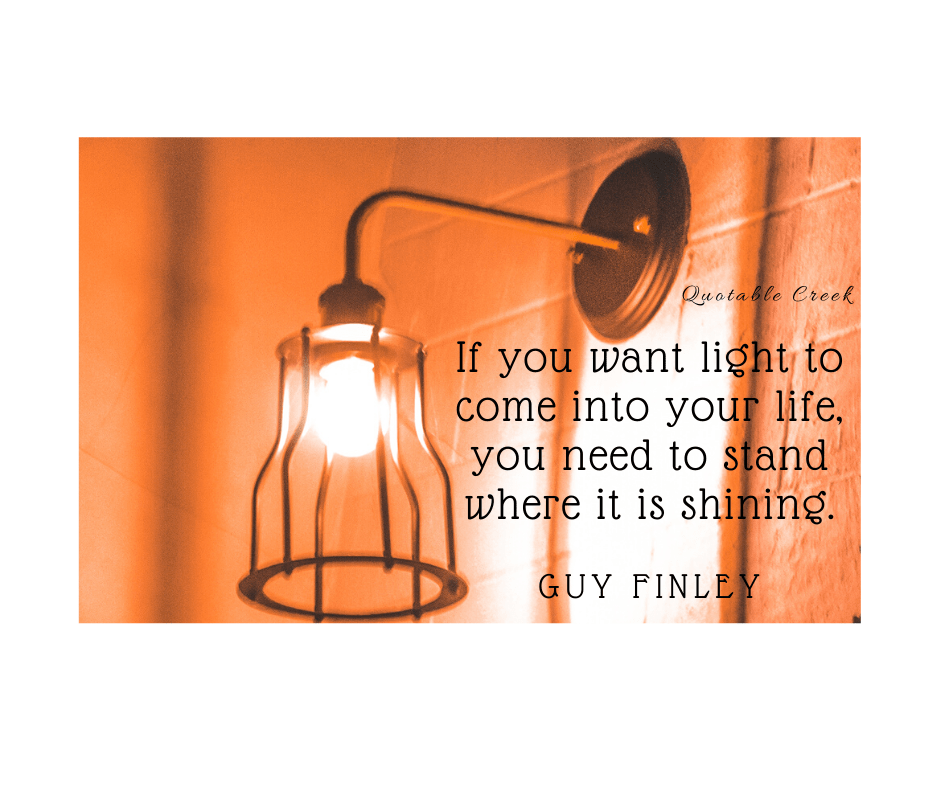
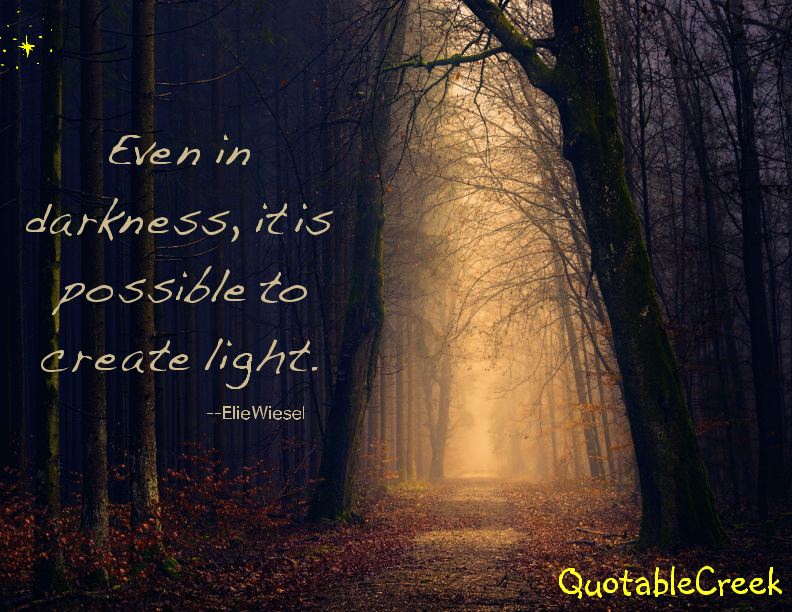
In every darkness, a bit of light will shine to light your way. It may be in the acts of kindness and generosity you see, in words of wisdom you remember and hold close to your heart, or memories of past struggles that you have gotten through to the other side. We draw strength and courage from each other, working together. That community will sustain us.
In his book, Healing the Divide, editor James Crews collects poem of kindness and compassion. Here is one by Danusha Laméris for you to carry with you today:
“I’ve been thinking about the way, when you walk down a crowded aisle, people pull in their legs to let you by. Or how strangers still say ‘bless you’ when someone sneezes, a leftover from the Bubonic plague. ‘Don’t die,’ we are saying. And sometimes, when you spill lemons from your grocery bag, someone else will help you pick them up. Mostly, we don’t want to harm each other. We want to be handed our cup of coffee hot, and to say thank you to the person handing it. To smile at them and for them to smile back. For the waitress to call us honey when she sets down the bowl of clam chowder, and for the driver in the red pick-up truck to let us pass. We have so little of each other, now. So far from tribe and fire. Only these brief moments of exchange. What if they are the true dwelling of the holy, these fleeting temples we make together when we say, ‘Here have my seat,’ ‘Go ahead—you first,’ ‘I like your hat.’”
We will get through this present darkness. Hold tight to the little kindnesses, savor them, and spread them where you can to light the way for those behind you.
For more, a reminder that we were made for times like these.
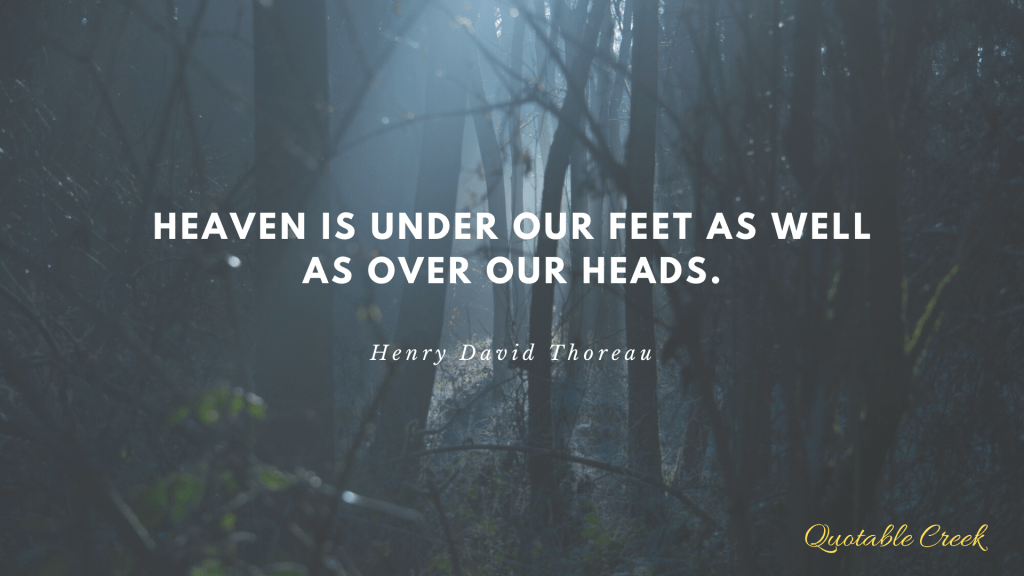
What do you think heaven looks like? Certainly, if we can see there, it is a place of great beauty and marvelous complexity where we marvel at God’s creation. If we can hear there, music that stirs the soul must be the score. And so on through our senses
But what if we are not corporeal in heaven and don’t have senses per se? What then? Perhaps it is a place of harmony, of communion, with everyone different but united in common purpose.
These are good things, yes? Appreciating beauty in God’s creation, enjoying music that stirs the soul, being so present in our bodies that we marvel at its systems? And, of course, communion, harmony, peace? These are good things.
Perhaps, today, we can take time to bring a bit of heaven to earth. Pause to admire the beauty around us, savor, marvel, be astonished. And then with our senses full and renewed, have courage to bring peace and harmony to our day.
Sometimes life is hard. Really hard. Relationships falter. Obstacles seem insurmountable. And just getting to the next day feels overwhelming. At times like these, we have to remember that it is OK to struggle.
We don’t have to be perfect. We do not need to have all the answers. Sometimes all we have are questions. But that is often a good place to start. And then we begin again, one foot in front of the other, perhaps not seeing the whole path ahead, but just enough to know where to put each foot.
“Just because something is difficult doesn’t mean it’s impossible. Uncomfortable? Yes. Exhausting and overwhelming and painfully hard? Yes. But not impossible. And it won’t necessarily feel this difficult and debilitating forever. You’ve made it through similar hard things before. You’ve survived every single bad day and every obstacle the universe has ever thrown at you. You’ve survived all the things you felt convinced would break you. Every single one. And this is evidence that you can make it through this too.
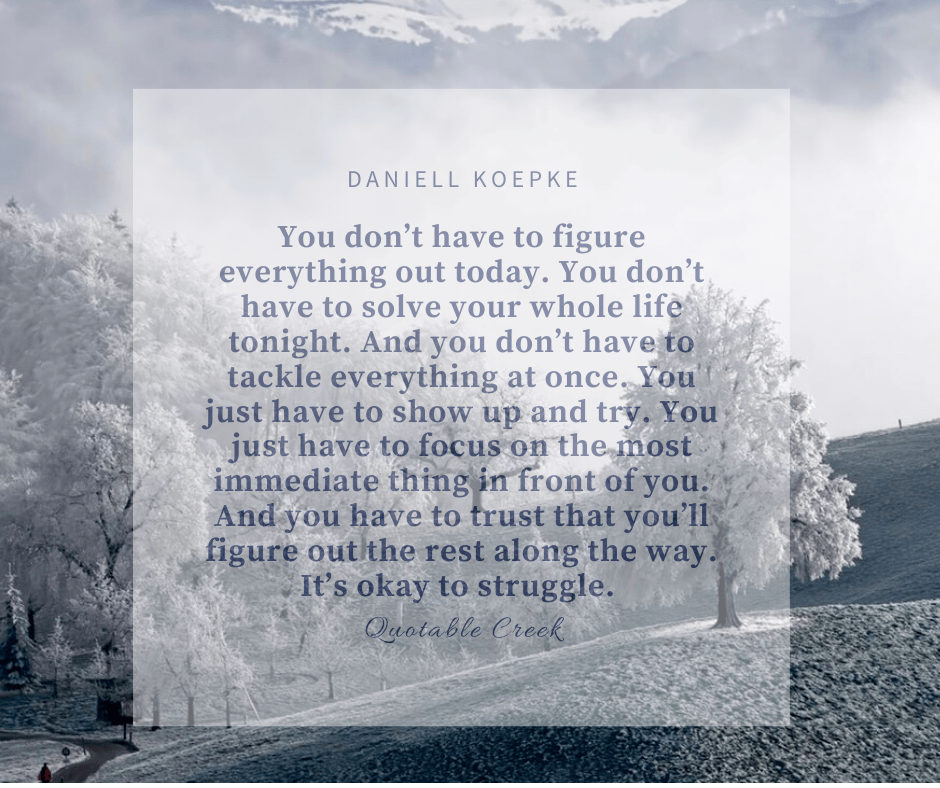
“You don’t have to figure everything out today. You don’t have to solve your whole life tonight. And you don’t have to tackle everything at once. You just have to show up and try. You just have to focus on the most immediate thing in front of you. And you have to trust that you’ll figure out the rest along the way. It’s okay to struggle. It’s okay to feel overwhelmed. And its okay to make mistakes. You’re still learning how to navigate this new path. It’s going to take time, and you’re allowed to give yourself that time. You don’t have to be perfect. You don’t have to get all A’s or be the best version of yourself or outperform everyone else. All you have to do is show up and try. It’s always been enough before. It will be enough this time too.”
— Daniell Koepke
Here’s to you finding the light to take that next step, and then the next and the next, until your path leads you out of this present darkness. It is OK to struggle.
Sometimes, when we feel down, we need to evaluate the input coming into our lives. Are we steeped in negativity? Maybe not just news, but the vitriol that follows it in the comments? The political back and forth can get ugly and pull us down. And then we can think about the friends we surround ourselves with. Are they upbeat, trying to make things better, or always complaining?
And, while we don’t want to retreat from fighting the good fight or the friends who are going through a rough patch, it’s so easy for people to tear things down, to find the flaws, to make a conflict, and, when we are around that kind of energy constantly, we can feel beaten down.
But, there is good news to be had, and there are positive people and opportunities to be found. Sometimes we need to focus our attention there, if only for a break from the storm.
Miep Gies was a young office worker when she hid and supported Anne Frank and her family, protecting them from Nazis and the danger of being sent to a concentration camp. After Anne and her family were betrayed and captured, Miep collected Anne’s diaries and eventually returned them to Anne’s father, Otto, who survived the war. That diary has been read by millions of people now, inspiring acts of heroism and showing, in a very intimate way, the horror of WWII as viewed through the eyes of an innocent, complex, lovely, vibrant girl, Anne.
Miep wasn’t famous or rich or particularly accomplished, yet she managed through her actions to shine a very bright light on hate and replace it with a more powerful portrait of love. Anne, too, wasn’t famous or rich or accomplished, although we can see now how she was a gifted author, but her words have been inspiring and a powerful force against evil in the world.
No matter our position or age or wealth or gender, we each can make a contribution that makes the world more bright.
Hurricane Harvey has been devastating, and the images showing those hardest hit have been heart-wrenching and dark. But sometimes, in those images, we glimpse the light. Consider this video of a man stopping to play his piano even as the water has nearly reached his piano bench. He brings a bit of beauty, peace, and light to a ravaged reality.
This video calls to mind the orchestra members on the Titanic who, forced with the certainty of imminent death, chose to play until the end so the music would bring comfort and peace to those also remaining on the ship as well as those struggling to reach the life boats:
Many brave things were done that night, but none were more brave than those done by men playing minute after minute as the ship settled quietly lower and lower in the sea. The music they played served alike as their own immortal requiem and their right to be recalled on the scrolls of undying fame.
Or perhaps it recalls the story of Vedran Smailovic who played his cello, in full dress attire, even as Sarajevo was being bombed around him:
As the 155-millimeter howitzer shells whistled down on this crumbling city today, exploding thunderously into buildings all around, a disheveled, stubble-bearded man in formal evening attire unfolded a plastic chair in the middle of Vase Miskina Street. He lifted his cello from its case and began playing Albinoni’s Adagio.
Smailovic did not consider himself a hero: “I am nothing special, I am a musician, I am part of the town. Like everyone else, I do what I can.”
But a hero he was. Adding light and beauty into a dark and dire situation is heroic. It’s counter-culture. It’s inspiring. And it makes the world a brighter place.
How can you create light in your circumstances today?


 QuotableCreek.com