Situational awareness.
I was robbed recently. I was enjoying lunch with a treasured friend, undoubtedly lost in the delightful way she tells stories and looks at life, when my purse was taken right off my chair as I sat there unaware. The restaurant’s security cameras showed two women, the perps, dressed in hot pink and bright orange, casually taking my purse and then driving off in their Mercedes (!) to Target where they started to put my credit card to work. The nerve.
I realized this incident had affected me more than I realized when the dreams came. Home invasion dreams where I was in my childhood home trying desperately to figure out how to protect my mother. I grabbed her and ran to the bedroom door, but men were trying to get in there, too, in tactical gear and heavily armed. I was running through all the escape possibilities in my head, realizing we might be trapped and I wouldn’t be able to save her, when I woke up, heart pounding.
So how do I quell these troubled waters. First, of course, was to cancel the cards and block my phone. But the next step is maybe the best for easing the troubled mind. Mr. Rogers reminded children to look for the helpers in any crisis. For me, helpers would include that friend, a retired nurse, cool under pressure, who dashed to my car to prevent the thieves, who now had my keys, from stealing it. I had visions of her clinging to the hood while they used the windshield wipers to dislodge her, but that’s my brain in overdrive not the reality. Instead, there was another helper who found my purse, sans phone and credit cards, abandoned in the bushes. Due to the kindness of the people eating around us who had responded to my yelps of distress and pointed me out to her, I got my purse, and key, back. And then there was the restaurant manager who calmly rebuffed my repeated and emphatic suggestions to plaster warnings about thieves everywhere, but instead saved all the identifying information on video for the police to follow up. He mentioned we all need to cultivate situational awareness.
Situational awareness. And therein lies the rub. I want to live in a world where I can have a leisurely lunch with my friend and no one is casing the joint, looking for some unsuspecting mark to rob. That would be a better world! But it’s not this world. So if one of us needs to change, the world or me, it will need to be me.
And as I stewed on these words—situational awareness—it occurred to me that they apply to pretty much everything. We have to stay focused on the world we have, the reality, and bring our attention to that place and circumstance and base our decisions and actions on that. Not on the world we wish we had, but the one we do have. The place we are. The reality we must confront. That’s where the real work gets done and progress gets made.
In his book, The Road Less Traveled, M. Scott Peck starts with the given, Life is difficult:
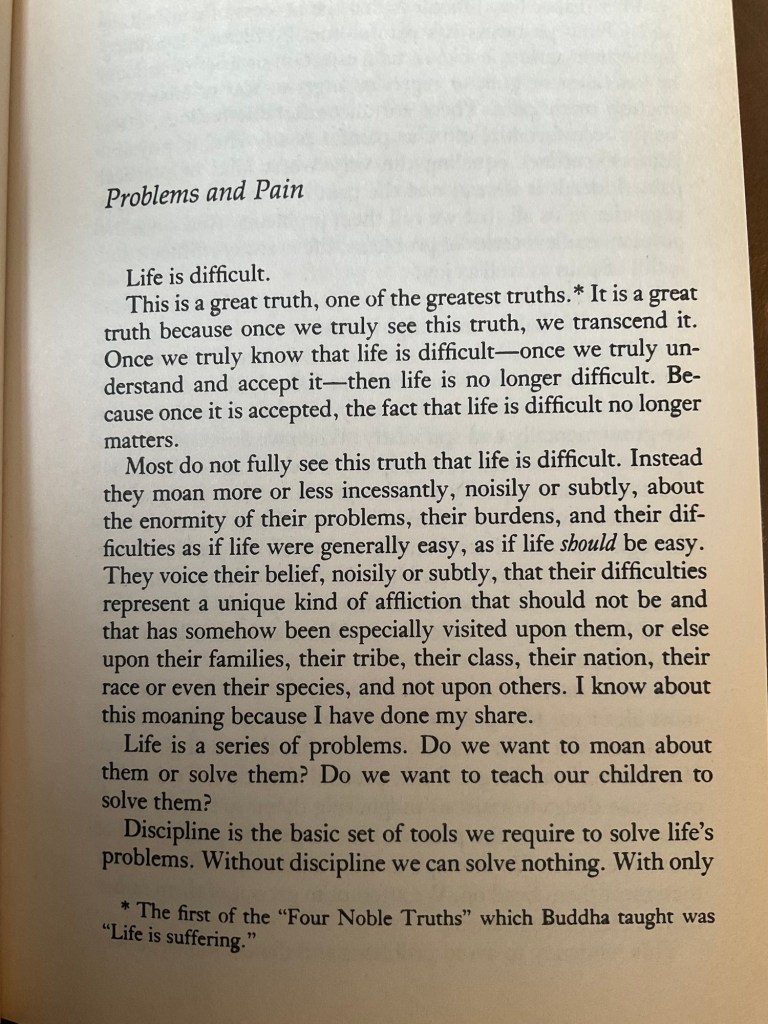
He goes on to say some equally profound things about how if the world isn’t aligning with our understanding of it, it is our understanding that must change, not that we should lie to ourselves to pretend the world supports our image. He likens it to maps. If the map you’re using isn’t getting you to where you want to go, it is the map that’s wrong, not the reality. The map must change.
As we look around, where are the places that things don’t make sense? The places our maps aren’t getting us where we want to be? Maybe things that are different now than they once were? Where do we need new maps?
We need to stay dedicated to reality, as much as it might trouble us, and adjust our maps so we can get back on track. Peck concludes :
The more effort we make to appreciate and perceive reality, the larger and more accurate our maps will be. But many do not want to make this effort. Some stop making it by the end of adolescence. Their maps are small and sketchy, their views of the world narrow and misleading. By the end of middle age most people have given up up the effort. …Only a relative and fortunate few continue until the moment of death exploring the mystery of reality, ever enlarging and refining their understanding of the world and what is true.

