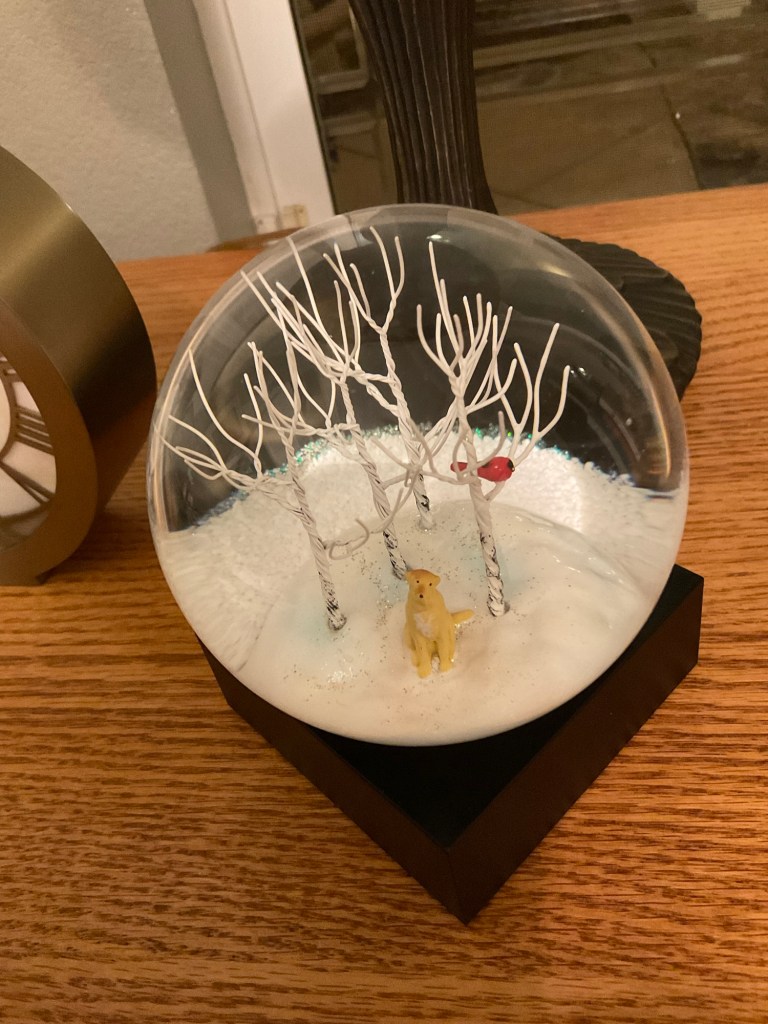
I recently bought a snow globe of a Labrador and a cardinal in the woods.
These two remind me of the unconditional love I was lucky enough to receive from my late dog, Honey
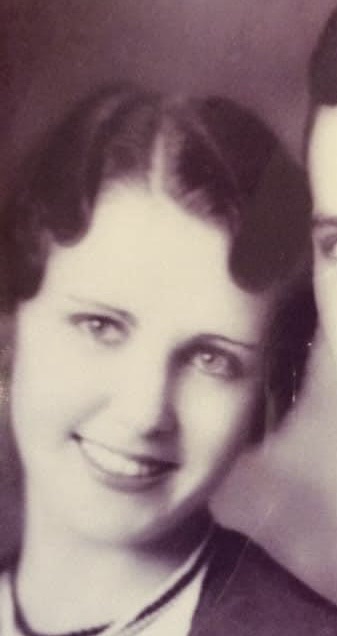
And my late, and very much beloved grandmother.
Honey was my soul animal, always with me, zooming with me into school visits during the pandemic, meeting and loving every neighbor we encountered on our long walks, my constant companion.
My grandmother loved me unconditionally, always eager to hear my stories, encouraging me in my writing, sharing life as two brunette mothers of redheads, growing together in our faith journeys.
I love having them there with me symbolically on my desk in this little snow globe because, frankly, grief is hard. Losing those precious to us leaves a gaping wound. But when we remember them, we remember the love they gave us, too, and that part feels good. When we carry them with us like that, they are still here.
(here is the root of the root and the bud of the bud
and the sky of the sky of a tree called life;which grows
higher than soul can hope or mind can hide)
and this is the wonder that’s keeping the stars apart
i carry your heart(i carry it in my heart)
And as we go on, past the loss, we carry those who have loved us with us in our hearts, giving us comfort and strength. We carry them with us, and, with that, we carry the unconditional love they gave that still sustains us, even now.
Whom we claim as our heroes is telling. Today, in these troubled, divided times, who is acting heroically? We don’t know how our or this story will end, but we do know the values we hold to be worth fighting for: honesty, self-sacrifice, honor, integrity, the common good. As we enter the day, let us hold true to our values to meet life’s challenges in hope that those everyday interactions spread ripples of good.
Enjoy these words from Heather Cox Richardson in honor of MLK, Jr. Day:
You hear sometimes, now that we know the sordid details of the lives of some of our leading figures, that America has no heroes left.
When I was writing a book about the Wounded Knee Massacre, where heroism was pretty thin on the ground, I gave that a lot of thought. And I came to believe that heroism is neither being perfect, nor doing something spectacular. In fact, it’s just the opposite: it’s regular, flawed human beings choosing to put others before themselves, even at great cost, even if no one will ever know, even as they realize the walls might be closing in around them.
It means sitting down the night before D-Day and writing a letter praising the troops and taking all the blame for the next day’s failure upon yourself in case things went wrong, as General Dwight D. Eisenhower did.
It means writing in your diary that you “still believe that people are really good at heart,” even while you are hiding in an attic from the men who are soon going to kill you, as Anne Frank did.
It means signing your name to the bottom of the Declaration of Independence in bold script, even though you know you are signing your own death warrant should the British capture you, as John Hancock did.
It means defending your people’s right to practice a religion you don’t share, even though you know you are becoming a dangerously visible target, as Sitting Bull did.
Sometimes it just means sitting down, even when you are told to stand up, as Rosa Parks did.
None of those people woke up one morning and said to themselves that they were about to do something heroic. It’s just that when they had to, they did what was right.
On April 3, 1968, the night before the Reverend Doctor Martin Luther King Jr. was assassinated by a white supremacist, he gave a speech in support of sanitation workers in Memphis, Tennessee. Since 1966, King had tried to broaden the civil rights movement for racial equality into a larger movement for economic justice. He joined the sanitation workers in Memphis, who were on strike after years of bad pay and such dangerous conditions that two men had been crushed to death in garbage compactors.
After his friend Ralph Abernathy introduced him to the crowd, King had something to say about heroes: “As I listened to Ralph Abernathy and his eloquent and generous introduction and then thought about myself, I wondered who he was talking about.”
Dr. King told the audience that if God had let him choose any era in which to live, he would have chosen the one in which he had landed. “Now, that’s a strange statement to make,” King went on, “because the world is all messed up. The nation is sick. Trouble is in the land; confusion all around…. But I know, somehow, that only when it is dark enough, can you see the stars.” Dr. King said that he felt blessed to live in an era when people had finally woken up and were working together for freedom and economic justice.
He knew he was in danger as he worked for a racially and economically just America. “I don’t know what will happen now. We’ve got some difficult days ahead. But it doesn’t matter…because I’ve been to the mountaintop…. Like anybody, I would like to live a long life…. But I’m not concerned about that now. I just want to do God’s will. And He’s allowed me to go up to the mountain. And I’ve looked over. And I’ve seen the promised land. I may not get there with you. But I want you to know tonight, that we, as a people, will get to the promised land!”
People are wrong to say that we have no heroes left.
Just as they have always been, they are all around us, choosing to do the right thing, no matter what.
Wishing us all a day of peace for Martin Luther King Jr. Day 2026.
Have you ever been at your wits’ end, and then someone’s kind words literally change your whole day and outlook? We can forget how simple words can make profound differences.
Consider this story from NPR:
STEPHANIE COLE: There I was in my black skirt and my white blouse and ready to go the first day. And I had been trained but very, very quickly. And as is true in a department store during Christmas, it was just bustling. You know how it is at Christmas, when everybody’s out shopping and everybody’s in a hurry and all these people around. This woman comes up to me with, I think, a Christmas tree ornament she wanted to buy, and I freeze. I just freeze. All of a sudden, I can’t remember anything. I can’t remember how to run the cash register. I can’t remember anything about the transactions. I am just absolutely frozen – and probably very close to tears. Just – I so wanted this to go right, and it was going so wrong.
She looked at me and paused and, with such a kind expression on her face, said, it’s all right. Take your time. I’m not in a hurry. And that was the release. All of a sudden, I could breathe, I could wait till somebody else could help me. It was going to be OK. It made such an impression that all these years later, not only do I still remember it, but I find myself – those words coming out of my mouth on numerous, many, many occasions over the years. You know, you encounter somebody whose first day on the job or they’re just having a bad day and things are really – you can tell they’re in a bad place. And you can say, it’s OK. I’m not in a hurry. Take your time. And it always makes the situation better. Always, always.
And so this woman, I can’t really remember her face – and certainly, she’s probably dead by now, given how old I was and how old she was – but she gave me that gift without knowing she gave me that gift, and it’s lasted all these years.
How lovely things would be if the way we picture ourselves doing something in our heads is the way it plays out in real life. The beautiful prose, perfect plotting, and subtle characterization all laying themselves down on the page when pen is lifted rather than being cruelly translated into the awkward phrasing, cliched plots, and stilted characters plaguing a first draft. If perfect leaps, spins, and arabesques just happen rather than the more likely falls on the bum. If we were already perfect rather than striving. If there were no gap between where we are and where we would like to be.
With all the armchair quarterbacks and critics out there on virtually every issue, you’d almost think effort and expertise don’t count for anything. And yet, mastery is always the result of effort. Full stop. Every master painter, skater, dancer, author, was once a novice. In fact, that journey from novice to master is the important thing, and those hacks on the sidelines are missing the point. As Theodore Roosevelt said:
It is not the critic who counts; not the man who points out how the strong man stumbles, or where the doer of deeds could have done them better. The credit belongs to the man who is actually in the arena, whose face is marred by dust and sweat and blood; who strives valiantly; who errs, who comes short again and again, because there is no effort without error and shortcoming; but who does actually strive to do the deeds; who knows great enthusiasms, the great devotions; who spends himself in a worthy cause; who at the best knows in the end the triumph of high achievement, and who at the worst, if he fails, at least fails while daring greatly, so that his place shall never be with those cold and timid souls who neither know victory nor defeat.
So this gap, between where we want to be and where we are, is where we focus our efforts and attention. Not on the critic, because everyone stumbles. But we press on. For to be great at anything takes practice and effort, and our attempt is awkward and halting, ungainly and bumbling at first. But it gets better. And those sitting on the sidelines, afraid or busy criticizing others, aren’t moving forward unless they, too, mind the gap and try.
Do you have a dream? Maybe to meet someone special, learn a language, write a book, learn an instrument, play a sport, travel? What is that dream?
Now, more importantly, what work are you doing to realize that dream? There are a plenty of people who dream of being musicians who never practice their instrument, or people who dream of being published who never write, or people who dream of traveling but never save up. Why is that?
One reason is it is fun to dream that you have God-given natural talent that will be discovered by the world someday like Lana Turner sitting at the counter sipping a Coke at the Top Hat Cafe. And, while those kinds of stories may happen occasionally, the much more common story is that someone who achieved their dream worked for it, and worked hard. Michael Jordan didn’t make his high school basketball team. Frank Sinatra spent hours holding his breath to improve his phrasing. Vincent van Gogh’s early work was, well, not that great.
And plenty of people who have become successful want to perpetuate the notion that they were just born that way. It was natural talent not hard work. It was their own efforts, not a result of having many people in their corner, helping them move forward. And sometimes it seems this way, doesn’t it? We see the Olympic performance, but not the struggle that led there. We read the best-selling novel from the overnight success, but don’t see all the drafts in the desk drawer. And something in us wants to believe that those people, those success stories, are different from us. They were just born different. But that’s not the truth.
Success isn’t like winning a lottery; it’s like running a marathon. Hard, grueling, and long-term. Some people achieve their dreams because they pursue them. They don’t just dream, although the dream–something that ignites your passions–is the first step. The dream isn’t all they needed though.
But the dream gave them curiosity to explore it from every angle. And that curiosity gave them energy to practice. And that practice brought improvement. That improvement was encouraging. And that encouragement helped them stay the course. Now sometimes following the dream will result in financial or other success, but that shouldn’t be the yardstick. The yardstick should be if you are doing what you dreamed of doing.
So, yes, dream of all you can be. But then figure out some concrete steps you can take to help you get there.
It’s okay to be heartbroken for more than one group of people at the same time. When it comes to showing compassion, we don’t have to pick sides. Sometimes, often really, maybe even always, there is hurt and anguish everywhere, and we can mourn the lot of it.
Beware people who tell you not to be concerned for this group or that group and the hurt they feel.
Beware those who try to dehumanize others.
Beware those who lump you in as the ‘enemy’ for working to assure people are treated humanely.
Beware people who draw lines between us and them.
Beware those who try to limit you to a label or single identity.
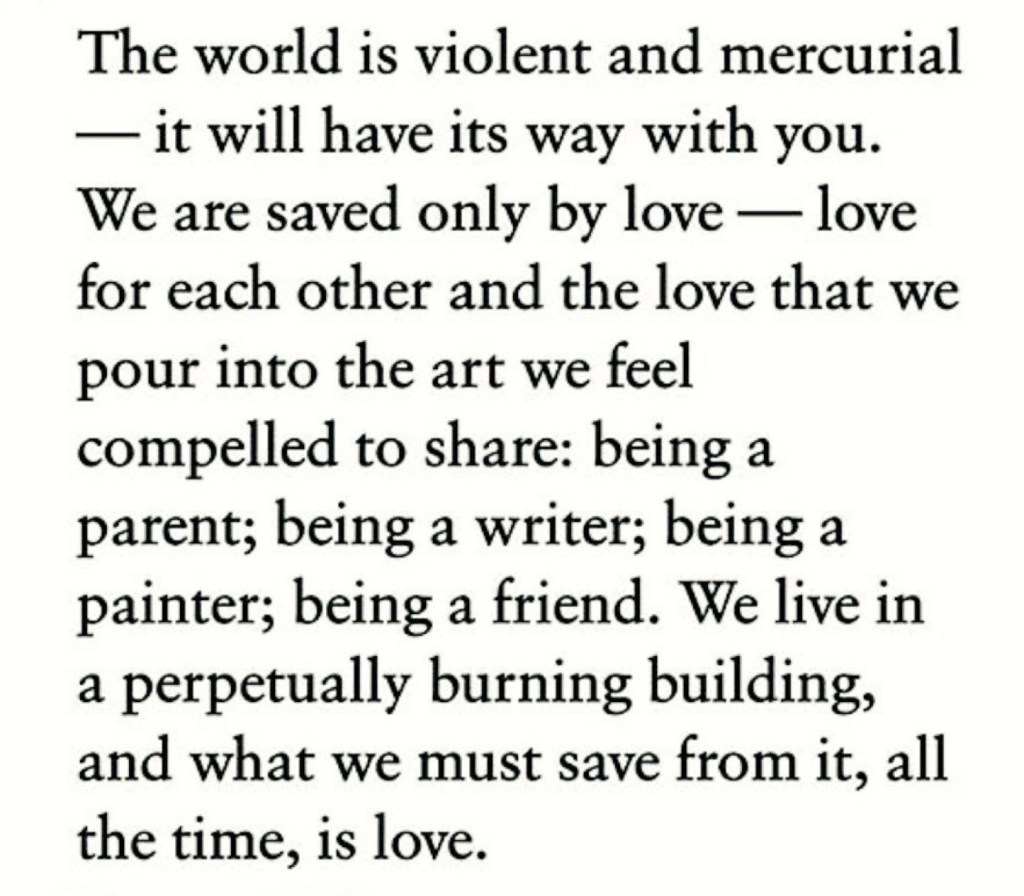
Our hearts are big enough to embrace it all. What we must save is love.
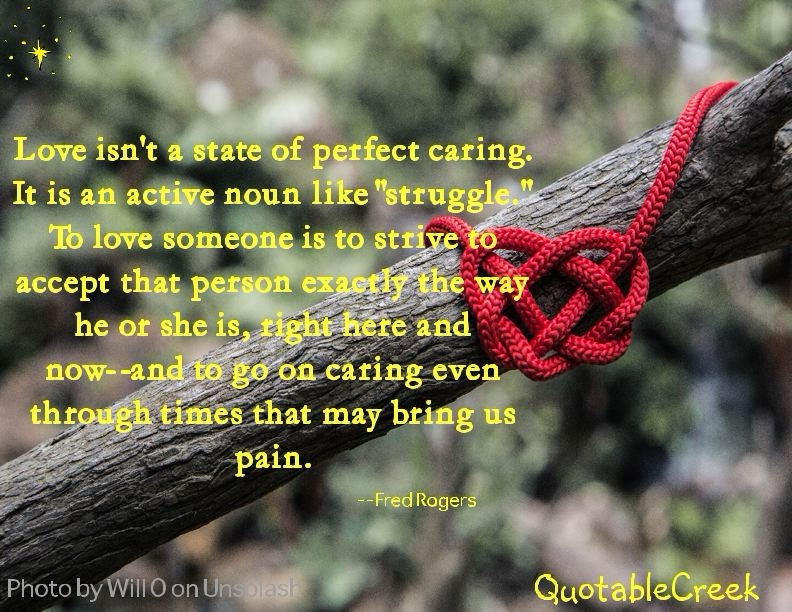
Love isn’t a feeling we fall in and out of. It’s an action we choose to take even when it may be challenging. Sometimes it brings pain. When we think of love as an active verb, like, as Mr. Rogers suggests above, ‘struggle’, rather than as an emotion, it opens our eyes to the fact that we must work at it. It’s a struggle, a constant readjustment and tinkering, constantly expanding our own understanding and empathy.
Love is not molding someone to our vision of what they should be, but accepting who they are and supporting them as they blossom. Thinking of love as something more akin to struggle encourages us to keep looking for new and better ways to show up for the people in our lives, to view the relationships as evolving rather than static, and to appreciate all the little successes and breakthroughs in those relationships along the way.
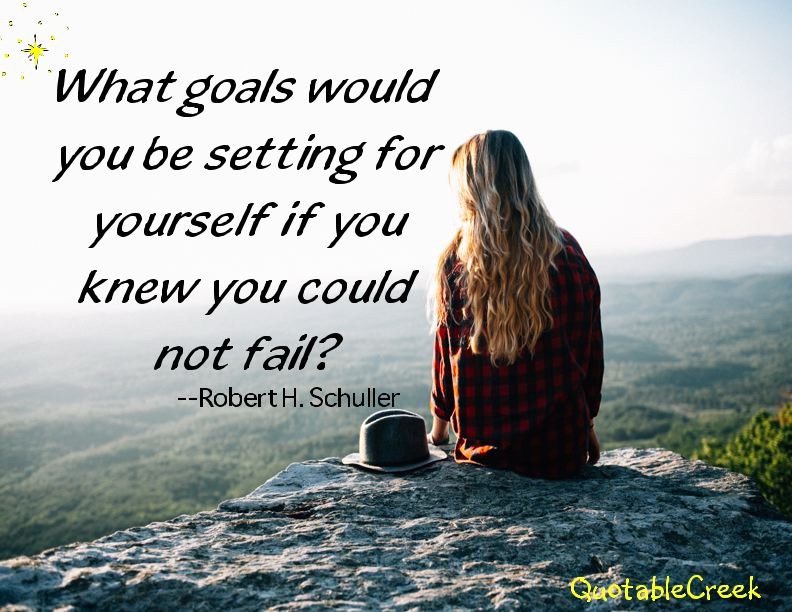
Fear of failure can keep us from trying something we really, really want to try. And it can keep us from admitting that we have taken a wrong turn and need to reevaluate things. But, at some point, we have to ask ourselves, why? What is so bad about failure?
Thomas Edison famously said, “I have not failed. I’ve just found 10,000 ways that won’t work.” Each experiment that did not succeed helped him move forward on the one path that would ultimately succeed by ruling out the other paths. That attitude helped spur him on because each failed experiment was itself a discovery and taught him something he didn’t know before.
In this remarkable TED talk, Kathryn Schulz, a self-proclaimed wrong-ologist, talks about failure and our responses to it and suggests that it is in these moments of failure, or, as she sees it, moments when reality does not align with our expectations, that the moments of growth, creativity, expansion happen:
So effectively, we all kind of wind up traveling through life, trapped in this little bubble of feeling very right about everything.
I think this is a problem. I think it’s a problem for each of us as individuals, in our personal and professional lives, and I think it’s a problem for all of us collectively as a culture. So what I want to do today is, first of all, talk about why we get stuck inside this feeling of being right. And second, why it’s such a problem. And finally, I want to convince you that it is possible to step outside of that feeling and that if you can do so, it is the single greatest moral, intellectual and creative leap you can make.
So why do we get stuck in this feeling of being right? One reason, actually, has to do with a feeling of being wrong. So let me ask you guys something — or actually, let me ask you guys something, because you’re right here: How does it feel — emotionally — how does it feel to be wrong? Dreadful. Thumbs down. Embarrassing. Okay, wonderful, great. Dreadful, thumbs down, embarrassing — thank you, these are great answers, but they’re answers to a different question. You guys are answering the question: How does it feel to realize you’re wrong? (Laughter) Realizing you’re wrong can feel like all of that and a lot of other things, right? I mean it can be devastating, it can be revelatory, it can actually be quite funny, like my stupid Chinese character mistake. But just being wrong doesn’t feel like anything.
I’ll give you an analogy. Do you remember that Loony Tunes cartoon where there’s this pathetic coyote who’s always chasing and never catching a roadrunner? In pretty much every episode of this cartoon,there’s a moment where the coyote is chasing the roadrunner and the roadrunner runs off a cliff, which is fine — he’s a bird, he can fly. But the thing is, the coyote runs off the cliff right after him. And what’s funny — at least if you’re six years old — is that the coyote’s totally fine too. He just keeps running — right up until the moment that he looks down and realizes that he’s in mid-air. That’s when he falls. When we’re wrong about something — not when we realize it, but before that — we’re like that coyote after he’s gone off the cliff and before he looks down. You know, we’re already wrong, we’re already in trouble, but we feel like we’re on solid ground. So I should actually correct something I said a moment ago. It does feel like something to be wrong; it feels like being right.
We have all been raised to get the right answers on the test, to score a winning shot, to achieve. But reality is more complex than a true-false quiz. No one of us has all the answers. And yet it feels like we do.
Schulz thinks this can be dangerous:
Think for a moment about what it means to feel right. It means that you think that your beliefs just perfectly reflect reality. And when you feel that way, you’ve got a problem to solve, which is, how are you going to explain all of those people who disagree with you? It turns out, most of us explain those people the same way, by resorting to a series of unfortunate assumptions. The first thing we usually do when someone disagrees with us is we just assume they’re ignorant. They don’t have access to the same information that we do, and when we generously share that information with them, they’re going to see the light and come on over to our team. When that doesn’t work, when it turns out those people have all the same facts that we do and they still disagree with us, then we move on to a second assumption,which is that they’re idiots. (Laughter) They have all the right pieces of the puzzle, and they are too moronic to put them together correctly. And when that doesn’t work, when it turns out that people who disagree with us have all the same facts we do and are actually pretty smart, then we move on to a third assumption: they know the truth, and they are deliberately distorting it for their own malevolent purposes. So this is a catastrophe.
This attachment to our own rightness keeps us from preventing mistakes when we absolutely need to and causes us to treat each other terribly. But to me, what’s most baffling and most tragic about this is that it misses the whole point of being human. It’s like we want to imagine that our minds are just these perfectly translucent windows and we just gaze out of them and describe the world as it unfolds. And we want everybody else to gaze out of the same window and see the exact same thing. That is not true, and if it were, life would be incredibly boring. The miracle of your mind isn’t that you can see the world as it is.It’s that you can see the world as it isn’t. We can remember the past, and we can think about the future,and we can imagine what it’s like to be some other person in some other place. And we all do this a little differently, which is why we can all look up at the same night sky and see this and also this and also this.And yeah, it is also why we get things wrong.
We are fallible. We make mistakes, constantly even, and no amount of convincing ourselves otherwise changes this particular reality. Once we accept this, we can soften our edges in the ways we treat each other and ourselves. We can jump into an uncertain future, not knowing what can happen because we realize we ACTUALLY DO NOT KNOW what will happen. That lack of knowledge isn’t something to be ashamed of or to pretend isn’t there like Wile E. Coyote who has just run off a cliff: it’s part of the human condition. We simply do not have all the answers.
Today, embrace the moment and consider each experience a learning opportunity to grow and stretch and learn. To maybe, even, discover you’ve been wrong and to incorporate that new knowledge into your choices going forward.
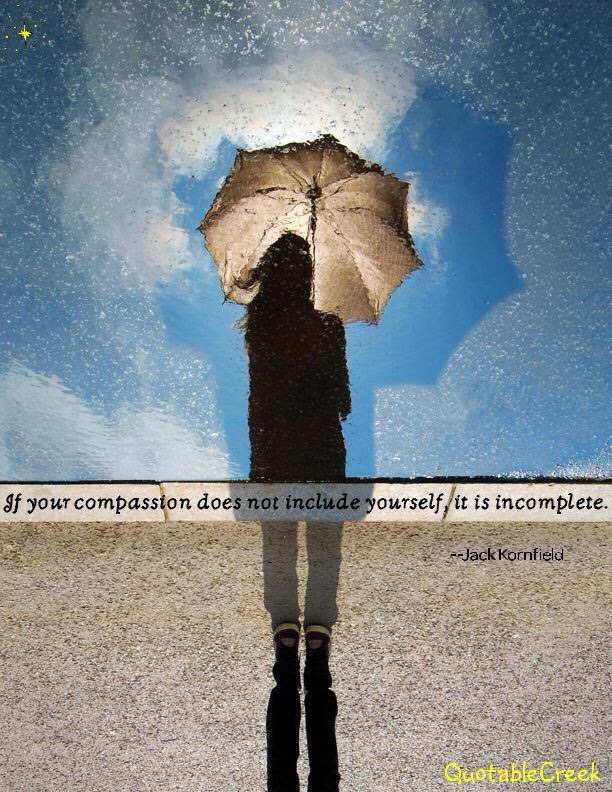
If one of your friends were struggling with the problems you are facing right now, what words would you offer in support? Would you call them names, berate them, remind them of all the other times they messed up just like this and how, honestly, can they ever expect to get anything right, ever?
Probably not. Right? But often this is the way we talk to ourselves. We replay all our other mistakes in our minds, call ourselves stupid, sink into our shells scared to face the world.
But why do we do this? If the words we would offer our friend are what we think would help, why are we so reticent to speak kind encouraging words to ourselves? Maybe today is a good day to try a different approach.
Be a kind friend to yourself. Offer yourself words of support and encouragement. Focus on all the many times you got things right. Tell yourself the truth: you are precious and beloved.
These days it feels a bit like we are bombarded by news, so overwhelming in scope as to cloud out the sun. Overwhelm is on the menu. And joy can feel like an exotic indulgence. And yet, choosing joy can be an act of resistance.
As Maria Popova notes, drawing on her experience in writing The Marginalian:
14. Choose joy. Choose it like a child chooses the shoe to put on the right foot, the crayon to paint a sky. Choose it at first consciously, effortfully, pressing against the weight of a world heavy with reasons for sorrow, restless with need for action. Feel the sorrow, take the action, but keep pressing the weight of joy against it all, until it becomes mindless, automated, like gravity pulling the stream down its course; until it becomes an inner law of nature. If Viktor Frankl can exclaim “yes to life, in spite of everything!” — and what an everything he lived through — then so can any one of us amid the rubble of our plans, so trifling by comparison. Joy is not a function of a life free of friction and frustration, but a function of focus — an inner elevation by the fulcrum of choice. So often, it is a matter of attending to what Hermann Hesse called, as the world was about to come unworlded by its first global war, “the little joys”; so often, those are the slender threads of which we weave the lifeline that saves us.
Delight in the age-salted man on the street corner waiting for the light to change, his age-salted dog beside him, each inclined toward the other with the angular subtlety of absolute devotion.
Delight in the little girl zooming past you on her little bicycle, this fierce emissary of the future, rainbow tassels waving from her handlebars and a hundred beaded braids spilling from her golden helmet.
Delight in the snail taking an afternoon to traverse the abyssal crack in the sidewalk for the sake of pasturing on a single blade of grass.
Delight in the tiny new leaf, so shy and so shamelessly lush, unfurling from the crooked stem of the parched geranium.
I think often of this verse from Jane Hirshfield’s splendid poem “The Weighing”:
So few grains of happiness
measured against all the dark
and still the scales balance.
Yes, except we furnish both the grains and the scales. I alone can weigh the blue of my sky, you of yours.
Pausing to notice and delight in these little moments can counterbalance the great and pressing weight of darkness. It is from each of these moments, we draw value and solace, hope and strength.
And we persevere, weaving the ‘slender threads’ of the lifelines that save us.



 QuotableCreek.com