This has been a week of extreme emotions for me. When I try to think of a metaphor for that, it’s tough because the emotions varied so much. Weather, maybe? Tornados to still winds, gentle rains to pounding storms, beating sun to numbing cold.
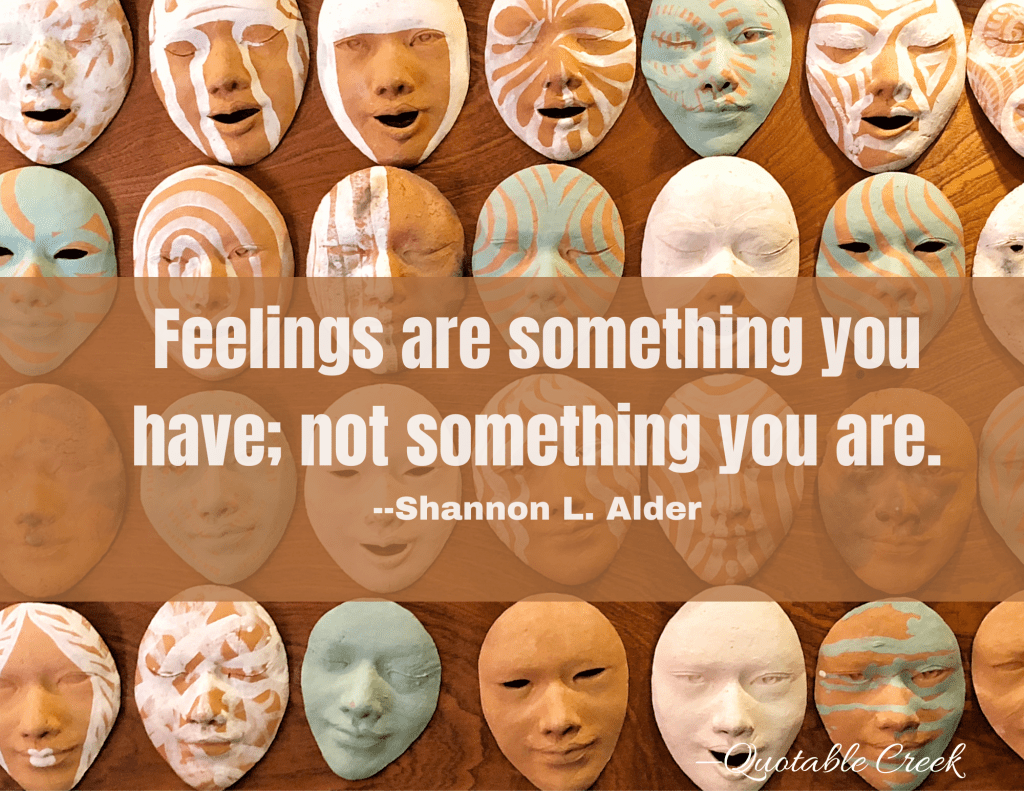
And then I remembered this poem by Rumi. I am not my emotions, though they might overwhelm me. Consider the emotions as visitors, and myself a guest house where a crowd of sorrows may enter and take up some space for a while before they pack their bags and move along.
The Guest House
by Jelalludin Rumi
This being human is a guest house. Every morning a new arrival. A joy, depression, a meanness, some momentary awareness comes as an unexpected visitor. Welcome and entertain them all! Even if they’re a crowd of sorrows, who violently sweep your house empty of its furniture, still, treat each guest honorably. He may be clearing you out for some new delight. The dark thought, the shame, the malice, meet them at the door laughing, and invite them in. Be grateful for whoever comes, because each has been sent as a guide from beyond.
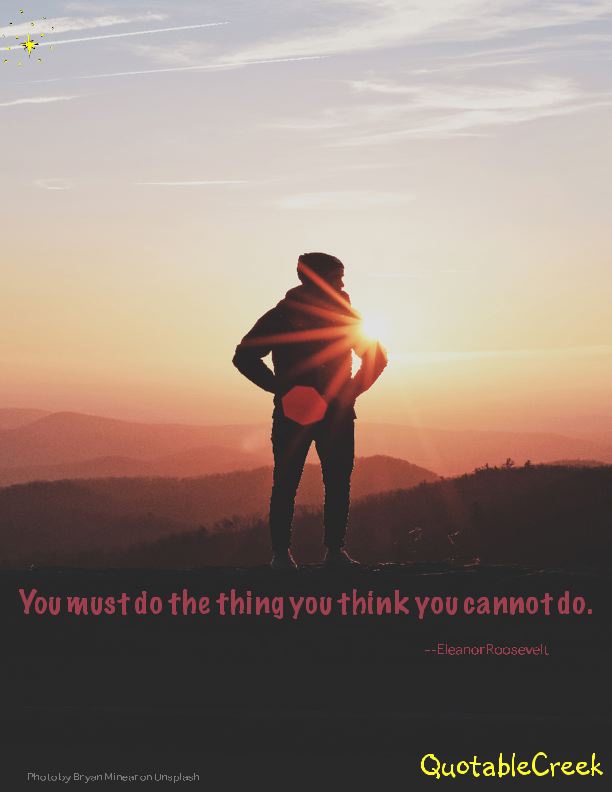
Standing up to fear changes a person. It helps you to put matters in perspective. Where once fear loomed over you, insurmountable, now you can honor the courage it took to move past it into unfamiliar territory.
Eleanor Roosevelt was a courageous woman. Despite her husband’s attempts to placate the South, she regularly bucked segregation and was a vocal proponent of civil rights. She was able to call out racism and force others to see it for what it was:
By 1939, ER decided to attack the hypocritical way in which the nation dealt with racial injustice. She wanted her fellow citizens to understand how their guilt in “writing and speaking about democracy and the American way without consideration of the imperfections within our system with regard to its treatment . . . of the Negro” encouraged racism. Americans, she told Ralph Bunche in an interview for Gunnar Myrdal’s American Dilemma, wanted to talk “only about the good features of American life and to hide our problems like skeletons in the closet.” Such withdrawal only fueled violent responses; Americans must therefore recognize “the real intensity of feeling” and “the amount of intimidation and terrorization” racism promotes and act against such “ridiculous” behavior.
You can’t clearly see a problem before you if you are too scared to look at it and call it out for what it is. Where are the injustices in your immediate orbit? Are there people being treated unfairly? How can you add your voice to help identify the problem and move toward healing? These problems are right here, close to home.
As Eleanor Roosevelt said:
Where after do human rights begin? In small places, close to home– so close and so small that they cannot be seen on any map of the world. Yet they are the world of the individual person: The neighborhood he lives in; the school or college he attends; the factory, farm or office where he works. Such are the places where every man, woman, and child seeks equal justice, equal opportunity, equal dignity without discrimination. Unless these rights have meaning there, they have little meaning anywhere. Without concerted citizen action to uphold them close to home, we shall look in vain for progress in the larger world.
Fear is a crippler. It keeps you rooted in a course of action you know to be wrong. Focusing on the fear helps it to loom even larger before you. Instead, focus on the better world you are trying to help build. Spreading love and justice is exciting and uplifting. Being part of something bigger than yourself, working for a common goal, in an effort to improve people’s circumstance is rewarding.
You don’t have to see the whole path in front of you. Take, and keep taking, that next step forward.
As I age, I have a new appreciation for those poets like Dylan Thomas raging against mortality. I do not want to go gentle into that good night. I like it here.
Here is a new variation on that theme I enjoyed:
Sorrow Is Not My Name BY ROSS GAY
—after Gwendolyn Brooks
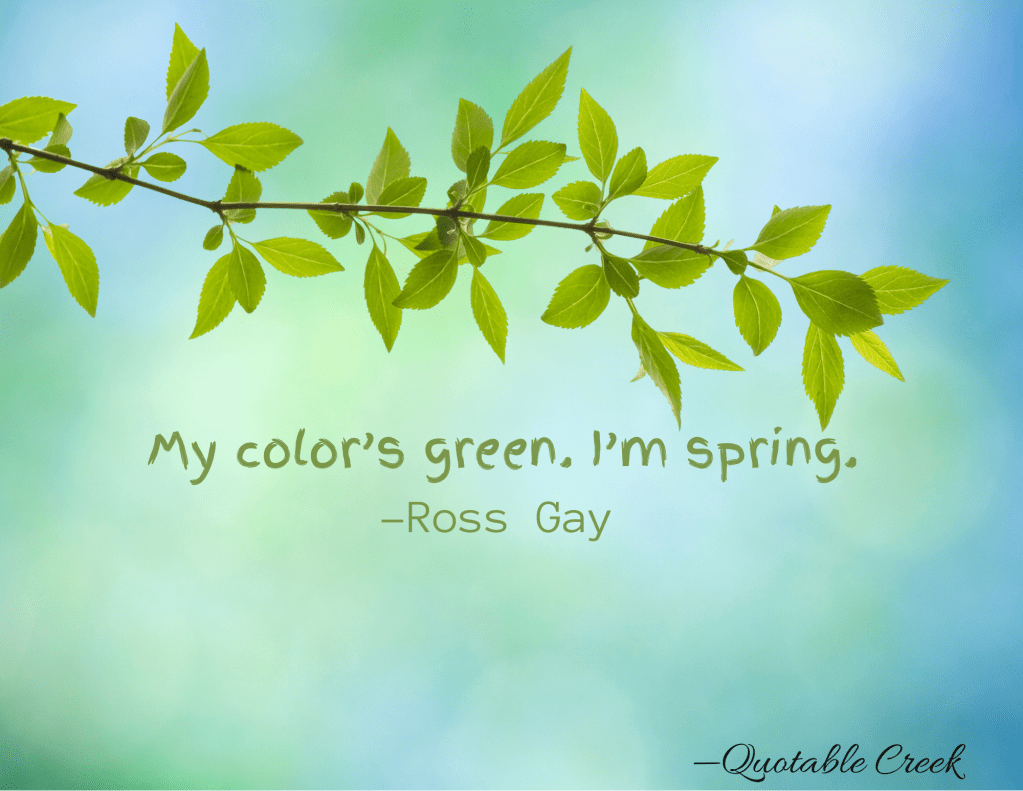
No matter the pull toward brink. No matter the florid, deep sleep awaits. There is a time for everything. Look, just this morning a vulture nodded his red, grizzled head at me, and I looked at him, admiring the sickle of his beak. Then the wind kicked up, and, after arranging that good suit of feathers he up and took off. Just like that. And to boot, there are, on this planet alone, something like two million naturally occurring sweet things, some with names so generous as to kick the steel from my knees: agave, persimmon, stick ball, the purple okra I bought for two bucks at the market. Think of that. The long night, the skeleton in the mirror, the man behind me on the bus taking notes, yeah, yeah. But look; my niece is running through a field calling my name. My neighbor sings like an angel and at the end of my block is a basketball court. I remember. My color’s green. I’m spring.
My daughter recently organized her library, not by any of the more common methods of organizing books—genre, audience, age, author last name, — but by color of the cover. I must say, this startled me. It upset my Dewey-decimal apple cart. But look how lovely it is!
I have always focused on organization, both as a lawyer and, now, as an author. It is so vital to figure out your system for how something is to be done. How to organize the information in the most compelling way. Generally, for instance, an appellate brief is organized chronologically, but often that isn’t the most persuasive way. Some testimony needs to be highlighted, some evidence footnoted. And so on. The organization of the brief is a hidden layer adding content. The same is true for stories, sometimes jumbling the timeline or telling things from multiple points of view adds layers and juxtapositions you simply couldn’t get in any other way.
Or, for that matter, consider organizing socks. As a little girl I tried out organizing my socks from white to black with all the colors in the middle in a lovely spectrum (she is my daughter!) but then realized that wasn’t as efficient as organizing them for their intended use—play, school, dress, etc. I’ve had similar questions in my closet. What goes with what? How should things be ordered? Currently my blouses and tops are organized from sleeveless to long-sleeved. But color would certainly be fun, or seasons, or play to formal. The possibilities are endless. But this brings me somewhat round about to my point.
Everything is organized, and we need to pay attention to how.
Consider a grocery store with the popular items at eye level and the tempting items at check out. Or the casino, windowless and clockless to encourage extended gambling. Or a library? What goes in fiction/non-fiction? Is that line ever blurry? Or the church: how would you organize a church? Where should the focus be? How, or do, you make it welcoming? Or a city? Is there a right and wrong side of the tracks? Why?
These kind of questions keep us sharp and open, more able to see when systems aren’t working or when the organization of a thing is manipulating us. And taking things and jumbling up the order, like sorting books by color rather than content, let’s us see with fresh eyes and catch new and interesting juxtapositions, and challenge the very systems we use for categorizing what’s in or out.
Today, I want to lift up the caregivers. Whether for an aging parent, ailing spouse, struggling child, or young grandchildren, or all or some of these together. It takes a good person to care and do their best to help.
Rosalyn Carter made this insight:
There are only four kinds of people in the world: Those who have been caregivers. Those who are currently caregivers. Those who will be caregivers. And those who will need a caregiver.
We are all interconnected. We all will experience a time when we need help and times when we can offer help. It is a blessing to care about others and to let others care for us. Caring is at the heart of every good thing done in the world.
So, to the caregivers: may God bless you. Your work is making a better world.
Have you ever wished you could erase someone or something from your mind? That you could go back to that time when you hadn’t messed up or been hurt? We long for that before, don’t we? We hold on to the anger or regret because we miss that before so much, that innocent time before something wounded us or before we wounded someone else.
But holding that emotion grounds us in the past and our wounds don’t heal, but fester. It happened. We can’t erase it or take it back. We need to acknowledge that bad stuff happens, sometimes stuff we do ourselves, and move on, forgiving ourselves and others, into the future we have in front of us now rather than longing for the future we had in front of us before.
This, right here, right now, is what your life is. The future in front of you is built on all the things that have happened to you and things you have done up to this point, even the bad things.
Step into that future, let go of the past, and be the best you you can be.
We’ve always done it this way. Have you heard this? Said it? Maybe it’s time to look at ‘it’ with fresh eyes.
The same is true for the way we act, think, believe. Take a look. Is there anything there that is worth a reconsideration?
As we age, it’s easy to fall into ruts, easy to believe our way is the right way, easy to assume any problems are the other person’s fault.
Self-reflection, hard, soul-deep reflection, the kind of reflection that might be filled with regret and tears and epiphanies and apologies, is a good tune-up for our inner selves. Without it, there will be no progress.
Do you have any difficult people in your life? Chances are you can’t force them to be less toxic, but there are steps you can take to be less bothered by the encounter. In this article by Christine Carter, she suggests, among other things, that showing mercy to this difficult person will rebound to you:
Anne Lamott defines mercy as radical kindness bolstered by forgiveness, and it allows us to alter a communication dynamic, even when we are interacting with someone mired in anger or fear or jealousy. We do this by offering them a gift from our heart. You probably won’t be able to get rid of your negative thoughts about them, and you won’t be able to change them, but you can make an effort to be a loving person. Can you buy them a cup of coffee? Can you hold space for their suffering? Can you send a loving-kindness meditation their way?
Forgiveness takes this kindness to a whole new level. I used to think I couldn’t really forgive someone who’d hurt me until they’d asked for forgiveness, preferably in the form of a moving and remorseful apology letter.
But I’ve learned that to heal ourselves we must forgive whether or not we’re asked for forgiveness, and whether or not the person is still hurting us. When we do, we feel happier and more peaceful. This means that you might need to forgive the other person at the end of every day—or, on bad days, every hour. Forgiveness is an ongoing practice, not a one-time deal.
When we find ways to show mercy to even the person who has cost us sleep and love and even our well-being, something miraculous happens. “When we manage a flash of mercy for someone we don’t like, especially a truly awful person, including ourselves,” Anne Lamott writes, “we experience a great spiritual moment, a new point of view that can make us gasp.”
Here’s the real miracle: Our mercy boomerangs back to us. When we show radical kindness, forgiveness, and acceptance—and when we tell the truth in even the most difficult relationship—we start to show ourselves those things. We realize that we can love and forgive and accept even the most terrible aspects of our own being, even if it is only for a moment. We start to show ourselvesthe truth, and this makes us feel free.
Perhaps you can show that difficult person mercy today.
Have you ever stopped to consider how many of your decisions are controlled by fear? Or how others may attempt to control you by exploiting those fears?
Fear is a useful emotion. It can help us avoid danger and give us a boost of adrenaline to combat foes. But bathing in it, day in and day out, as some news sources would have us do, is a recipe for disease. Our bodies simply aren’t equipped to be in a constant state of fight or flight.
One of the answers must be to consider the reality of what makes you afraid. Is someone telling you stories to whip up your emotions? Is it true? If someone is manipulating you, you must find a way to step back and give yourself some perspective. Consider other sources. Evaluate the data. Analyze what will happen if the dreaded event comes true. Find physical ways to give your body comfort.
Ask yourself, what is this person trying to make me fear, and what are they trying to get me to do. What’s in it for them? That analysis will help give us the tools to determine if the fear is real or if someone is manipulating us.
We can buck up and deal with real threats. But imagined threats, particularly when someone is trying to keep you afraid to manipulate your actions, requires your own intervention.
We each decide if we are to be the hero of the story our lives are writing. We each will hear calls to adventure and must decide whether we will rise to the occasion. We each struggle with challenges and learn, or not, from the experience. What will your story be? How will you meet the challenges you encounter?
In this short film, Matthew Winkler outlines Joseph Campbell’s Hero Journey, a path we all must take.



 QuotableCreek.com