Faith is not a contest. It’s not praying louder or more eloquently for all to see. It’s not giving or fasting for show.
It’s an internal, deeply personal thing between you and God. It’s a dark of the night hope, and a bright green day joy. It the bulb pushing its way stubbornly through the soil with the promise of spring. It’s holding on to the values you know to be right even in the face of temptation, or expedience, or doubt.
Lent is a time for us to dig deep into our souls, to reconnect with God and each other, to remind ourselves of who and whose we are, and then live out that truth.
We can’t choose everything in life, but we can choose what kind of person we want to be.
As we deal with storms across the country and unprecedented blizzard watches here in Southern California, consider the importance of rain. Rain can be like encouragement, bringing nourishment and rebirth to dry parched land. It can promote an abundance of life and energy.
But, in excess, rain can cause flooding and landslides. It can sweep people away into rushing water and leave the landscape devastated.
Our words have the same power. We can be supportive and encouraging, fostering life and vitality in those we engage with. Or we can be harsh and critical, pessimistic and judgmental. Our words can both heal and wound. Our choice.
We can choose to be encouraging and supportive, rather than bleak and pessimistic.
We can avoid being the person who rains on someone else’s parade.
Have you ever stopped to consider how many of your decisions are controlled by fear? Or how others may attempt to control you by exploiting those fears?
Fear is a useful emotion. It can help us avoid danger and give us a boost of adrenaline to combat foes. But bathing in it, day in and day out, as some news sources would have us do, is a recipe for disease. Our bodies simply aren’t equipped to be in a constant state of fight or flight.
One of the answers must be to consider the reality of what makes you afraid. Is someone telling you stories to whip up your emotions? Is it true? If someone is manipulating you, you must find a way to step back and give yourself some perspective. Consider other sources. Evaluate the data. Analyze what will happen if the dreaded event comes true. Find physical ways to give your body comfort.
Ask yourself, what is this person trying to make me fear, and what are they trying to get me to do. What’s in it for them? That analysis will help give us the tools to determine if the fear is real or if someone is manipulating us.
We can buck up and deal with real threats. But imagined threats, particularly when someone is trying to keep you afraid to manipulate your actions, requires your own intervention.
It’s startling to hear something you’ve shared with someone in confidence being talked about elsewhere. It makes you feel so exposed, but, more important, it undermines trust in the relationship. Perhaps keeping secrets isn’t possible, and Ben Franklin was right when he said, “Three may keep a secret, if two of them are dead.”
But, just maybe, people should try harder to be worthy of trust. Brené Brown talks about the important elements of trust, to the acronym BRAVING:
Boundaries Setting boundaries is making clear what’s okay and what’s not okay, and why
Reliability You do what you say you’ll do. At work, this means staying aware of your competencies and limitations so you don’t overpromise and are able to deliver on commitments and balance competing priorities.
Accountability You own your mistakes, apologize, and make amends.
Vault You don’t share information or experiences that are not yours to share. I need to know that my confidences are kept, and that you’re not sharing with me any information about other people that should be confidential.
Integrity Choosing courage over comfort; choosing what’s right over what’s fun, fast, or easy; and practicing your values, not just professing them.
Nonjudgment I can ask for what I need, and you can ask for what you need. We can talk about how we feel without judgment.
Generosity Extending the most generous interpretation to the intentions, words, and actions of others.
It is important to learn which stories are yours to share, to leave the decision whether to share in the hands of the person who owns the story, and to be a safe place for your friend to come. We all need friends; let’s be good ones.
Many trees these days looks dead. And yet spring will come. Bulbs planted long ago under frigid ground are even now pushing out sprouts working their way to the surface. Spring will come.
Believing in spring is a bit like an act of faith. Things look bleak and dead, yet we hope for new life and regeneration. Renewal. what was broken can be mended. What was lost can be found. Those who have given up can find hope.
As we hear news that former President Carter is receiving hospice care, I pray his faith sustains and comforts him and his family, and that they find peace. In his words:
God is not my personal valet. God does not build a protective fence around my life, keep me from trouble, fulfill my personal desires, or guarantee my success. However, through prayer God offers me comfort, reassurance, satisfaction, courage, hope, and peace.”
How often do we give others the benefit of the doubt? Do we assume the innocent explanation or conclude the worst? Are we patient, or do we pounce at the very first mistake someone makes in trying to get their thoughts out? Do we search for the best in others, or do we protect ourselves in advance about the damage we fear may be inevitable by opening our hearts to trusting someone again?
Wouldn’t it be lovely to live in a world where everyone gave everyone else the benefit of the doubt? Where perceived offenses weren’t allowed to fester and grow? Where there was trust?
Consider this beautiful poem on friendship by Dinah Maria Craik. Isn’t this how we would like to make each other feel?
Friendship
by Dinah Maria Craik
Oh, the comfort —
the inexpressible comfort of feeling safe with a person —
having neither to weigh thoughts nor measure words,
but pouring them all right out,
just as they are,
chaff and grain together;
certain that a faithful hand will take and sift them,
keep what is worth keeping,
and then with the breath of kindness blow the rest away.
I’ve been blessed with good friends, some friendships going back decades. What a gift it is to travel this life in the company of people who know you, warts and all, and love you. And what a sacred thing it is to be someone’s friend, trusted with their stories, their heartaches, their joys. Friendship is the glue that holds this whole crazy thing called life together.
Writer Anaïs Nin opined that “Each friend represents a world in us, a world possibly not born until they arrive, and it is only by this meeting that a new world is born.” As Nin conveys, friendship can elicit joy, companionship, and growth—enriching our entire experience of the world.
And, as it turns out, friendship is good for what ails us:
Strong friendships are a critical aspect of most people’s emotional well-being. Research indicates that close friendships are associated with greater happiness, self-esteem, and sense of purpose. These bonds are even associated with physical outcomes, such as lower blood pressure and a longer lifespan.
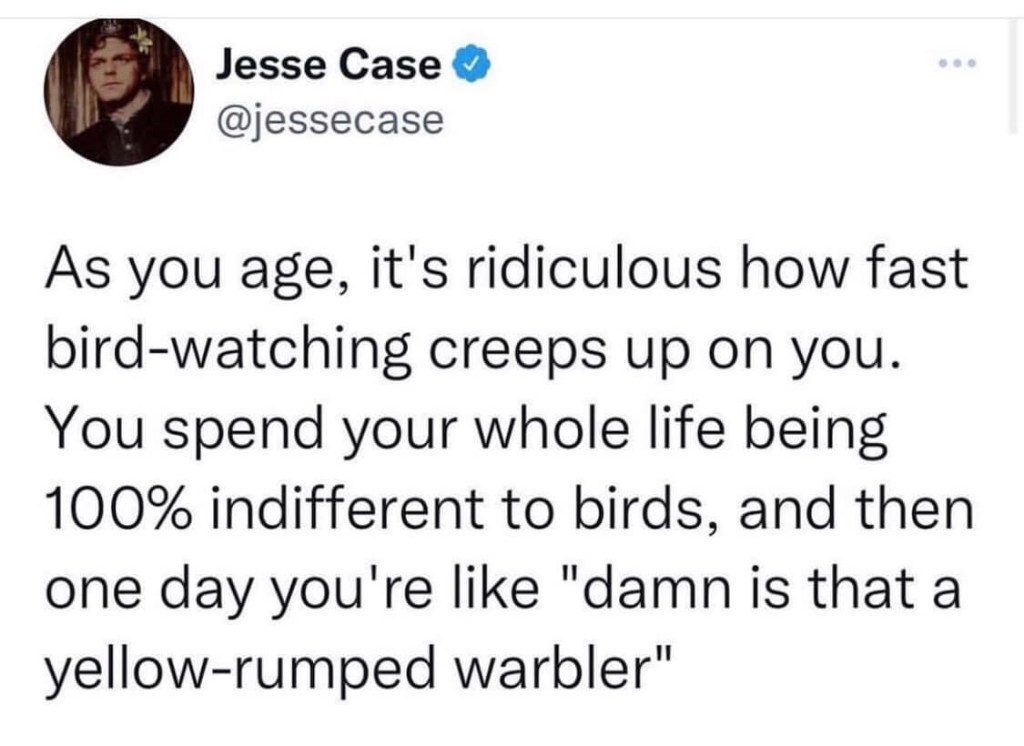
Some of my friends and I are noticing our interests shift these days. This tweet sums up the phenomenon perfectly.
And it’s not just birds, but the weather, the garden, the laugh of a child. The little moments bear a new luster. And of course it makes sense. As our lives are rushing by in our younger years, the little things can get lost. We always will have the time to stop and look, to smell the roses, we reason, so we put it off. But as we feel our time here becoming more finite, our attention hones. We pause. We marvel. We are constantly astonished.
As it turns out, this experience isn’t so much a reflection of our age as it is our perception of time. When we feel time vast, spreading out before us, our focal point is on the future, but when we feel a possible end to our time here, our attention draws close and we appreciate the little things. So even someone young facing death will have this urge to stop and soak in the little things.
In his book, Being Mortal; Medicine and What Matters in the End, Atul Gawande summarizes research on this experience:
“…how we seek to spend our time may depend on how much time we perceive ourselves to have. When you are young and healthy, you believe you will live forever. You do not worry about losing any of your capabilities. People tell you “the world is your oyster,” “the sky is the limit,” and so on. And you are willing to delay gratification—to invest years, for example, in gaining skills and resources for a brighter future, you seek to plug into bigger streams of knowledge and information. You widen your networks of friends and connections, instead of hanging out with your mother. When horizons are measured in decades, which might as well be infinity to human beings, you most desire all that stuff at the top of Maslow’s pyramid- achievement, creativity, and other attributes of ‘self-actualization,” but as your horizons contract—when you see the future ahead of you as finite and uncertain—your focus shifts to the here and now, to everyday pleasures and the people closest to you.”
Being Mortal: Medicine and What Matters in the End, by Atul Gawande
But our ‘knowledge’ of the time we have is far from certain. Sometimes our belief we will always have another day keeps us from appreciating the days we have. Practices like mindfulness and meditation, reading poetry, help ground us in the present so we can capture those moments, but it’s difficult to keep our own mortality enough in our consciousness to really grasp the preciousness of each moment.
In the play, Our Town, by Thornton Wilder, the lead character Emily, a young woman who loses her life early in childbirth, is given the opportunity to revisit one day in her life, and she sees it all with new eyes:
Emily: Oh, Mama, look at me one minute as though you really saw me. Mama, fourteen years have gone by. I’m dead. You’re a grandmother, Mama! Wally’s dead, too. His appendix burst on a camping trip to North Conway. We felt just terrible about it – don’t you remember? But, just for a moment now we’re all together. Mama, just for a moment we’re happy. Let’s really look at one another!…I can’t. I can’t go on.It goes so fast. We don’t have time to look at one another. I didn’t realize. So all that was going on and we never noticed. Take me back — up the hill — to my grave. But first: Wait! One more look. Good-bye , Good-bye world. Good-bye, Grover’s Corners….Mama and Papa. Good-bye to clocks ticking….and Mama’s sunflowers. And food and coffee. And new ironed dresses and hot baths….and sleeping and waking up. Oh, earth, you are too wonderful for anybody to realize you. Do any human beings ever realize life while they live it–every, every minute? Stage Manager: No. (pause) The saints and poets, maybe they do some. Emily: I’m ready to go back.”
Our Town, by Thornton Wilder
Today is that day, a day for us to realize life while we’re living it, every, every minute as much and as best as we can.
Rob Kenney has a YouTube channel Dad, How Do I? where he teaches his nearly 3 million viewers how to do stuff. He got the idea for his channel wondering about the kids growing up without dads and wanting to help fill that space for them, teaching them how to tie their tie, do their taxes, check their oil, plant a tree, and so on. He tells them he’s proud of them.
What a sweet idea. And resource! But, more importantly, how wonderful it is to see someone consciously being a positive role model, using his know-how to help others, and trying to fill a void.
The truth is we all have the potential to be role models. Whether it’s how we behave under pressure, handle a crowded line, or talk with someone who disagrees, our actions matter. People will see us and think about whether they want to follow our example. We have a responsibility to be a good one.
We each decide if we are to be the hero of the story our lives are writing. We each will hear calls to adventure and must decide whether we will rise to the occasion. We each struggle with challenges and learn, or not, from the experience. What will your story be? How will you meet the challenges you encounter?
In this short film, Matthew Winkler outlines Joseph Campbell’s Hero Journey, a path we all must take.