Erring in the direction of kindness

What do we regret most as we contemplate the end of our time here? Maybe the lesson from that regret can inform our present. In an outstanding commencement speech, George Saunders reflects on his own failures and encourages the graduating students to look for opportunities to be kind. He reflects on a memory haunting him from his childhood:

In seventh grade, this new kid joined our class. In the interest of confidentiality, her Convocation Speech name will be “ELLEN.” ELLEN was small, shy. She wore these blue cat’s-eye glasses that, at the time, only old ladies wore. When nervous, which was pretty much always, she had a habit of taking a strand of hair into her mouth and chewing on it.

So she came to our school and our neighborhood, and was mostly ignored, occasionally teased (“Your hair taste good?” — that sort of thing). I could see this hurt her. I still remember the way she’d look after such an insult: eyes cast down, a little gut-kicked, as if, having just been reminded of her place in things, she was trying, as much as possible, to disappear. After awhile she’d drift away, hair-strand still in her mouth. At home, I imagined, after school, her mother would say, you know: “How was your day, sweetie?” and she’d say, “Oh, fine.” And her mother would say, “Making any friends?” and she’d go, “Sure, lots.”

Sometimes I’d see her hanging around alone in her front yard, as if afraid to leave it.

And then — they moved. That was it. No tragedy, no big final hazing.

One day she was there, next day she wasn’t.

End of story.

Now, why do I regret that? Why, forty-two years later, am I still thinking about it? Relative to most of the other kids, I was actually pretty nice to her. I never said an unkind word to her. In fact, I sometimes even (mildly) defended her.

But still. It bothers me.

So here’s something I know to be true, although it’s a little corny, and I don’t quite know what to do with it:

What I regret most in my life are failures of kindness. 

Those moments when another human being was there, in front of me, suffering, and I responded . . . sensibly. Reservedly. Mildly.

We all have so many opportunities to make a difference, just by simply being kind, offering a smile, reaching out in friendship. And, when we reflect on the kindnesses that have made the difference to each of us in our own lives, we realize those little shows of kindness are what matter.

Saunders continues to remind each of us that our inner selves, our souls, shine as brightly as ever, and, even as we strive for success, to keep checking in with that inner place, and to believe it exists and greet the world from there:

Do all the other things, the ambitious things — travel, get rich, get famous, innovate, lead, fall in love, make and lose fortunes, swim naked in wild jungle rivers (after first having it tested for monkey poop) – but as you do, to the extent that you can, err in the direction of kindness. Do those things that incline you toward the big questions, and avoid the things that would reduce you and make you trivial. That luminous part of you that exists beyond personality — your soul, if you will — is as bright and shining as any that has ever been. Bright as Shakespeare’s, bright as Gandhi’s, bright as Mother Teresa’s. Clear away everything that keeps you separate from this secret luminous place. Believe it exists, come to know it better, nurture it, share its fruits tirelessly.

When you are confronted with a choice, err in the direction of kindness.

Counting not months but moments.

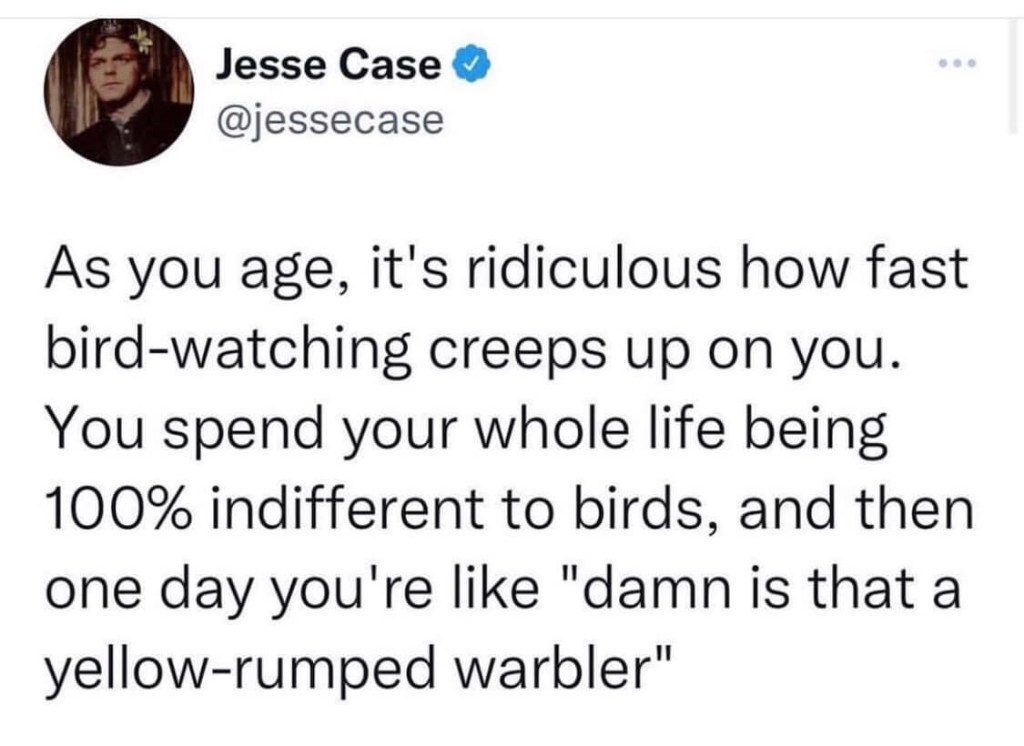
Some of my friends and I are noticing our interests shift these days. This tweet sums up the phenomenon perfectly.

And it’s not just birds, but the weather, the garden, the laugh of a child. The little moments bear a new luster. And of course it makes sense. As our lives are rushing by in our younger years, the little things can get lost. We always will have the time to stop and look, to smell the roses, we reason, so we put it off. But as we feel our time here becoming more finite, our attention hones. We pause. We marvel. We are constantly astonished.

As it turns out, this experience isn’t so much a reflection of our age as it is our perception of time. When we feel time vast, spreading out before us, our focal point is on the future, but when we feel a possible end to our time here, our attention draws close and we appreciate the little things. So even someone young facing death will have this urge to stop and soak in the little things.

In his book, Being Mortal; Medicine and What Matters in the End, Atul Gawande summarizes research on this experience:

“…how we seek to spend our time may depend on how much time we perceive ourselves to have. When you are young and healthy, you believe you will live forever. You do not worry about losing any of your capabilities. People tell you “the world is your oyster,” “the sky is the limit,” and so on. And you are willing to delay gratification—to invest years, for example, in gaining skills and resources for a brighter future, you seek to plug into bigger streams of knowledge and information. You widen your networks of friends and connections, instead of hanging out with your mother. When horizons are measured in decades, which might as well be infinity to human beings, you most desire all that stuff at the top of Maslow’s pyramid- achievement, creativity, and other attributes of ‘self-actualization,” but as your horizons contract—when you see the future ahead of you as finite and uncertain—your focus shifts to the here and now, to everyday pleasures and the people closest to you.”

Being Mortal: Medicine and What Matters in the End, by Atul Gawande

But our ‘knowledge’ of the time we have is far from certain. Sometimes our belief we will always have another day keeps us from appreciating the days we have. Practices like mindfulness and meditation, reading poetry, help ground us in the present so we can capture those moments, but it’s difficult to keep our own mortality enough in our consciousness to really grasp the preciousness of each moment.

In the play, Our Town, by Thornton Wilder, the lead character Emily, a young woman who loses her life early in childbirth, is given the opportunity to revisit one day in her life, and she sees it all with new eyes:

Emily: Oh, Mama, look at me one minute as though you really saw me. Mama, fourteen years have gone by. I’m dead. You’re a grandmother, Mama! Wally’s dead, too. His appendix burst on a camping trip to North Conway. We felt just terrible about it – don’t you remember? But, just for a moment now we’re all together. Mama, just for a moment we’re happy. Let’s really look at one another!…I can’t. I can’t go on.It goes so fast. We don’t have time to look at one another. I didn’t realize. So all that was going on and we never noticed. Take me back — up the hill — to my grave. But first: Wait! One more look. Good-bye , Good-bye world. Good-bye, Grover’s Corners….Mama and Papa. Good-bye to clocks ticking….and Mama’s sunflowers. And food and coffee. And new ironed dresses and hot baths….and sleeping and waking up. Oh, earth, you are too wonderful for anybody to realize you. Do any human beings ever realize life while they live it–every, every minute?
Stage Manager: No. (pause) The saints and poets, maybe they do some.
Emily: I’m ready to go back.”

Our Town, by Thornton Wilder

Today is that day, a day for us to realize life while we’re living it, every, every minute as much and as best as we can.

Praying our way into gratitude.

There are as many ways to pray as there are people praying. But what is it, exactly? Maybe it’s easier to answer what it isn’t: a flamboyant show, a chance to pose and preen publicly, a subterfuge, a droning recitation of memorized but not considered words.

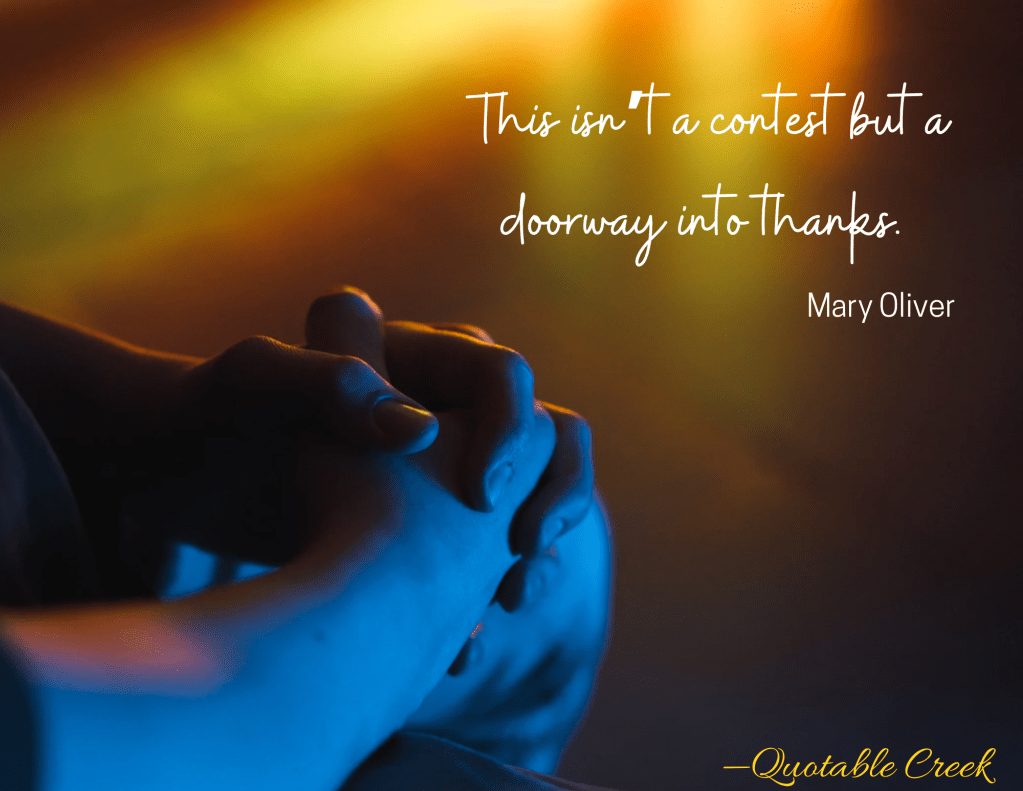
What prayer actually is, though, is more complicated: a bridge between ourselves and the mysterious, a chance to become small, and yet fully individual, in a vastness, an experience of awe. Mary Oliver’s definition above in her poem Praying is lovely: a doorway into thanks. Consider the whole poem:

Praying

It doesn’t have to be

The blue iris, it could be

Weeds in a vacant lot, or a few

Small stones; just

Pay attention, then patch

A few words together and don’t try

To make them elaborate,

This isn’t a contest but the doorway

Into thanks, and a silence in

Which another voice may speak.

Pay attention; see the beauty around you; give thanks. Rinse and repeat.

Being a good creature

Sy Montgomery’s delightful book, How To Be a Good Creature, is a ‘Memoir in Thirteen Animals‘. What an interesting way to organize a memoir, focusing on the impact various animals have made on her life and what they have taught her about co-existing as fellow creatures on this planet! It is a profound, yet simple, book.

If you were to write a memoir of your life through that lens, who would the animals be that impacted your life in meaningful and enriching ways? What life lessons did you learn? How were your limits expanded from sharing space with that fellow creature?

For inspiration, consider Montgomery’s words:

All the animals I’ve known–from the first bug I must have spied as an infant, to the moon bears I met in Southeast Asia, to the spotted hens I got to know in Kenya–have been good creatures. Each individual is a marvel and perfect in his or her own way. Just being with any animal is edifying, for each has a knowing that surpasses human understanding. A spider can taste the world with her feet. Birds can see colors we can’t begin to describe. A cricket can sing with his legs and listen with his knees. A dog can hear sounds above the level of human hearing, and can tell if you’re upset even before you’re aware of it yourself. Knowing someone who belongs to another species can enlarge your soul in surprising ways.

I often wish I could go back in time and tell my young, anxious self that my dreams weren’t in vain and my sorrows weren’t permanent. I can’t do that, but I can do something better. I can tell you that teachers are all around to help you: with four legs or two or eight or even none, some with internal skeletons, some without. All you have to do is recognize them as teachers and be ready to hear their truths.

Today, consider the wonder of creation around you and thank your teachers of the non-human persuasion.

Being the heroes of our own story

We each decide if we are to be the hero of the story our lives are writing. We each will hear calls to adventure and must decide whether we will rise to the occasion. We each struggle with challenges and learn, or not, from the experience. What will your story be? How will you meet the challenges you encounter?

In this short film, Matthew Winkler outlines Joseph Campbell’s Hero Journey, a path we all must take.

How will we fare?

Being a Good Samaritan

The Parable of the Good Samaritan is well known. In short, a man lies helpless and injured in the road. Religious leaders rush past offering no assistance, while a Samaritan stops and offers the wounded man succor and solace.

What makes one person stop to help while others rush by? Is it the belief that helping is the right way to show up in the world? A religious mandate even? Or is there more to it?

In a famous study at Princeton, researchers evaluated a group of seminarians, specifically discussing the Parable of the Good Samaritan, and then sending them to a task, indeed to lecture on the very parable, where they would necessarily walk right past someone needing help. Even with the parable fresh on their minds, the future pastors for the most part walked right by. Presumably these were nice people who intended to spend a lifetime in service. And yet, they walked right by. They acted in a way incongruent with their professed beliefs.

A surprising result to say the least. But the conclusion from the experiment was that the biggest influencer in whether they stopped to help was not their religious beliefs or their innate kindness, but their perception of time. The more of a hurry they were in, the less likely they were to help.

So how does this inform our choices?

A general kind intent to help is not enough. We are all the Princeton Divinity Students rushing to our next important task and potentially neglecting the plight of others right in our path. We must slow down the clock and really see the people around us. And we need to be ok with the idea that our plans and schedules might be disrupted. Surely stopping to help someone in need will change your day, will inconvenience you, and cause you to spend time and perhaps money in an unplanned way.

But the help you might be able to offer someone in need could be invaluable.

Going high

We are bombarded daily with stories of fraud, cheating, self-interest, and dishonesty. People talking over each other, shoving, hostile. Everything is so charged and hot. Sometimes it feels like the people who stoop to these tactics might win the race and that we should do it, too. Otherwise, the ‘bad’ side will triumph. And yet.

Honesty matters. Integrity matters. Truth matters. Fairness and justice matter. On the foundations of these qualities, trust is built.

Explaining her ‘go high’ comment, Michelle Obama says,

My answer is yes. We need to keep trying to go high. Operating with integrity matters. It will matter forever. It is a tool.

At the same time, though, I want to be clear: Going high is something you do rather than merely feel. It’s not some call to be complacent and wait around for change, or to sit on the sidelines as others struggle. It is not about accepting the conditions of oppression or letting cruelty and power go unchallenged. The notion of going high shouldn’t raise any questions about whether we are obligated to fight for more fairness, decency, and justice in this world; rather, it’s about how we fight, how we go about trying to solve the problems we encounter, and how we sustain ourselves long enough to be effective rather than burn out. There are some who see this as an unfair and ineffective compromise, an extension of respectability politics, in which we conform to rather than challenge the rules in order to get by. Why, people rightly wonder, do we need to try to be so reasonable all the time?

I can see how some think that reason leaves no room for rage. I understand the perception that going high means that you somehow remove yourself and remain unbothered by all that might otherwise gall and provoke you.

But it’s not that at all.

When I first said those words…, I was neither removed nor unbothered. In fact, I was pretty agitated….

But where was my actual power? I knew it didn’t reside in my hurt and rage, at least as they existed in raw forms. My power lay in whatever I could manage to do with that hurt and rage, where I could take it. It hinged on whether or not I could elevate those feelings into something that would become harder for others to write off, which was a clear message, a call to action, and a result I was willing to work for.

That’s what going high is for me. It’s about taking an abstract and usually upsetting feeling and working to convert it into some sort of actionable plan, to move through the raw stuff and in the direction of a larger solution.

I want to be clear that this is a process, and not always a quick one. It can take time and patience. It’s okay to sit and stew for a while, to live inside the agitation caused by injustice or fear or grief, or to express your pain. It’s okay to grant yourself the space you need to recover or heal. For me, going high usually involves taking a pause before I react. It is a form of self-control, a line laid between our best and worst impulses. Going high is about resisting the temptation to participate in shallow fury and corrosive contempt and instead figuring out how to respond with a clear voice to whatever is shallow and corrosive around you. It’s what happens when you take a reaction and mature it into a response.

Because here’s the thing: Emotions are not plans. They don’t solve problems or right any wrongs. You can feel them—you will feel them, inevitably—but be careful about letting them guide you. Rage can be a dirty windshield. Hurt is like a broken steering wheel. Disappointment will only ride, sulking and unhelpful, in the back seat. If you don’t do something constructive with them, they’ll take you straight into a ditch.

My power has always hinged on my ability to keep myself out of the ditch.

https://time.com/6233764/michelle-obama-go-high-2022/

Here’s to staying out of the ditch.

Celebrating others

Sometimes it feels like such a competitive world. And we develop an either him or me kind of mentality. A zero sum game, where an advantage for one person represents a loss to another. Like pie. more for you, less for me.

But what if it’s not? What if something good for one person, elevates the amount of good in the world for us all? What if the very act of celebrating another person’s success benefits us as well and makes a more positive, harmonious world?

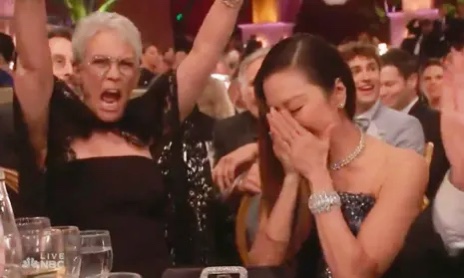
I didn’t watch the Golden Globes, but I was taken with this picture of Jamie Lee Curtis celebrating the success of her co-star Michelle Yeoh:

Fiercely supportive, celebratory, in Yeoh’s corner to the Nth degree. It wasn’t an award for Curtis, but it was a time for her to celebrate her friend. This energy inspires us all, doesn’t it?

The reaction to this now viral moment has surprised Curtis:

“I’m still stunned that a moment of natural exuberance and joy became some sort of a symbol for women supporting other women,” Curtis wrote in the [Instagram] post.

Let’s be there for each other, rejoicing in each other’s successes.

Winging it

In this now third year of pandemic, we have learned something important. We must temper our expectations and hopes with the realization that nothing is a sure bet. To expect the unexpected. To prepare for the unforeseeable. And, perhaps most importantly, to find delight wherever and whenever we can. And to store it up.

One of my absolute delights this year has been an early morning bird walk at Descanso Gardens with ‘real’ birders. What a joy it is to see these people in their element, knowing each call, able to spot and identify each bird, speaking with enthusiasm about the birds’ characteristics and habits. These birders are so kind, pointing and explaining, pointing and explaining. So much fascinating detail!

I’m a newbie to this bird watching thing, but I love it. It’s like a giant Where’s Waldo everywhere around you, all at once. I don’t yet have the eye or the ear to be a great spotter, and probably never will, but I have a secret weapon. I discovered Merlin. It’s an app that records the sounds around you, and tells you what birds are there. What a wonder!

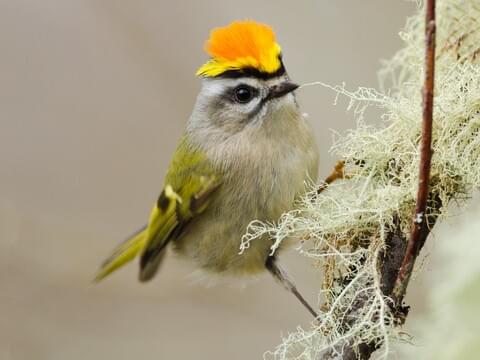
I turned it on while we were walking and discovered that there was a Golden Crowned Kinglet nearby. I didn’t see or hear it, at least not to know what I was seeing/hearing, but a leader was soon calling it out and pointing. Magic. (Just look at the cute little guy!)

Just since I’ve been typing this post, I’ve had my iPhone on the window sill while my cat, Marie, looks out over her domain, and Merlin has picked up 7 birds: Anna’s Hummingbird, Common finch, Lesser finch, Song Sparrow, Cassin’s Kingbird, California Scrub-Jay, and the Bushtit! This feels magical, like I’ve opened a doorway into another world and am tiptoeing in.

I hope this new year opens a magical doorway for you, perhaps something unexpected and new, that brings you delight.

Pay attention

The Rose Parade is always a joyous start to the new year, the pageantry, the vivid colors, the community. The floats are huge, once nearly 100 feet tall. (Disney 2004). Every inch must be covered with something organic—mostly flowers, of course, but also oatmeal, potatoes, beans, seeds, and so on. The illusions created are remarkable. Look at the bicycles in the photo above (Kaiser 2023). Every detail created out of flowers and organic material. You think you’re looking at bicycles, but really you’re looking at a masterful combination of organic material:

The pink and yellow bikes are made from cut straw flowers confetti, while the blue bike is made from blue statice. The black bike tires are made from onion seeds and the handlebars are comprised of dark lettuce seeds. Other flowers and materials used include pampas grass, banana leaf, red and pink anthurium, commadore fern, Italian ruscus, lemon leaf, and green dianthus.

https://www.latfusa.com/article/2022/12/the-kaiser-permanente-rose-parade-float-has-40000-roses

In many ways, a Rose Parade float is a metaphor for life: you think you see things one way, but really everything is a combination of multitudes of factors—point of view, back story, nuance, history. Very little is as objective as we first think. This is particularly true when it comes to looking at each other. We are all a combination of life experience, history, bias, personality, filters and so on. We each bring that myriad of factors to our encounters.

Our job in everything is to look closely and pay attention, to move past assumption and bias. Jumping to hasty conclusions will get you trying to ride bicycles made of pampas grass.