Hope, and hope again.
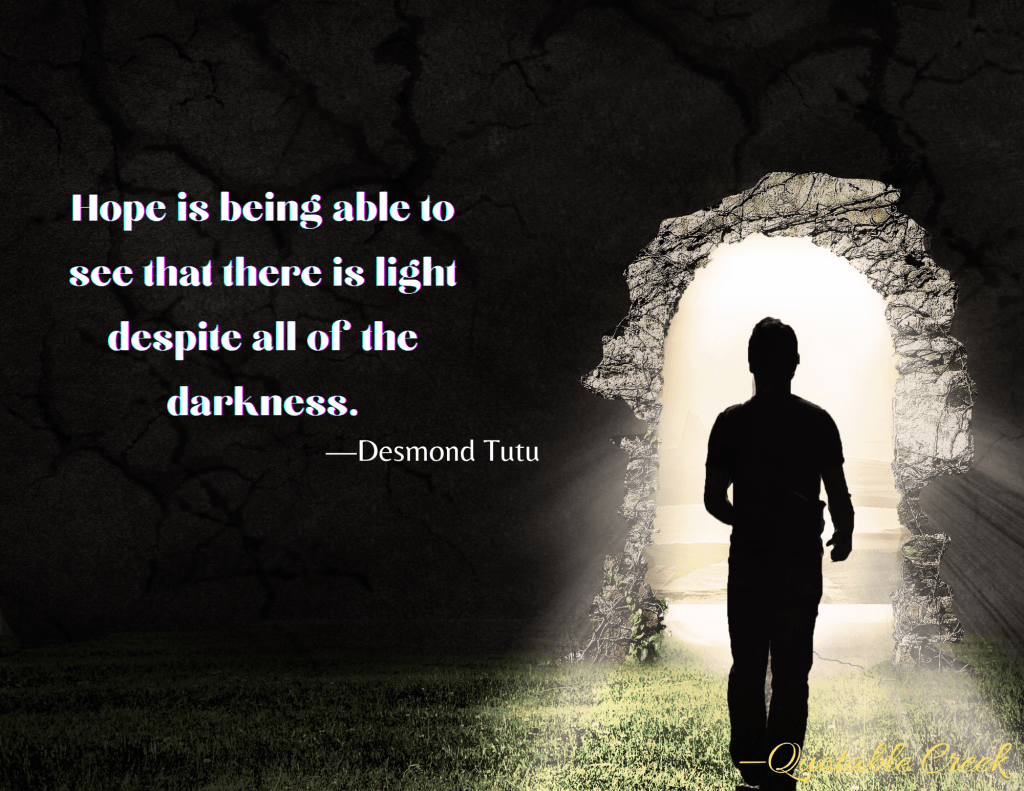
What is hope, really, but a persistent insistence that things can be better, that there is more to it, that the final answers are yet to be revealed. Emily Dickinson describes hope as

“Hope” is the thing with feathers –

That perches in the soul –

And sings the tune without the words –

And never stops – at all –

And sweetest – in the Gale – is heard –

And sore must be the storm –

That could abash the little Bird

That kept so many warm –

I’ve heard it in the chillest land –

And on the strangest Sea –

Yet – never – in Extremity,

It asked a crumb – of me.”

And this feels right. Hope sits there perched, singing, warming our souls and keeping us fed. A wordless song because we may not even have the ability to put our emotions into words or know what it is we hope for. And this is a positive, persistent hope, but somewhat passive, waiting.

And yet, we know, too, that hope gets its fingernails dirty because while hope sits on the periphery expectant, it can also be in the fray fighting for a better world. That kind of hope is captured by Matthew @CrowsFault:

“People speak of hope as if it is this delicate ephemeral thing made of whispers and spider’s webs. It’s not. Hope has dirt on her face, blood on her knuckles, the grit of cobblestones in her hair, and just spat out a tooth as she rises for another go.”

And this, too, seems true. Hope keeps our souls fed but also prompts our entering the arena, helping us to do the hard work to make a better world for all.

Let 2023 be a year of hope, perched and singing to our souls, but also inching us forward to do the hard work, offering our time and talents, to bring about a better today.
Look at all you’ve done…

The new year brings with it an expectation to reflect and set intentions for how to perhaps improve from the last. Often these reflections result in an examination of all the ways we’ve fallen short and a profession to do better, eat better, exercise better…be better. Often the premise unspoken is that we’re not enough, we must improve, be different.

I wonder if there is a better way to start a new year. Perhaps in astonishment that we have made it through a year filled with so many challenges and yet we persisted. Perhaps filled with gratitude that our opportunities to contribute and bring joy to others continues. Perhaps thinking about all the small wonders that make up our life and rejoicing.

Each new year is an opportunity to wake up with the enthusiasm of Scrooge after his ghostly visits and realize that here we are, in the thick of it, able to love and be loved, able to contribute, and make a difference, filled with delight:

“Running to the window, he opened it, and put out his head. No fog, no mist; clear, bright, jovial, stirring, cold; cold, piping for the blood to dance to; Golden sunlight; Heavenly sky; sweet fresh air; merry bells. Oh, glorious. Glorious!”

When he finds out from a boy outside his window that it is still Christmas Day, Scrooge says, “I haven’t missed it. Yes, the spirits did it all in one night—they can do anything they want to do.”

Then his thoughts turn, with glee, to anonymous giving, saying to himself, “I’ll send [a turkey] to Bob Cratchit’s! rubbing his hands, and splitting with a laugh. “He shan’t know who sends it. It’s twice the size of Tiny Tim….”

“The chuckle with which he said this, and the chuckle with which he paid for the Turkey, and the chuckle with which he paid for the cab, and the chuckle with which he recompensed the boy, were only to be exceeded by the chuckle with which he sat down breathless in his chair again, and chuckled till he cried.”

Chuckled until he cried. How thin the edge between joy and grief. What a gift it is to be here. How precious in its finiteness. But here we are, dancing, able to bring joy to others. Here now, but not forever.

Rejoice!

Happy new year!

Woven delights.

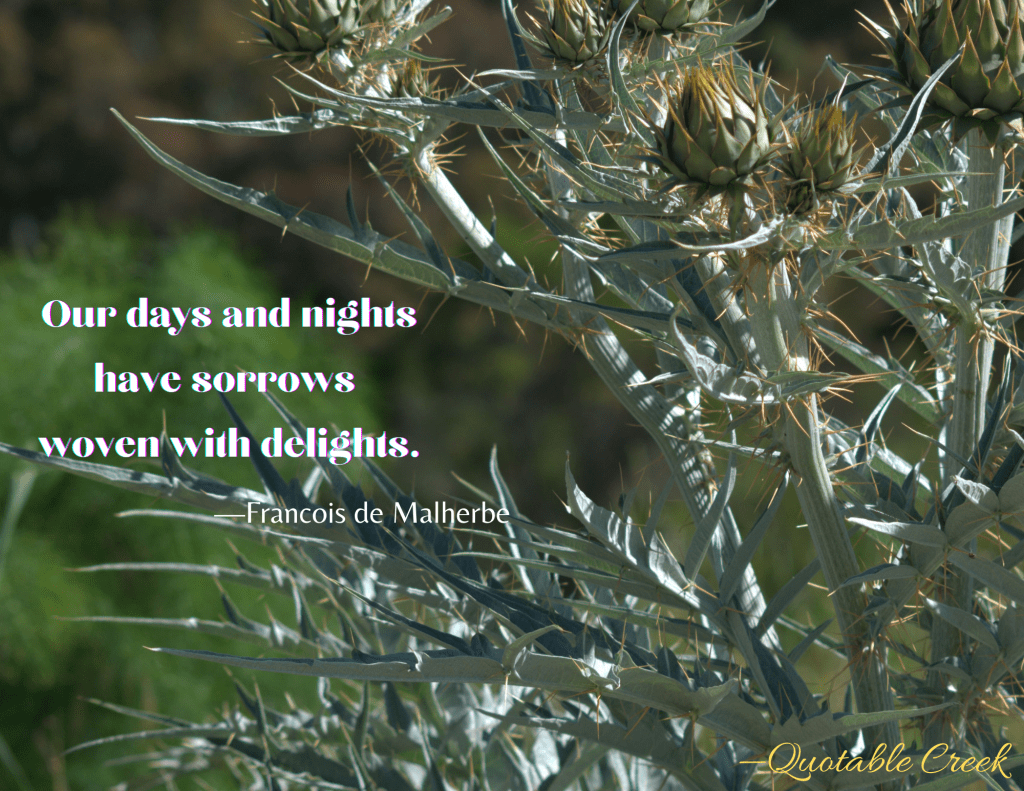
Everything is a bit of a mix, isn’t it? Even a perfect moment is inseparable from its transience. Glennon Doyle coined the term ‘brutiful’ for this, a mix of brutal and beautiful.

In his Book of Delights, Ross Gay embarks on a quest to document the delights of each day for a year. Everything from bindweed to community to the joys of gardening. That act of paying attention, looking for the delights in each day, is, in itself, a delight, an opening to the promise and possibility of each moment.

Just the act of searching for those delights and holding them up, maybe even writing them down, serves to make each moment more meaningful and appreciated. As we train and condition ourselves to notice the things that delight us, even those we would never normally consider delights, we grow in gratitude and awe. Our worlds take on more depth and value. And we are better able to see the roses amidst the thorns.

Doing it anyway.

Many of us have been afraid, and fear can naturally lead us to withdraw and retreat from the world. And this makes sense.

But sometimes the things that made us afraid continue and become our new normal, and then we must learn how to continue to do what needs to be done despite the fear.

This is courage.

We each have hidden wells of courage to draw from in trying times. We each have within us a voice that calls us to act, whether it is in caring for one another or speaking out against injustice.

In these times of disorder and distress, we confront new normals at every turn. And part of these new normals necessarily involves confronting and accepting your new reality and learning how to continue to make a positive difference in the world despite the challenges.

It’s ok to be afraid. Do what needs to be done anyway.

What is worth fighting for?

What is worth fighting for? Sometimes a battle is won in a courageous show of strength and derring do. A fire fighter runs into a burning building to save a child. A passerby stops to help victims of an accident. A pilot steers a damaged plane to safety.

But sometimes the battle requires showing up time after time with love, kindness, and patience. Not giving up on someone. Having faith that love will win. Believing that relationships can be salvaged.

That takes courage, too.

A place where we’ll be safe.

Where do we find comfort when we’re hurting? For many, it is through song, through prayer, or through poetry…sometimes through all three together.

I pray this father-daughter duet brings you joy. I pray the words stir your soul and fill you with comfort. God’s peace.

Lyrics to “The Prayer,” written by Carole Bayer Sager and David W. Foster

I pray you’ll be our eyes

And watch us where we go

And help us to be wise

In times when we don’t know

Let this be our prayer

When we lose our way

Lead us to a place

Guide us with your grace

To a place where we’ll be safe

La luce che tu hai (I pray we’ll find your light)

Nel cuore resterà (And hold it in our hearts)

A ricordarci che (When stars go out each night) L’eterna stella sei (Whoa)

Nella mia preghiera (Let this be our prayer)

Quanta fede c’è (When shadows fill our day)

Lead us to a place (Guide us with your grace)

Give us faith so we’ll be safe

La forza che ci dà (We ask that life be kind)

È il desiderio che (And watch us from above)

Ognuno trovi amor (We hope each soul will find) Intorno e dentro a sé (Another soul to love)

Let this be our prayer

Just like every child

Need to find a place

Guide us with your grace

Give us faith so we’ll be safe

Deep listening.

When was the last time you felt heard?

Listening, truly listening–without an agenda, without interrupting, without offering solutions or fixes, without criticism or judgment–is a rare thing. But it is vital to relationships. And it is a gift to be in a position to listen. Someone is trusting you with their story, their feelings, their hurts and hopes. That is precious. How can we best listen to each other?

In this thoughtful article, Martha Caldwell offers advise for listening compassionately in the classroom that really applies well to any situation. As a compassionate environment transforms a classroom, it too transforms any relationship. Consider her suggestions:

1. Be fully present. We bear witness to someone’s felt experience by giving them our complete and undivided attention. Paying full attention when someone is speaking creates safety and focus in the classroom. Compassionate listeners maintain complete silence and pay attention not only to words they hear, but also to facial expressions, body language, and tone of voice, noticing even the silences between words.

2. Know listening is enough. Listening with deep attention involves a calm, relaxed state of mind, free of the desire to “fix” someone or solve their problems for them. It does not involve giving advice or intervening in any way. If our minds are busy coming up with solutions for the speaker, we fail to truly listen.

3. Respond with acceptance. Deep listeners are motivated by the desire to understand how others feel and how their experiences have affected them. Their genuine interest and heartfelt concern make it safe for others to share their vulnerabilities because they sense that what they say will be received without judgement.

4. Understand conflict as part of real-life learning. A learning community in which people are encouraged to be honest and express how they feel involves a degree of risk. Conflict may arise. Sometimes this happens, and working through difficult feelings may take time. However, when we stay connected and stick with the process, conflict can be a catalyst for positive change. When conflict can be resolved, relationships often become stronger.

5. Ask authentic questions to learn more. By asking open-ended questions like “What was that like for you?,” “Can you tell me more about that?,” or “What were you experiencing?,” compassionate listeners guide speakers to share more deeply. These questions are motivated by the desire to honestly learn more (as opposed to reinforcing preconceived notions). If they think they may not have understood something, listeners can repeat back what they think they heard and ask for clarification. “Did I hear that right?”

6. Be gentle with yourself. Deep listening involves compassion for yourself as well as for others. Accept yourself and your internal feeling responses without judgement. Allow yourself time to process and learn.

7. Treat the candidness of others as a gift. Honor the trust others have placed in you and keep what you hear confidential.

Today, listen deeply and be grateful that someone is trusting you with their story.

Inhaling peace.

We tend to think of peace as the absence of violence as quiet is the absence of noise, but is it more? Perhaps peace is active. It exists in the kind word offered, the refusal to meet hate with hate, the comfort of following higher principles, the strength of the outstretched hand. It is so easy to lose, to slip into mirroring the hate and violence we see around us, to sit silent in front of a bully, to trade barbs, to slide down. Peace is active. We maintain it in our hearts and mind. We breathe deeply to draw us back to that peaceful place. We remember truth, honor, decency, compassion. We breathe in all that is good, we exhale the bad.

Author Shauna Niequist talks about the anxiety we are all experiencing now and suggests breath prayer:

“Christians have been practicing breath prayer since at least the sixth century & there are lots of ways to do it. One way that’s been helping me lately: choose one word to pray as you inhale–what you’re asking God to bring into your life/body/spirit/world, and one word to exhale–what you’re asking God to carry for you, so that you can release it as you breathe out.

Inhale healing/exhale fear.

Inhale peace/exhale anxiety.

Inhale hope/exhale despair.

Inhale hope/exhale chaos.”

As you move forward into your day, remember to take deep breaths, center yourself, and carry on.

Miracles

Do you like to read the end of a novel first? Maybe especially when it’s a particularly stressful novel, and you want to make sure your favorite characters come out ok? It’s comforting, isn’t it? To know how the story ends, that no matter how deep the characters are in trouble, they will find a way out. And then you can read the book without being so nervous.

In this world, though, we don’t get to peek at the end of the book. We soldier on hoping and working toward better tomorrows. And we don’t know what will happen to our favorite people. Or even ourselves, for that matter.

But we do know, when we look back at the story of our own life, or at the greater story of the world, that great things have often come out of very trying times. Great art, certainly. But more than that, great advancement–inventions, cures, technology. Maybe even peace.

As we go through these challenging times, let us keep our hopes on the possibility that tomorrow will be a better day, even if that tomorrow is still a ways away.

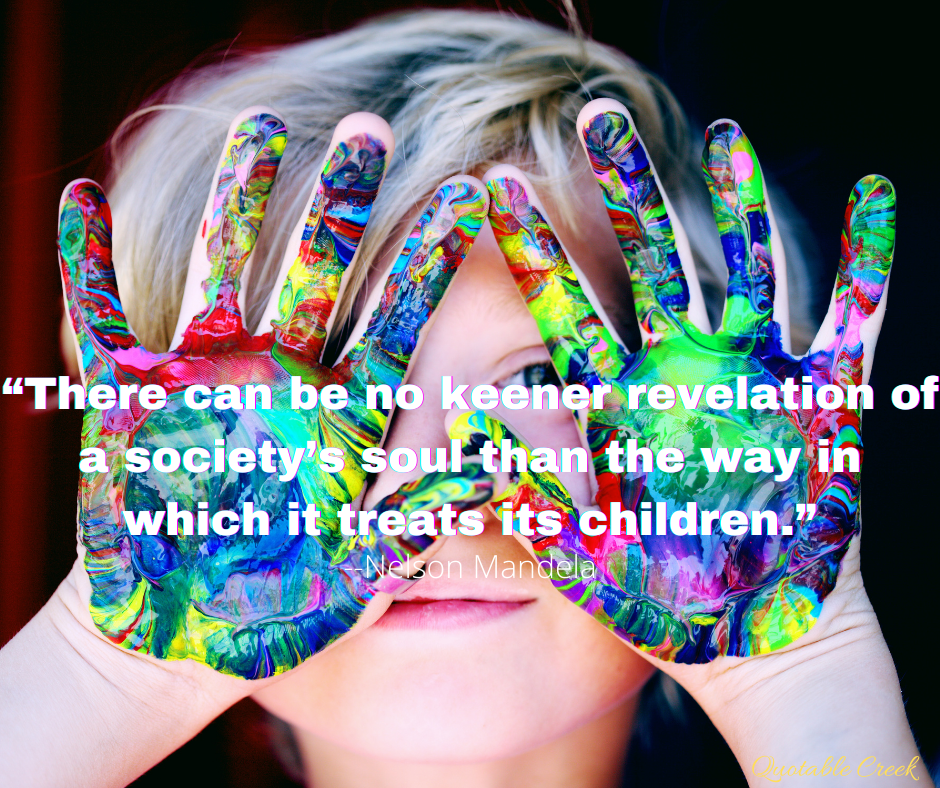
Consider the children.

We all hurt right now. Our whole world grieves the loss of what once was. The present turmoil and divisiveness weigh us down. Each of us is struggling.

But what of the children? How are they doing? How will they remember this time?

They look to us to keep them safe, to care for them, to put their needs first. They don’t understand the greater turmoil. They see, keenly, what is right in front of them. What is that?

While we may not have a ton of control over world events, we do have control over how we treat the littlest among us. Consider the profound effect your words and actions have on children just starting to be introduced to the world. Temper your anger, your frustration, your dismay. There is no harm in having a full range of emotions, and teaching children that they, too, will be subject to sadness and disappointment, frustration and anger, bewilderment and helplessness as they age. But never let them forget that you love them and are with them and that you will stay in their corners come what may.