Fail again. Fail better.

Fear of failure can keep us from trying something we really, really want to try. And it can keep us from admitting that we have taken a wrong turn and need to reevaluate things. But, at some point, we have to ask ourselves, why? What is so bad about failure?
Thomas Edison famously said, “I have not failed. I’ve just found 10,000 ways that won’t work.” Each experiment that did not succeed helped him move forward on the one path that would ultimately succeed by ruling out the other paths. That attitude helped spur him on because each failed experiment was itself a discovery and taught him something he didn’t know before.
In this remarkable TED talk, Kathryn Schulz, a self-proclaimed wrong-ologist, talks about failure and our responses to it and suggests that it is in these moments of failure, or, as she sees it, moments when reality does not align with our expectations, that the moments of growth, creativity, expansion happen:
So effectively, we all kind of wind up traveling through life, trapped in this little bubble of feeling very right about everything.
I think this is a problem. I think it’s a problem for each of us as individuals, in our personal and professional lives, and I think it’s a problem for all of us collectively as a culture. So what I want to do today is, first of all, talk about why we get stuck inside this feeling of being right. And second, why it’s such a problem. And finally, I want to convince you that it is possible to step outside of that feeling and that if you can do so, it is the single greatest moral, intellectual and creative leap you can make.
So why do we get stuck in this feeling of being right? One reason, actually, has to do with a feeling of being wrong. So let me ask you guys something — or actually, let me ask you guys something, because you’re right here: How does it feel — emotionally — how does it feel to be wrong? Dreadful. Thumbs down. Embarrassing. Okay, wonderful, great. Dreadful, thumbs down, embarrassing — thank you, these are great answers, but they’re answers to a different question. You guys are answering the question: How does it feel to realize you’re wrong? (Laughter) Realizing you’re wrong can feel like all of that and a lot of other things, right? I mean it can be devastating, it can be revelatory, it can actually be quite funny, like my stupid Chinese character mistake. But just being wrong doesn’t feel like anything.
I’ll give you an analogy. Do you remember that Loony Tunes cartoon where there’s this pathetic coyote who’s always chasing and never catching a roadrunner? In pretty much every episode of this cartoon,there’s a moment where the coyote is chasing the roadrunner and the roadrunner runs off a cliff, which is fine — he’s a bird, he can fly. But the thing is, the coyote runs off the cliff right after him. And what’s funny — at least if you’re six years old — is that the coyote’s totally fine too. He just keeps running — right up until the moment that he looks down and realizes that he’s in mid-air. That’s when he falls. When we’re wrong about something — not when we realize it, but before that — we’re like that coyote after he’s gone off the cliff and before he looks down. You know, we’re already wrong, we’re already in trouble, but we feel like we’re on solid ground. So I should actually correct something I said a moment ago. It does feel like something to be wrong; it feels like being right.
We have all been raised to get the right answers on the test, to score a winning shot, to achieve. But reality is more complex than a true-false quiz. No one of us has all the answers. And yet it feels like we do.
Schulz thinks this can be dangerous:
Think for a moment about what it means to feel right. It means that you think that your beliefs just perfectly reflect reality. And when you feel that way, you’ve got a problem to solve, which is, how are you going to explain all of those people who disagree with you? It turns out, most of us explain those people the same way, by resorting to a series of unfortunate assumptions. The first thing we usually do when someone disagrees with us is we just assume they’re ignorant. They don’t have access to the same information that we do, and when we generously share that information with them, they’re going to see the light and come on over to our team. When that doesn’t work, when it turns out those people have all the same facts that we do and they still disagree with us, then we move on to a second assumption,which is that they’re idiots. (Laughter) They have all the right pieces of the puzzle, and they are too moronic to put them together correctly. And when that doesn’t work, when it turns out that people who disagree with us have all the same facts we do and are actually pretty smart, then we move on to a third assumption: they know the truth, and they are deliberately distorting it for their own malevolent purposes. So this is a catastrophe.
This attachment to our own rightness keeps us from preventing mistakes when we absolutely need to and causes us to treat each other terribly. But to me, what’s most baffling and most tragic about this is that it misses the whole point of being human. It’s like we want to imagine that our minds are just these perfectly translucent windows and we just gaze out of them and describe the world as it unfolds. And we want everybody else to gaze out of the same window and see the exact same thing. That is not true, and if it were, life would be incredibly boring. The miracle of your mind isn’t that you can see the world as it is.It’s that you can see the world as it isn’t. We can remember the past, and we can think about the future,and we can imagine what it’s like to be some other person in some other place. And we all do this a little differently, which is why we can all look up at the same night sky and see this and also this and also this.And yeah, it is also why we get things wrong.
We are fallible. We make mistakes, constantly even, and no amount of convincing ourselves otherwise changes this particular reality. Once we accept this, we can soften our edges in the ways we treat each other and ourselves. We can jump into an uncertain future, not knowing what can happen because we realize we ACTUALLY DO NOT KNOW what will happen. That lack of knowledge isn’t something to be ashamed of or to pretend isn’t there like Wile E. Coyote who has just run off a cliff: it’s part of the human condition. We simply do not have all the answers.
Today, embrace the moment and consider each experience a learning opportunity to grow and stretch and learn. To maybe, even, discover you’ve been wrong and to incorporate that new knowledge into your choices going forward.



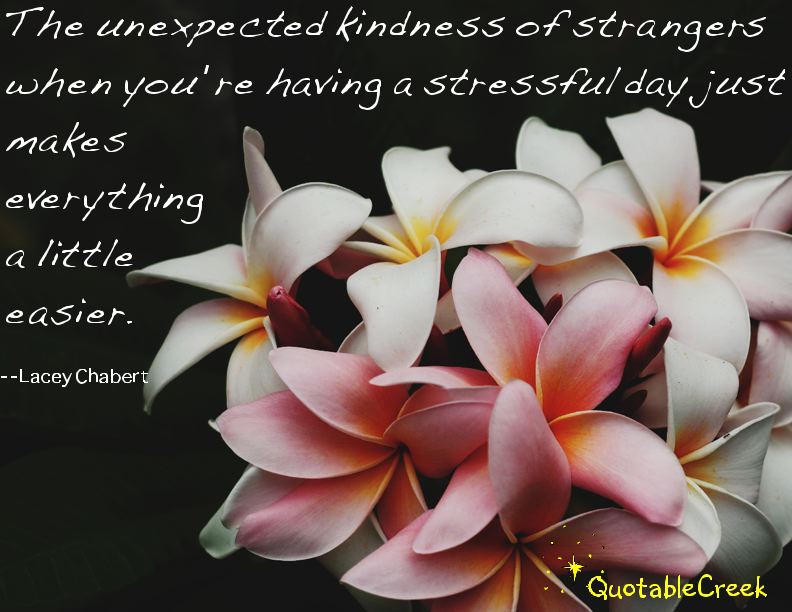 Have you ever been at a restaurant or grocery store with a crying or tantrumming child? It’s awful, that feeling of everyone staring at you and blaming you for somehow disrupting their lives. Not to mention, the criticism and judgment! Some people are only too eager to point out just what you are doing wrong and how you shouldn’t be out in public if you can’t control your children. But, sometimes, a stranger reaches out and helps– offers to amuse the baby, gives you a wink of encouragement, tells you they’ve been there, too, and that things will get better. That little