Stay hungry. Stay foolish.

heart

As 2016 heads to a close, we look  forward to a new year and turn our attention to how to make it our best year yet. In this powerful TED talk, Steve Jobs reflects on his life and offers insights into how to make these decisions so that, when you die, you will truly have lived. Chief among these is his insistence on following what you love, regardless of whether that makes sense, and even when that path goes in unpredictable or unestablished ways. He urges us not to waste time by leading someone else’s life by following their dogma or sense of what should be done, but instead to pursue our own hearts and intuition because “they somehow already know what you truly want to become.” Death, he claims, is a powerful motivator because confronting it squarely strips away the inessential and makes the vital more plain. We “are already naked,” he points out. There is nothing to lose by following your heart.

Jobs reminds us not to lose faith. Sometimes “life is going to hit you in the head with a brick,” but that is not the end of your story. Instead, failure opens up new opportunities and possibilities. Keep doing what you love. Keep following your own heart and intuition.

Keep the faith.

Remember whose you are.

cleanheart

The days before Christmas can be frantic. We sometimes find our tempers short, our tongues loose, and our wits frayed. We think of Christmas as something in the future, speeding toward us, that we need to hurry around and prepare for so that we can enjoy His coming. But a birthday, like Christmas, is a celebration of something that has already happened. And, in the case of Christmas, it is a celebration of a whole new world order that is here. We are His now, not just at Christmas. We need to shine with His love now and everyday. Particularly when the world is harried. We need to reflect the joy and peace that comes with knowing that love conquers all.

Pause. Breathe. And remember whose you are.

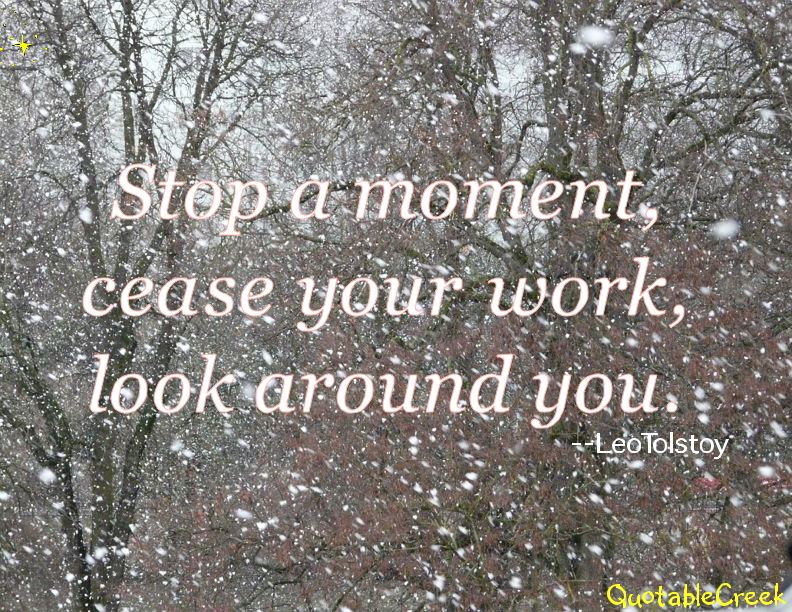
Take a moment.

moment

Got a minute?

The rush of holidays and year end can be powerful. So much to do. We can’t stop bustling. Something might get dropped.

We don’t have time to see the look of wonder on a child’s face, or hear the kitten-soft whisper of snow beginning to fall, or breathe in the musky scent from a neighbor’s chimney. We don’t have time to drop to our knees with gratitude for being in this place and time, with these people to love, and these hands to serve, and these eyes to soak in the beauty around us. There is so much to do we simply don’t have time to pause and pay attention to the blessing of it all.

Or do we?

Hold on.


aint

Is your life all ups, no downs? Do you ever feel a need to make it look like it is? Maybe to pretend the rough stuff doesn’t exist or put on a big smile to cover a broken heart? Do you ever feel like there must be something wrong with your faith if your life is going badly?

Truth is, shit happens. To the best, most faithful of people. Life’s struggles can feel overwhelming. You can get to the point where you simply cannot see how someone could think and feel the way they do. You can lose hope.

At times like these you need to breathe deep and get yourself to a quiet place. And it sure would do no harm, and maybe a whole lot of good, to read a poem like this:


The Peace of Wild Things

by Wendell Barry

When despair for the world grows in me

and I wake in the night at the least sound

in fear of what my life and my children’s lives may be,

I go and lie down where the wood drake

rests in his beauty on the water, and the great heron feeds.

I come into the peace of wild things who do not tax their lives with forethought

of grief. I come into the presence of still water.

And I feel above me the day-blind stars waiting with their light.

For a time I rest in the grace of the world, and am free.

And the good news is, you can read this poem, and your soul will calm without even being in that place where the wood drake rests in his beauty on the water. The words of a good poem are like magic. They can heal you and still the churning waters of your soul. And they can help you remember the ‘day-blind stars waiting with their light’, because, yes, we cannot see the stars in the daytime, but they are there. Shining.

May you rest in the grace of the world and find peace.


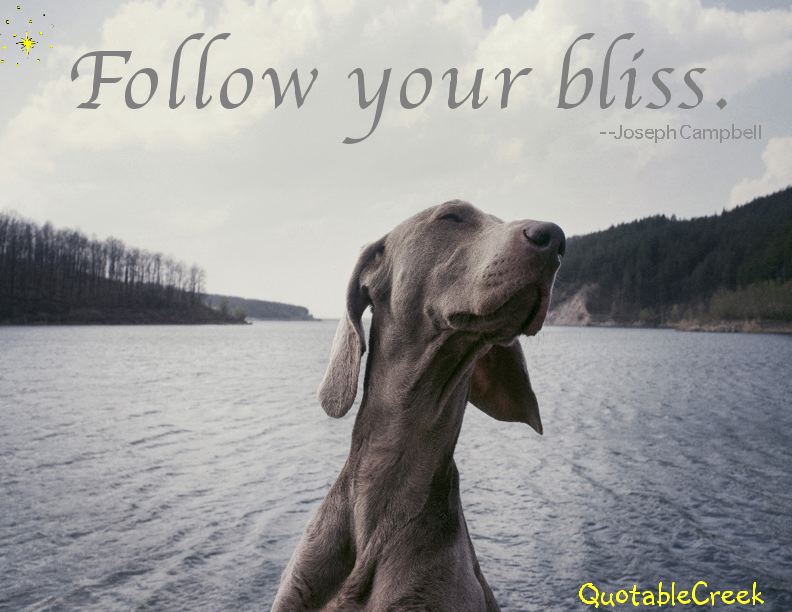
Follow your bliss.

bliss

What is your bliss? What fills you with purpose and passion and spills out of you into the world around you?

That’s not always an easy question.

Sometimes we can look at the high moments in our work or life, the moments that brought joy and satisfaction, and follow them like breadcrumbs back to the bliss, that thing that we love doing.

Sometimes, we are born knowing our passion and purpose. It is as apparent as the nose on our face, if we can see it and follow it before it’s squashed by life.

In the attached video, one boy seems to know what brings him joy and purpose right out of the gate: making bears for hospitalized children, turning sadness into joy, despair into hope, and, maybe even, saving his own dad in the process.

There is so much to love about this story, but, as you watch, consider his parents’ response. They don’t force him to be like all the other boys. They don’t mock or deride him for his dream. They don’t push him into a mold of their own devising.

They let him blossom.


Be the river.

river

Life is like a river. It moves faster and faster as it draws to its conclusion. It draws us along and challenges us to go with the flow, to confront the challenges head on, to stay alert, to enjoy the view. We don’t know what is around each bend, but we do know how to meet challenges–with love, with acceptance, with courage.

Enjoy Garth Brooks on this point!


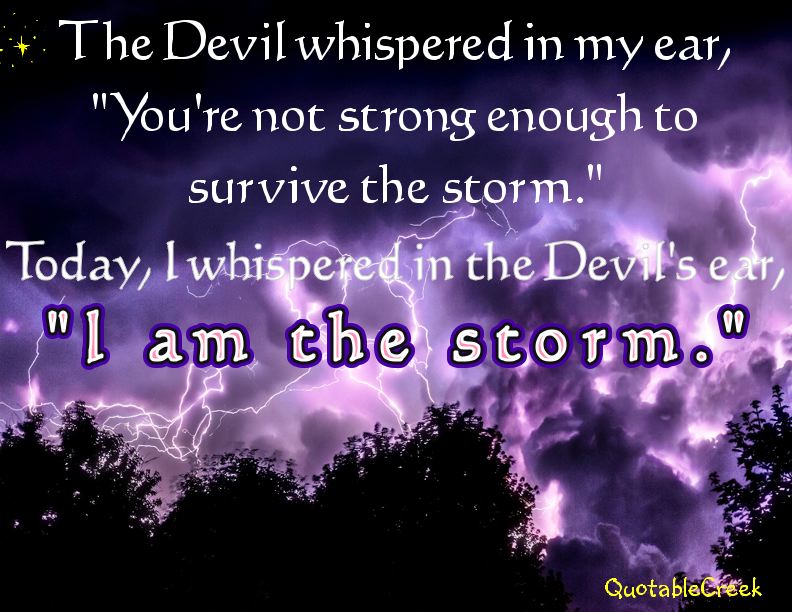
Be the storm.

storm

Is there a sleeping giant inside of you waiting to wake up and make a difference? Perhaps there is a cause you want to help or a need you see in your community? Are there people who need an ally? What can you do? How can you help?

You are more powerful than you ever dreamed.

Now is the time.


Be kind.

kindness

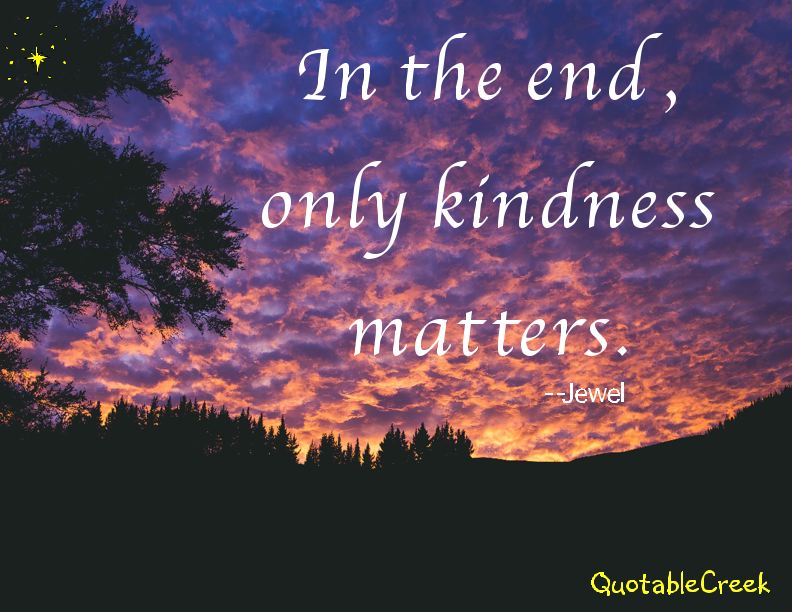
Kindness isn’t something you ponder in your heart. It is something you do–with your hands, with your words, with your gifts. Person to person, face to face. Lift those who have fallen; feed those who are hungry; speak up for those without a voice; reach out to those who feel alone.

In her song, Hands, Jewel reminds us that even when our hands are small, they are the tools we have to help others and we must use them. That is the way we will use our lives to make a difference for the better in the lives of those around us.

When she was 18, pop singer Jewel lived in a van. One day, she walked into a store to shoplift a dress; but looking at her hands, she realized she controlled them. “I realized I was cheating myself.” Here’s a song titled ‘Hands’ with a beautiful refrain: ‘In the end, only kindness matters.”

Listen to Jewell’s beautiful song here. And, today, contemplate her words:

We will fight, not out of spite
For someone must stand up for what’s right
Cause where there’s a man who has no voice
There ours shall go singing

My hands are small, I know,
But they’re not yours they are my own
And I am never broken

Today, be kind. Look for any and every opportunity to make a difference.


Rise up.

serenity

Life knocks us down. What helps us get back up?

It’s not about how smart we are, or who we know, or what school we went to. It’s about resilience. Our emotional IQs may be just as important, if not more important, than our actual IQs.

Our emotional intelligence is subtle:

Emotional intelligence is the “something” in each of us that is a bit intangible. It affects how we manage behavior, navigate social complexities, and make personal decisions that achieve positive results. Emotional intelligence is made up of four core skills that pair up under two primary competencies: personal competence and social competence.

And, as luck would have it, our emotional intelligence is something we can work to improve:

Unlike your IQ, your EQ is highly malleable. As you train your brain by repeatedly practicing new emotionally intelligent behaviors, your brain builds the pathways needed to make them into habits. Before long, you will begin responding to your surroundings with emotional intelligence without even having to think about it. And as your brain reinforces the use of new behaviors, the connections supporting old, destructive behaviors will die off.

Consider these nine habits of emotionally intelligent people:

1. They’re relentlessly positive. 
2. They have a robust emotional vocabulary.

3. They’re assertive.

4. They’re curious about other people.

5. They forgive, but they don’t forget. 
6. They won’t let anyone limit their joy.

7. They make things fun.

8. They are difficult to offend. 
9. They quash negative self-talk.

Focus on the things you can control. Don’t get lost in the negativity of things beyond your sphere of influence. Remember to stay positive and joyful.

And then get yourself back up!


Chuck the lies.

honesty

Lie? Why not? Everyone does it, don’t they?

We have many words for lies: white lies, fudging, fibs, whoppers, but what is at the heart of each is knowingly substituting a different version of the facts for what we know is the truth. Sometimes, like with Wells Fargo and Bernie Madoff, the lies result in substantial financial gain for the liar and substantial loss for the victim.

What propels someone to lie so extravagantly or, even, at all?

Studies show that the big whoppers evolve from the littlest of lies: our brain changes as we lie, making us more and more willing to tell bigger and bigger lies:

A new study claims to provide the first empirical evidence showing that dishonesty gradually increases over time. By using scans that measured the brain’s response to lying, researchers saw that each new lie resulted in smaller and smaller neurological reactions ― especially in the amygdala, which is the brain’s emotional core.

In effect, each new fib appeared to desensitize the brain, making it easier and easier to tell more lies.

This is alarming, not just because it can lead to widespread fraud but also because a liar begins to live in an alternate reality. Over time, people can begin to believe the lies they tell themselves and others, putting them in a position where their beliefs just don’t square with the world they’re living in. They are constantly confronted with the disconnect between their altered reality and reality itself, leading to greater and greater anger and frustration. Sometimes those lies are self-delusional, leading people to never adequately address and progress beyond their own problems. In short, lies lead to fragmentation, discord, breach of trust, chaos.

Now, truth doesn’t always lead to harmony. Some truths lead to a road of very hard work, reconciliation, and compromise. But at the heart of telling the truth is an increase in trust which is the glue that binds a couple, a family, a community, a country, and is necessary for any true progress.