Listening, or just waiting for your turn to talk?

listen

Listening, truly listening, is rare. Most people are just waiting for their turn to reply. Or maybe not even waiting, but interrupting to say what is on their mind. Two people both talking, but neither listening, and no one, consequently, heard. Too often, we want to avoid the discomfort of listening, particularly if someone is hurting, and so we turn the conversation back to something safe, ourselves.

Celeste Headlee recounts a time when she tried to support her grieving friend, but failed:

A good friend of mine lost her dad some years back. I found her sitting alone on a bench outside our workplace, not moving, just staring at the horizon. She was absolutely distraught and I didn’t know what to say to her. It’s so easy to say the wrong thing to someone who is grieving and vulnerable. So, I started talking about how I grew up without a father. I told her that my dad had drowned in a submarine when I was only 9 months old and I’d always mourned his loss, even though I’d never known him. I just wanted her to realize that she wasn’t alone, that I’d been through something similar and could understand how she felt.

But after I related this story, my friend looked at me and snapped, “Okay, Celeste, you win. You never had a dad, and I at least got to spend 30 years with mine. You had it worse. I guess I shouldn’t be so upset that my dad just died.”

I was stunned and mortified. My immediate reaction was to plead my case. “No, no, no,” I said, “that’s not what I’m saying at all. I just meant that I know how you feel.” And she answered, “No, Celeste, you don’t. You have no idea how I feel.”

She walked away and I stood there helplessly, watching her go and feeling like a jerk. I had totally failed my friend. I had wanted to comfort her, and instead, I’d made her feel worse. At that point, I still felt she misunderstood me. I thought she was in a fragile state and had lashed out at me unfairly when I was only trying to help.

But the truth is, she didn’t misunderstand me at all. She understood what was happening perhaps better than I did. When she began to share her raw emotions, I felt uncomfortable. I didn’t know what to say, so I defaulted to a subject with which I was comfortable: myself.

I may have been trying to empathize, at least on a conscious level, but what I really did was draw focus away from her anguish and turn the attention to me. She wanted to talk to me about her father, to tell me about the kind of man he was, so I could fully appreciate the magnitude of her loss. Instead, I asked her to stop for a moment and listen to my story about my dad’s tragic death.

Read more: http://www.oprah.com/inspiration/celeste-headlee-the-mistake-i-made-with-my-grieving-friend#ixzz5BWgsfjLr

How often do we do this in our conversations? We listen to the story, only to remember a time when we experienced something similar and then quickly switch focus to our story. Do we sit with a person in their grief, their discomfort, their loneliness? Or do we try to change the topic to something more pleasant?

Headlee continues:

From that day forward, I started to notice how often I responded to stories of loss and struggle with stories of my own experiences. My son would tell me about clashing with a kid in Boy Scouts, and I would talk about a girl I fell out with in college. When a co-worker got laid off, I told her about how much I struggled to find a job after I had been laid off years earlier. But when I began to pay a little more attention to how people responded to my attempts to empathize, I realized the effect of sharing my experiences was never as I intended. What all of these people needed was for me to hear them and acknowledge what they were going through. Instead, I forced them to listen to me and acknowledge me.

Sociologist Charles Derber describes this tendency to insert oneself into a conversation as “conversational narcissism.” It’s the desire to take over a conversation, to do most of the talking and to turn the focus of the exchange to yourself. It is often subtle and unconscious. Derber writes that conversational narcissism “is the key manifestation of the dominant attention-getting psychology in America. It occurs in informal conversations among friends, family and co-workers. The profusion of popular literature about listening and the etiquette of managing those who talk constantly about themselves suggests its pervasiveness in everyday life.” Derber describes two kinds of responses in conversations: a shift response and a support response. The first shifts attention back to yourself, and the second supports the other person’s comment. Here is a simple illustration:

Shift Response
Mary: I’m so busy right now.
Tim: Me too. I’m totally overwhelmed.

Support Response
Mary: I’m so busy right now.
Tim: Why? What do you have to get done?

Here’s another example:

Shift Response
Karen: I need new shoes.
Mark: Me too. These things are falling apart.

Support Response
Karen: I need new shoes.
Mark: Oh yeah? What kind are you thinking about?

Shift responses are a hallmark of conversational narcissism. They help you turn the focus constantly back to yourself. But a support response encourages the other person to continue their story. These days, I try to be more aware of my instinct to share stories and talk about myself. I try to ask questions that encourage the other person to continue. I’ve also made a conscious effort to listen more and talk less.

Read more: http://www.oprah.com/inspiration/celeste-headlee-the-mistake-i-made-with-my-grieving-friend#ixzz5BWhblDfL

Today, pay attention to your conversations. Think about the difference between shift responses and support responses, and focus on listening.

Plunge into life.

book2

Plunging into a good book expands your empathy, takes you to places you’ve never experienced, and lets you walk in the shoes of someone who thinks, acts, and lives in a way different from you. And you can fall in love, again and again, with the perfectly flawed, endearing characters you encounter there. It helps you realize that the world is complex and full of many perspectives and life experiences, that your way is not the only way, that you are one thread in an infinite, glorious tapestry of life.


Avoid the drift.

holdhands

Otters sleep holding hands. In the open water, it would be so easy for them to drift away from each other in the ebb and flow of the tides. They also use kelp to wrap around themselves, but there is something about the image of sleeping otters holding hands to stay connected that is utterly endearing.Sea_otters_holding_hands.jpg.638x0_q80_crop-smart.jpg

We, too, bounce around in rough seas, and it is easy to drift away from those we love. Distractions, distance, inattentiveness add up until you are apart, in the storm separately, rather than braving it together.

Today, work to avoid the drift away from those you love.

Spotlight on Home

homeswithinSomething there is in each of us that yearns for home.  Sometimes we confuse that yearning with a physical place. We travel back to that place and wonder why it feels different. What has changed? Why doesn’t it still feel like home? Sometimes we confuse that yearning with a particular time, a past perhaps that wasn’t complicated with today’s troubles, and lose ourselves in nostalgia. Sometimes we confuse that yearning with a particular person and, if we lose that person, wonder if we will ever feel at home again.



But what if home is not a particular place in time but a feeling we can take steps to cultivate? Here are some suggestions that might bring that feeling of home into your life:

Embrace the Now

Think about those times when you felt a deep sense of belonging and contentedness. Chances are, it was when you were lost in some sort of activity, maybe with people you love, and you lost all sense of time. No checklists, no to-dos, no schedule. Just falling into the moment and letting it lift you out of the day into something bigger.

Welcome Others

Remember that old TV show, Cheers, when everyone shouted “Norm” when he came in? A place where “everyone knows your name?” That sense of welcome is something we can offer others. Greeting them, smiling, welcoming them into the conversation or community. That is a profound thing we can do, and that sense of home that we give to them will undoubtedly rebound to us and make that place in time feel more homey for everybody.

Lay Down Your Weapons

It is hard to enjoy someone else’s company when you’re disagreeing with them. Sure, some conflict is necessary and even healthy to life together, but set aside time to come together in harmony with people. Search for the common elements you agree on. Abandon the judgment and criticism. Enjoy a game or activity that deemphasizes competition. Savor the time together.

Use Your Own Definitions

It’s easy in a social media culture to look at other people’s homey pictures and events and think you need to duplicate those exact things if you want to feel the sense of home they’re experiencing. In fact, that’s one of the strategies behind advertising: “Look at these happy people. Don’t you want to be just like them? If you buy our product, you will be!’ But that comparative decision-making is a set up for disappointment. Instead, look at your people and experiences and find ways to enjoy them that are uniquely your own. And then maybe consider holding those moments a bit sacred, away from the instinct to share. Savoring your home life beats bragging about it every day.

Realize Life is Difficult

For many people, that feeling of home doesn’t include suffering or loss or heartbreak, but is this the way it should be? Isn’t that comforting of each other through the ups and downs of life exactly what home should feel like? We don’t need to run from the hardships in life, we just need to be there with each other through them. Everyone’s life has bumps and bruises. We are all vulnerable.  Pretending we aren’t and that we have the perfect home life is just a set-up for disappointment. For those of us who have weathered storms, having a friend or family member down in the trenches with us has made all the difference and made even the horrible experience feel like home.

Make Time for Your People

Who are the people you love and make you feel at home? Are you finding time to spend with them? Sometimes, even when we love people and hold them close to our hearts, we need to schedule time to spend together. It’s a fast-paced world, finding an opportunity to slow it down to spend time with your loved ones is important, even if you have to pencil it in on your schedule.

Your Roots are Global

The connections between you and anyone else in this world exist, no matter how far removed. For an eye-opening experiment into just this theory exactly, take a look at this DNA experiment.  That knowledge of connection to others, even those seemingly nothing like you or even those you hate, can ground you to see others as yourself, to greet others, to befriend others, to join into a global community where you can feel at home wherever you go.

Today, come home.

Carrot, stick, or something better?

playforher

Falling in love is one of the most powerful things we will ever do. It’s all consuming. We lose our boundaries and dive deep into exploration, spending hours learning about this “other”–person, sport, activity, place, hobby, whatever it may be. As time goes on, maybe we put our boundaries back up, or take things for granted, or revel in our own accomplishments or prowess. If so, remember back to when everything was new and startling. Remember back to when that love was young. How did it feel to drop your boundaries and protections and artifices and fall into the astonishment of discovering an all-consuming joy. That child lives in you still. Fall in love anew.

An unfailing love.


home

How many kids these days are seen by their parents as just another way to show off? Look at my honor student, or my beauty, or my accomplished someone. It’s a way of vicarious puffing–if my kid is so smart, beautiful, wonderful, popular, surely the parent must be, too. But that’s not love; it’s pride. Love loves without having to be earned. It is steady and true. The parent who truly loves their child delights in their essence, in their idiosyncrasies, in all the ways they are their own person. That kind of love sustains a child and lets them lay down the shackles of constant performance anxiety and welcomes them home.

Consider Thomas Edison. We think of him as one of our most brilliant inventors, a shining star. Would it surprise you to know his teachers gave up on him and sent him home to be educated by his mother? She, needless to say, did not give up on him but helped him thrive. We all could use a love like that!

Your love canvas.

artistic

The artist creates something from nothing.  Being artistic requires a commitment to keep working, to keep seeing with fresh eyes, to keep trying. Each individual creation may or may not be beautiful, but the artist keeps creating, for it is how they express their love.

Love creates something from nothing. Where once there were strangers, now people are joined by an invisible bond that has substance if not weight. Maintaining that love requires constant effort. Like the artist, the lovers keep creating, keep striving for something more perfect, keep expressing their love.

Both art and love are expressed in the doing.

Pause.

awhile

The world these days moves at a breakneck speed. Twitter and social media speed it up even further.

We are tempted to respond to everything and everyone immediately with whatever thought first passes through our minds. But is that always our best thought? Once said, can it be retrieved?

Often, it is far better to pause, to breathe, to contemplate before deciding whether what we have to say can meaningfully add to the conversation or will just contribute to the din.

Embrace the now.

lorde

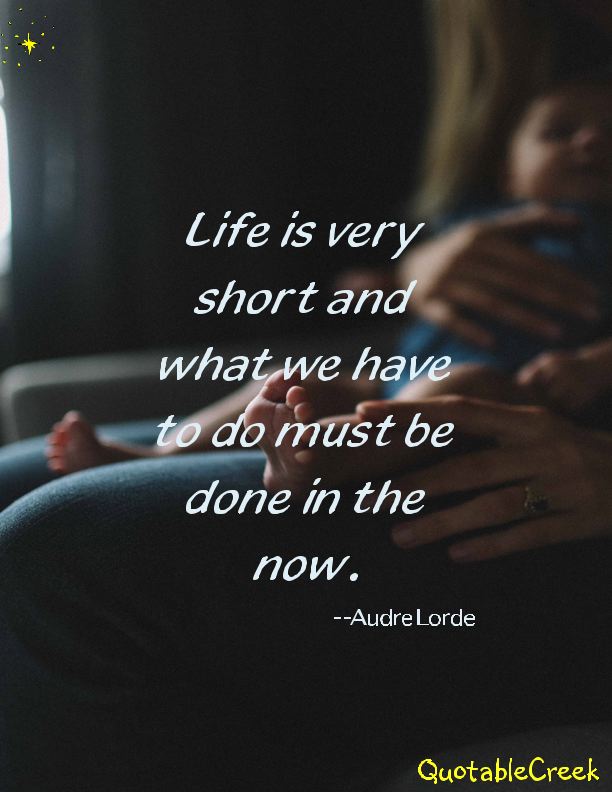
Life is short. Seize it. Spend it. Enjoy it.

And find time to share little moments together with the people who are on this journey with you. For inspiration, watch this delightful video of a dad beatboxing with his very appreciative baby:


Life’s a schoolroom.

schoolroomJust when we think we get what life is all about, something comes along to knock us upside the head and show us we have it wrong. It forces us to reevaluate our foundational assumptions about the purpose of life and look at things in a whole new way. It’s a paradigm shift.

Stephen Covey tells of a paradigm shift he experienced:

“I remember a mini-Paradigm Shift I experienced one Sunday morning on a subway in New York. People were sitting quietly — some reading newspapers, some lost in thought, some resting with their eyes closed. It was a calm, peaceful scene. Then suddenly, a man and his children entered the subway car. The children were so loud and rambunctious that instantly the whole climate changed.

“The man sat down next to me and closed his eyes, apparently oblivious to the situation. The children were yelling back and forth, throwing things, even grabbing people’s papers. It was very disturbing. And yet, the man sitting next to me did nothing.

“It was difficult not to feel irritated. I could not believe that he could be so insensitive to let his children run wild like that and do nothing about it, taking no responsibility at all. It was easy to see that everyone else on the subway felt irritated, too. So finally, with what I felt was unusual patience and restraint, I turned to him and said, “Sir, your children are really disturbing a lot of people. I wonder if you couldn’t control them a little more?”

“The man lifted his gaze as if to come to a consciousness of the situation for the first time and said softly, ‘Oh, you’re right. I guess I should do something about it. We just came from the hospital where their mother died about an hour ago. I don’t know what to think, and I guess they don’t know how to handle it either.’

“Can you imagine what I felt at that moment? My paradigm shifted. Suddenly I saw things differently, I felt differently, I behaved differently. My irritation vanished. I didn’t have to worry about controlling my attitude or my behavior; my heart was filled with the man’s pain. Feelings of sympathy and compassion flowed freely. “Your wife just died? Oh, I’m so sorry. Can you tell me about it? What can I do to help?” Everything changed in an instant.

“Many people experience a similar fundamental shift in thinking when they face a life-threatening crisis and suddenly see their priorities in a different light, or when they suddenly step into a new role, such as that of husband or wife, parent or grandparent, manager or leader.

“It becomes obvious that if we want to make relatively minor changes in our lives, we can perhaps appropriately focus on our attitudes and behaviors. But if we want to make significant, quantum change, we need to work on our basic paradigms.

“In the words of Thoreau, ‘For every thousand hacking at the leaves of evil, there is one striking at the root.’ We can only achieve quantum improvements in our lives as we quit hacking at the leaves of attitude and behavior and get to work on the root, the paradigms from which our attitudes and behaviors flow.”

(from Stephen Covey’s book, The Seven Habits of Highly Effective People)

Or consider the paradigm shift that Ebenezer Scrooge’s partner, now a ghost, Jacob Marley, recounts to him before the visit of the three Christmas ghosts in Christmas Carol. Both Scrooge and Marley thought they had life figured out–it was all about business and making money, the more the better. But Marley has had a paradigm shift since dying:

“‘But you were always a good man of business, Jacob,’ faltered Scrooge, who now began to apply this to himself.

“‘Business!’ cried the Ghost, wringing its hands again. ‘Mankind was my business; charity, mercy, forbearance, and benevolence, were, all, my business. The deals of my trade were but a drop of water in the comprehensive ocean of my business.’ “

Get ready to get hit upside the head, metaphorically speaking. It may be time for a paradigm shift.