What lasts, anyway?

depart

It is so easy to work, work, work, building up our resumés. Noses to the grindstone. Shouldering on. But, when it all comes to a stop, when we are done on this Earth, have we built up what really matters?

Will we leave behind people who loved us, who we loved with everything we had to give while we had the chance to give it? Have we showed our people how much they mean to us? Have we dared to truly love?

Or will we leave too much left unsaid, unfelt, unloved?

We still have time to choose.


Love nature.

penguin

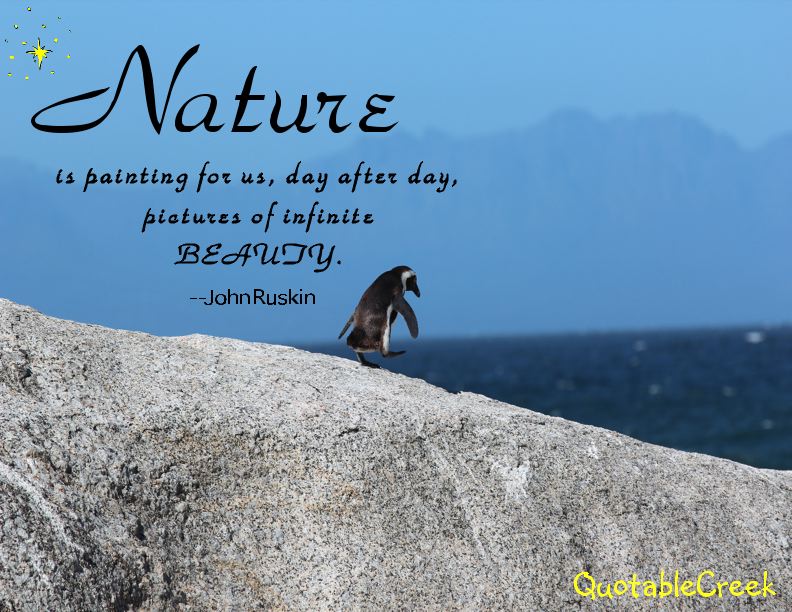
Once there was a man who found a penguin covered in oil, suffering, unable to move, on a Brazilian beach. He took mercy on the penguin, fed it sardines, cleaned it, and nursed it back to health. And, after 11 months, the little penguin returned to the sea.

But the following year, that penguin, Dindim, came back to the 71 year-old retired brick-layer who had saved him. And Dindim keeps coming back, traveling over eight thousand miles, to visit Mr. De Souza every year since 2011. When Dindim sees Mr. De Souza he wags his little tail and barks like a dog, settling into Mr. De Souza’s lap for cuddles and sardines. Dindim won’t let any other animals near his man.

Every year, while others of his kind are nesting, Dindim returns to Mr. De Souza who thinks of the little penguin as his child.

Every year for six years now.

What kind of miracle is this? An abiding love between a man and a penguin.  A wild animal filled with love and gratitude. Nature more complex and rich and full of mystery than we ever could have imagined.

Beautiful.

Spread light.

lightbulb

Have you ever heard of Sybil Ludington?

How about Paul Revere?

In 1777, 16 year-old Sybil rode 40 miles (twice the distance of Revere’s ride) through the raining night to warn the Colonial militia of the advancing British army. She was thanked personally by George Washington for her service and bravery and yet few now know her name.

What’s most important in a war, of course, is who wins, and battlefields are littered with fallen soldiers, some remembered, most forgotten. Behind the scenes are countless more. Some heroic, some cowardly. Some remembered, most forgotten.

Fame is ephemeral. It doesn’t attach itself only to heroes or the deserving. If you chase it, you may well find yourself doing the wrong things for the wrong reasons. And, even then, if you do the things that you think will make you famous, fame could well elude you.

Character, on the other hand, is everything. Doing the right thing regardless of whether you will be remembered for it or get credit always wins. Again, your actions may go unnoticed or unappreciated, but that doesn’t change the inquiry. Doing the right thing is its own reward.

What is the right thing in these morally ambiguous and complicated times? Faith, hope, and love remain. And the greatest is love.

Do the loving thing. Spread light, not darkness. Work for peace, not division. Let your words and actions be gentle and true.

Love each other.
Hug your goldfish.

animals

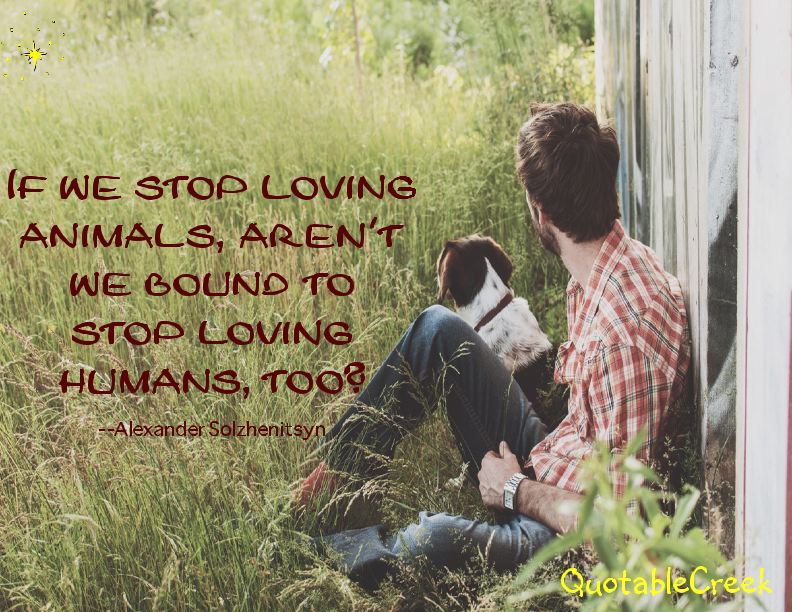
Have you ever loved an animal? When you looked in her eyes you knew that she loved you right back and that she somehow understood you down to your core… and loved you anyway. There is something humbling about that insight–to realize that it isn’t just about humans, that animals are creatures with souls, too. And there is something awe-inspiring about realizing that animals can love. It makes the world a bigger more interesting place.

Love is what it’s all about. Check out this photo montage of babies with their doting animal friends to remind yourself that this world is a loving, hopeful, delightful place.

Say ahhh.

Ahkindness

What if kindness were contagious? Spreading from person to person like the most virulent flu? How might that transform a community or, even, the world?

In this classroom, kindergarteners are spreading kindness all around:

Some people might say that kindness isn’t a characteristic as common to American society as it once was.

Nevertheless, it’s standard procedure for a group of young students in one little corner of Texas County, as Plato Elementary School kindergarten teacher Amy Hathaway leads her class in an ongoing project called the “Kindness Konnection.”

Execution of the idea is three-fold: Kids mail cheerful letters to people all over the U.S., take walks to visit elderly “friends” around the Plato community and pick up trash during their outings. The first two aspects allow the students an unusual opportunity to make peoples’ days better.

“We have heard from many people who said they were having a bad day and got a letter,” Hathaway said. “They ask, ‘why me?’ I say we just do it to be nice.”

These five-year olds are spreading ripples of kindness that are reaching out across the country and making other people’s lives better. Those ripples are causing other people to send out ripples and so on and so on and so on. Their teacher marvels at the results of her little kindness experiment:

“I don’t know how not to any more,” she said. “It’s one of the most fantastic things I’ve ever done in my life. Instead of just teaching the kids to be nice, we’ve learned what friendship really is.

“We can all make a difference in this world; even a small child has the power to influence others. Kids are the greatest thing in the world, and I love sharing them with people.”

We can all send out ripples of kindness into our world. Those ripples may well create a tsunami of kindness.

Do your bit.

handsbutterfly

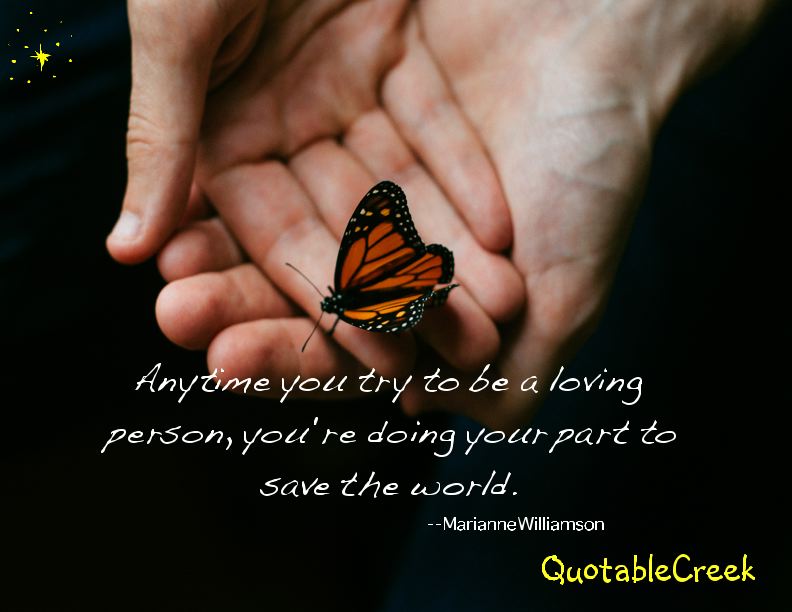
So much to do. Where to start? It is easy to get overwhelmed with the world’s problems and think there is nothing you can do to solve them. And that may well be true— if you had to work alone. But problems tend to be solved by many people, each doing their own little bit. Small actions multiplied by large numbers of people yield results.

And what about the smaller problems? Can you solve them? The answer is that you are far more powerful than you realize, and that by putting your love out there into the world you are making a difference. Maybe in profound ways.

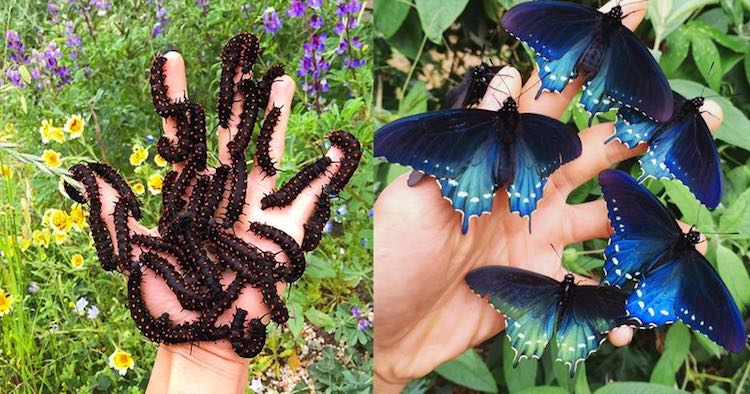
For one guy, his little difference, his bit, saved an entire species:

When [Tim Wong]  first learned of the predicament of the pipevine swallowtail, the 28-year-old swooped in to help by creating a screened backyard enclosure with ideal environmental conditions for the insect.

He filled it with specific plants that the insects like to feed on. Then, he gathered a group of 20 different pipevine swallowtail caterpillars from nearby areas. As he carefully nursed the small tribe of precious insects, their numbers began to quickly multiply.

Now years later, the DIY butterfly breeder brings dozens of caterpillars to the San Francisco Botanical Garden’s “California Native” exhibit every week—and thanks to Wong’s efforts, the pipevine swallowtail has been successfully repopulated in the city for the first time in decades.

Imagine that.

Pipevine-Swallotail-Butterflies-Tim-Wong

What is your little bit? What are the ways you can put love out there in the world?

Don’t for a minute think it doesn’t make a difference.

Welcome home.

ache

Something there is in each of us that yearns for home.  Sometimes we confuse that yearning with a physical place. We travel back to that place and wonder why it feels different. What has changed? Why doesn’t it still feel like home? Sometimes we confuse that yearning with a particular time, a past perhaps that wasn’t complicated with today’s troubles, and lose ourselves in nostalgia. Sometimes we confuse that yearning with a particular person and, if we lose that person, wonder if we will ever feel at home again.

But what if home is not a particular place in time but a feeling we can take steps to cultivate?

What is it, really, that ache for home? Perhaps it is a longing for a time and place when you felt welcome and that someone cared if you were there and was happy to see you. A longing for community, for fitting in. Life is difficult and we are all vulnerable, but that feeling of home makes the burden lighter somehow. Someone cares.

And, while we can’t travel backwards to any particular place or time when we felt at home, we can take steps right now today and every day from now on to be welcoming to others. The people shouting ‘Norm’ felt just as much a part of the community as Norm did when he walked into the bar in the old sitcom Cheers. 

To welcome others and to be welcomed both feel like home. There is as much community in reaching out to others as there is in someone reaching out to you. So consider who may be feeling adrift, in need of a community or a welcoming hand. And then reach out because, when your hands meet, you will both feel a bit more comfortable in this wild unpredictable and often inhospitable world.

Welcome home!

Listen.

listenduty

When was the last time you felt heard?

Listening, truly listening–without an agenda, without interrupting, without offering solutions or fixes, without criticism or judgment–is a rare thing. But it is vital to relationships. And it is a gift to be in a position to listen. Someone is trusting you with their story, their feelings, their hurts and hopes. That is precious. How can we best listen to each other?

In this thoughtful article, Martha Caldwell offers advise for listening compassionately in the classroom that really applies well to any situation. As a compassionate environment transforms a classroom, it too transforms any relationship. Consider her suggestions:

1. Be fully present. We bear witness to someone’s felt experience by giving them our complete and undivided attention. Paying full attention when someone is speaking creates safety and focus in the classroom. Compassionate listeners maintain complete silence and pay attention not only to words they hear, but also to facial expressions, body language, and tone of voice, noticing even the silences between words.

2. Know listening is enough. Listening with deep attention involves a calm, relaxed state of mind, free of the desire to “fix” someone or solve their problems for them. It does not involve giving advice or intervening in any way. If our minds are busy coming up with solutions for the speaker, we fail to truly listen.

3. Respond with acceptance. Deep listeners are motivated by the desire to understand how others feel and how their experiences have affected them. Their genuine interest and heartfelt concern make it safe for others to share their vulnerabilities because they sense that what they say will be received without judgement.

4. Understand conflict as part of real-life learning. A learning community in which people are encouraged to be honest and express how they feel involves a degree of risk. Conflict may arise. Sometimes this happens, and working through difficult feelings may take time. However, when we stay connected and stick with the process, conflict can be a catalyst for positive change. When conflict can be resolved, relationships often become stronger.

5. Ask authentic questions to learn more. By asking open-ended questions like “What was that like for you?,” “Can you tell me more about that?,” or “What were you experiencing?,” compassionate listeners guide speakers to share more deeply. These questions are motivated by the desire to honestly learn more (as opposed to reinforcing preconceived notions). If they think they may not have understood something, listeners can repeat back what they think they heard and ask for clarification. “Did I hear that right?”

6. Be gentle with yourself. Deep listening involves compassion for yourself as well as for others. Accept yourself and your internal feeling responses without judgement. Allow yourself time to process and learn.

7. Treat the candidness of others as a gift. Honor the trust others have placed in you and keep what you hear confidential.

Today, listen deeply and be grateful that someone is trusting you with their story.

Befriend away.

eaglefriend

It’s not particularly challenging to love people who look, act, and think just like us. The more we insulate ourselves within that group, the more we think in terms of us and them, in and out. We ‘other’ people. We see only the things we think divide us and gloss over all the commonalities.

What if we were to take a different approach?

What if we were to struggle to see from a different perspective? What if we were to build on common ground that exists between all people? What if we were to delight in our differences? What if we were to reach out our hands in kindness?

What then?

Love in all you do.

vessel

Sometimes we just need to get out of the way. What if we think of ourselves as vessels to collect love and then pour it out–not just on ourselves and those close to us, but on everyone and everything? What would our days look like if every encounter with someone else was an opportunity to be loving and thoughtful? What would our world look like if we used our time and energy to love it? What would our relationships look like if we laid down all our weapons–anger, resentment, hurt, selfishness–and just took the time to love each other, as if our very lives depended on it?  They just may.