Be the crane.

protect

Where would we be without people who passionately care about others, including those beyond their immediate circle? Who will protect the vulnerable, the voiceless, and the overlooked? Who will speak out on behalf of Earth herself?

We protect the things we love. When we see a hurting world and people, maybe we need to broaden our love.

Take a minute to watch this remarkable video of a father crane protecting his young from an alligator.

What a beautiful metaphor this father crane is for us: yes there are alligators in the world; they come in lots of shapes in sizes.

But let’s hear it for the cranes.

Ever grateful.

entitlement

What do you feel entitled to? Your life, job, spouse, happiness, health, good weather? It’s remarkable how we can feel that we have earned our stations in life and are entitled to all the good things.

Until something happens to take it away.

A diagnosis, job loss, natural disaster, and then we realize we weren’t entitled to any of it after all. It was a gift, and we hadn’t been grateful.

Think of all you have been blessed with and be grateful.

Create.

artist

How do you define success?

Is it in a purely monetary way or is it more nuanced and complex?

A creative life expands the heart and sharpens the senses. It opens the creator to insight and wisdom. It constantly pushes the creator to new levels. It is a fountain of youth and immortality all in one.

Mountain or molehill?

mad

We talk so much louder with our actions than our words. How we treat other people, what rankles us, what motivates us, who our heroes are–these speak volumes about who we are regardless of what’s on our resumes.

What gets you mad?

If you step back and look reasonably objectively at it, you can get glimpses into your inner self that may appall you. Maybe ego, pride, pettiness, and self-pity are more present than you would have ever guessed, and now’s the time to change that up and set your sites on bigger foes.

What to contribute?

contribute

Consider the inspiring story of Amanda Southworth, a teen who attempted suicide seven times but then went on to use her experience to create an app to help others facing debilitating depression. Amanda explained what helped her make that transition:

What saved her: a sixth-grade robotics club in 2011, which introduced her to the possibilities of technology and inspired her to soak up knowledge about web development and artificial intelligence from the internet and textbooks.

Her first app, AnxietyHelper, a mental health resource guide, debuted in the app store in September 2015 during her ninth-grade Latin class. Her excited classmates downloaded it, and she finished the day with 18 users. Even that small achievement gave her belief in her own power and a sense of purpose, Southworth says.

“I was always very destructive toward myself. Coding is the opposite. It’s about creating. It’s about taking different characters on a keyboard and transforming them into something bigger than you,” she said.

In May 2017, she launched a mobile app called Verena for the LGBTQ community after friends were bullied in the tense political climate around the presidential election. Verena, which means protector in German, locates hospitals, shelters and police stations and users can create a list of contacts to be alerted in an emergency.

“Everything in my life has shown me that both good and bad things in this world will continue to happen and that’s out of our control. But it’s what we do with the things that happen to us that can make all of the difference,” she said in a TedX talk last November in Pasadena, California. “My name is Amanda Southworth, I’m 15 years old, a junior in high school and I’m still alive.”

Southworth’s conclusion that “it’s what we do with the things that happen to us that can make all of the difference” is profound. Each of us faces challenges and hardships. But each of us also has the ability to use our experiences to make a contribution for others, to make our lives count.

What’s your contribution?

SaveSave

SaveSave

Flex your fearless muscle.

fear

So much of success comes from stepping beyond your comfort zone, reaching out to others, trying things a new way, taking risks. Some of us were born natural risk takers, but for the rest of us, it helps to challenge yourself to try new things, speak out, push yourself. The more we do, the more we can do.

Pause.

jellyfish

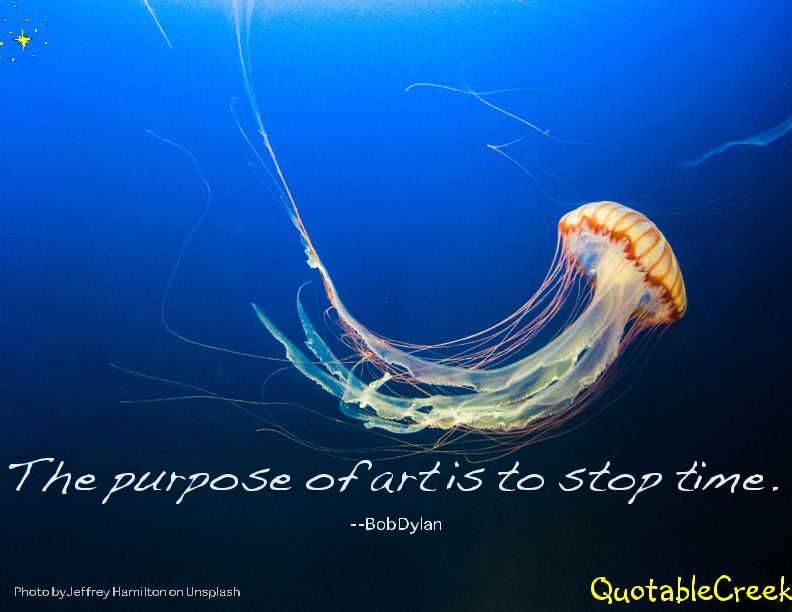
We are caught in the steady, persistent, ruthless flow of time. And yet there are moments when we can step out of time to pause, focus, and gain perspective. The arts do that. As you admire a piece of art, whether photograph, painting, novel, poem, film, dance and so on, we are grounded in detail. We can observe intricacy. We pause in the captured emotion and can rest there awhile. We are transported.

When the cares of the world become too great, we can pause and admire the detail in a jelly fish, the sweetness in bird song, or read soothing words such as these by Wendell Barry:

The Peace of Wild Things

When despair for the world grows in me

and I wake in the night at the least sound

in fear of what my life and my children’s lives may be,

I go and lie down where the wood drake

rests in his beauty on the water, and the great heron feeds.

I come into the peace of wild things

who do not tax their lives with forethought

of grief. I come into the presence of still water.

And I feel above me the day-blind stars

waiting with their light. For a time

I rest in the grace of the world, and am free.


Take a moment to pause on something beautiful.

Wipe the dust off your soul.

soulwash

It is so easy to get discouraged when living a creative life. Your words are criticized; your paintings don’t sell. “They” don’t believe you have any promise. Sometimes the struggle to be commercially successful in a creative field can be so daunting that you abandon the art. But then you remember that art isn’t about “them” or “success” or “critical acclaim” at all. It’s about bringing your truths into the light, being creative, pushing yourself, being you.

Nowhere is this better illustrated than in the case of Henri Rousseau, a forty year old toll collector who wanted to paint. His work was derided, and yet he continued. He found joy in the painting. Not until the end of his life did anyone take his work seriously. As summarized by Maria Popova:

Long before history came to celebrate him as one of the greatest artists of his era, long before he was honored by major retrospectives by such iconic institutions as the MoMA and the Tate Museum, long before Sylvia Plath began weaving homages to him into her poetry, he spent a lifetime being not merely dismissed but ridiculed. And yet Rousseau — who was born into poverty, began working alongside his plumber father as a young boy, still worked as a toll collector by the age of forty, and was entirely self-taught in painting — withstood the unending barrage of harsh criticism with which his art was met during his entire life, and continued to paint from a deep place of creative conviction, with an irrepressible impulse to make art anyway…. [Rousseau’s life is] an emboldening real-life story, and a stunningly illustrated one, of remarkable resilience and optimism in the face of public criticism, of cultivating a center so solid and a creative vision so unflinching that no outside attack can demolish it and obstruct its transmutation into greatness.

The message from Rousseau’s life speaks to all of us: he was a success all along. He persevered with a remarkable resilience to produce work that spoke to him and pursued a passion that made him happy. That, the pursuit of great art, rather than the financial success was what gave his journey depth and meaning and lifted up his soul.


Going counter-culture.

dalai

Is kindness passé? Patience out of date? Love revolutionary? In today’s world, these virtues seem counter-culture. People are quick to be mean, impatient for their own way, and blinded by hate. The loudest rant dominates over the considered opinion.

In this commencement speech, Jake Tapper urges the graduates to be kind, to shy away from meanness, the easy and lazy option:

How can we go that extra distance to show up in this world as kind and patient, to refuse to meet meanness with meanness, but instead with the loving response?

The littlest heroes

burdens

There are the larger than life heroes who accomplish monumental things, and then there are the everyday unknown heroes who may be even more inspiring if only we knew their stories. They are just like us, regular folks, without a forum or bankroll, doing their best to make the world a better place for all people.

Consider 4 year old Austin Perine. He has made it his mission to feed the homeless. (And inspired Burger King to offer him $1000 to do it!) He does it because ‘It’s just the right thing to do.”

His motto is simple: Show Love.


That’s a mission we can all get behind: Show Love.