Sorry. Not sorry?

goodapology

Some apologies make things worse. They don’t feel like apologies at all. They feel, instead, like just more hurt. Other apologies acknowledge the wound and help it heal. What makes the difference?

In When Sorry Isn’t Enough: Making Things Right with Those You Love, Gary Chapman (of Five Love Languages fame) and Jennifer Thomas suggest that a true apology must have six characteristics:

Expressing regret–It’s important for an apology to be for something you did or said.  The more specific, the more it acknowledges the harm caused, the better. “I’m sorry you’re so sensitive,” doesn’t really feel like an apology because it is just restating some perceived flaw in the victim and isn’t focussing on anything you did wrong. Even if the harm was wholly unintended, when your actions cause another person pain, an apology is warranted. It goes to the very essence of the apology: I did not mean to hurt you.

Accepting responsibility— Yes, the pressures of the world can sometimes lead us to get wound up and stressed and to hurt other people, but that does not make it the world’s fault. We control ourselves. We are responsible if we act badly. Blaming the boss, the dog, the economy, the other drivers is deflecting. Apologies for the state of the world or all its ills will not feel like a real apology to the person you lashed out at. Apologizing for losing your temper or not considering the effects of your actions will.

Making restitution–“How can I make it right?” are powerful words. It shows an acknowledgement that what you did caused someone else harm. Maybe you can’t make it right. Maybe you can never make it right. But listening to the victim explain the damage is a powerful step forward in the process. Listening here is key–no justifying your actions, no quarreling with the facts, no defenses, just listening to the other person share their perspective. If there is something you can do to make things better, do that thing.

Genuinely repenting–If you are truly sorry, and have listened deeply to the pain you’ve caused, you will not want to cause that person pain again. You will stop causing the damage. You will want to change. Maybe you will need to write down the steps you want to take to prevent causing further harm. Maybe you will slip up and need to start again. But the most important thing is that you will try to not do this again. Otherwise, are you really sorry?

Requesting Forgiveness–“Can you forgive me?” are powerful words. They show you care about the relationship. They show you understand you did things wrong. They show you are not in control of the relationship.

Everyone messes up. Not everyone takes responsibility for messing up. When we do take responsibility for the harm we’ve caused, it may strengthen our relationships and help them grow stronger. Trust can reenter, fostering healing.

Randy Pausch, the author of the quote above, gave a powerful Last Lecture before he died young of pancreatic cancer. His timeless words can teach us all a lesson about life and living.

Are you lonely?

loneliness

Are you lonely? Does your heart long to be heard and understood? For someone to get you? And for you to really hear someone in return? Are you yearning to share your heart’s stories with someone else?

Loneliness has nothing to do, really, with being alone. In fact, the worst way to be lonely might be when you are with someone else but not feeling connected.

Is there a way to ease our heart’s loneliness?

One possibility is to open yourself up. Share your true thoughts and feelings, not the masks you wear in the world, but your true self. And then be a safe place for someone else to be naked emotionally with you. Scary, yes. But what good is it if you’re not being yourself in your own relationships?

To speak to that loneliness in all of us, take a moment to savor this beautiful poem by Mary Oliver and listen for the world calling you into your place in the family of things.

Wild Geese

by Mary Oliver

You do not have to be good.
You do not have to walk on your knees
For a hundred miles through the desert, repenting.
You only have to let the soft animal of your body
love what it loves.
Tell me about despair, yours, and I will tell you mine.
Meanwhile the world goes on.
Meanwhile the sun and the clear pebbles of the rain
are moving across the landscapes,
over the prairies and the deep trees,
the mountains and the rivers.
Meanwhile the wild geese, high in the clean blue air,
are heading home again.
Whoever you are, no matter how lonely,
the world offers itself to your imagination,
calls to you like the wild geese, harsh and exciting —
over and over announcing your place
in the family of things.

Get dirty.


futuregardenThe daffodils are coming. Planted last fall–before the snow, before the holidays, before the divisive American election– they are starting to poke up. Soon they will be blooming everywhere adding cheer to the lives of whomever might see them.

A garden is a microcosm of life. Seasons of vibrance and beauty fall away into a frozen landscape seemingly devoid of color. But then, maybe when you’ve almost forgotten, there is blossoming and rebirth.

Gardeners and children know something that many of us have forgotten: there is joy in the dirt.

Literally.

It turns out, “Prozac may not be the only way to get rid of your serious blues. Soil microbes have been found to have similar effects on the brain and are without side effects and chemical dependency potential.”

Studies show the benefits gardeners and children will swear by of playing in the dirt are actually based on science.

It’s true. Mycobacterium vaccae is the substance under study and has indeed been found to mirror the effect on neurons that drugs like Prozac provide. The bacterium is found in soil and may stimulate serotonin production, which makes you relaxed and happier. Studies were conducted on cancer patients and they reported a better quality of life and less stress. Lack of serotonin has been linked to depression, anxiety, obsessive compulsive disorder and bipolar problems. The bacterium appears to be a natural antidepressant in soil and has no adverse health effects. These antidepressant microbes in soil may be as easy to use as just playing in the dirt.

So go ahead. Get dirty.

Consider the birds.

silence

Consider the birds. They have so much to teach us. They sing; they fly; they soar. When the storm is over, they come out and sing, fly, and soar again. They vary dramatically from the tiny hummingbird to the great bald eagle, but they have so much in common. And, when we are quiet, they remind us to look up, to look to the future and the possibility that lies there. It turns out considering the birds is good for our well-being, keeping depression at bay.

Be still and notice the birds. Do you see the vulture with its huge wings soaring above you? Do you hear the hawk shriek?  Do you see the crows tuck in their wings and dive to open them again and rise only after you gasp, worried?

Watch them bathe in a puddle, delighting in the way the water splashes around them. Listen to them sing.

They sing for you.

Read.

read1

Nowhere can you experience life from someone else’s point of view better than in a book. You can feel what it is like to be another gender, race, lifeform. Time is no limitation–you might experience life now, in the past, in the future. Opening those pages allows you to step inside someone else’s shoes. And that can’t help but change you, stretch your empathy, and expand your experience.

What would it be like if you could talk over things with those characters? Ask them about life in their shoes?

In a very cool project, doing exactly that, library patrons have the chance to check out a human book. Hopefully the human book they check out will be someone with a different life experience and perspective.

So check out a book, or maybe talk with someone as unlike from you as you can find. You’ll be surprised at all the things you have in common.


Thank you.

exquisite

How do we thank someone for the big things? The REALLY big things? Like saving your life? Or seeing promise in you when no one else did? Or for lifting you up when you had nothing left to offer?

Whatever the big thing is that makes your breath catch in your throat and your eyes well up with tears when you think about what your life would be like without that person in it?

Thank yous like that call for something bigger than a note or flowers. They call for your whole self. A thank you from your heart in whatever way most clearly can show the enormity of your gratitude.

In these two heartwarming videos, a man thanks his dog for being his beloved companion, and a mother dog thanks the woman who rescued her pregnant self. These over-the-top gestures cross language and even species barriers.

Thank you!

Welcome home.

ache

Something there is in each of us that yearns for home.  Sometimes we confuse that yearning with a physical place. We travel back to that place and wonder why it feels different. What has changed? Why doesn’t it still feel like home? Sometimes we confuse that yearning with a particular time, a past perhaps that wasn’t complicated with today’s troubles, and lose ourselves in nostalgia. Sometimes we confuse that yearning with a particular person and, if we lose that person, wonder if we will ever feel at home again.

But what if home is not a particular place in time but a feeling we can take steps to cultivate?

What is it, really, that ache for home? Perhaps it is a longing for a time and place when you felt welcome and that someone cared if you were there and was happy to see you. A longing for community, for fitting in. Life is difficult and we are all vulnerable, but that feeling of home makes the burden lighter somehow. Someone cares.

And, while we can’t travel backwards to any particular place or time when we felt at home, we can take steps right now today and every day from now on to be welcoming to others. The people shouting ‘Norm’ felt just as much a part of the community as Norm did when he walked into the bar in the old sitcom Cheers. 

To welcome others and to be welcomed both feel like home. There is as much community in reaching out to others as there is in someone reaching out to you. So consider who may be feeling adrift, in need of a community or a welcoming hand. And then reach out because, when your hands meet, you will both feel a bit more comfortable in this wild unpredictable and often inhospitable world.

Welcome home!

Take a nature bath.

deepnature

When was the last time you hiked? Or paused to admire the intricacy of a flower? Or listened to birds sing? Or felt the breeze tousle your hair?

When times are tough, the tough immerse themselves in nature. It soothes us, comforts us, leads us back to our bearings. While many benefits of nature are unsurprising–relaxation, bliss, awe–some are downright startling. Studies show spending time in nature makes us more altruistic and helps us be more social creatures.

Now, a large body of research is documenting the positive impacts of nature on human flourishing—our social, psychological, and emotional life. Over 100 studies have shown that being in nature, living near nature, or even viewing nature in paintings and videos can have positive impacts on our brains, bodies, feelings, thought processes, and social interactions. In particular, viewing nature seems to be inherently rewarding, producing a cascade of position emotions and calming our nervous systems. These in turn help us to cultivate greater openness, creativity, connection, generosity, and resilience.

Take time today to dip your toe in nature. It’s good for whatever ails you.

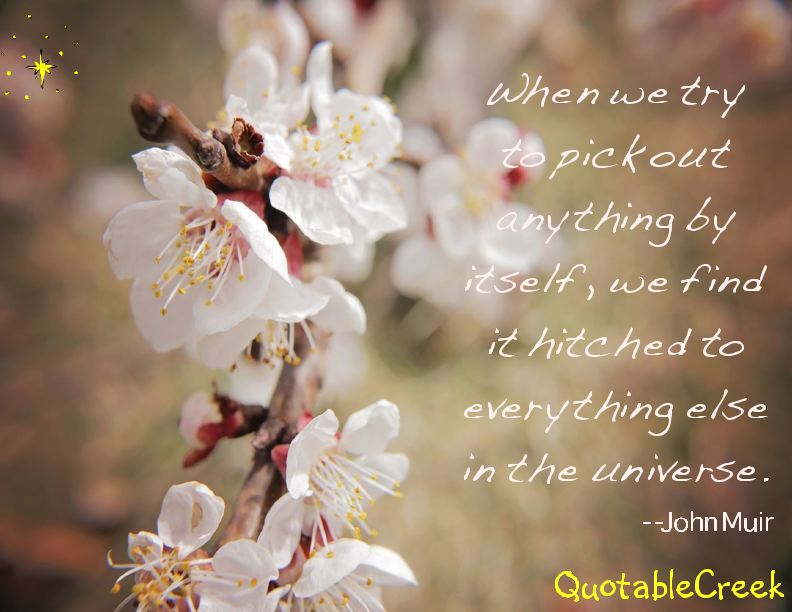
We’re hitched.

hitched

Where do you stop?

Is it at your skin, that organ holding all your pieces all together? If it’s there, at your skin, how do your words fly out into the air and touch, maybe even wound, someone else? Does your you stop when your physical self passes away? If so, how do memories of you inspire your grandchildren to smile long after your death?

When did you start? Was is at your birth? If so, how do you carry the genetic material of all your ancestors that have come before? How are you influenced by events that occurred long before you were born?

Is your you sufficient and complete in itself? Or does your you depend on many others, both human and not human? The plants and trees for oxygen? Other people for companionship? The air, the moon, the stars, the sun, plants, animals, gravity……a giant web of life, really?

It is hard to isolate our actions. Instead they ripple out into the world around us, resulting in things sometimes seen but more often unseen.  In this delightful video, we see an orangutan preschool, a learning community. But, at the heart of the delight in these darling animals is a cold truth: they were orphaned, probably by people that walked and talked like we do. Instead of spending the first seven or eight years of life with their mothers, they are spending it with people trying to teach them how to be orangutans.

When we put out our ripples into this world, let our words be gentle and kind and our touch soft. Let us keep in mind that we are not separate from each other and nature, but that we all share this place we call home. We are all hitched.

Listen.

listenduty

When was the last time you felt heard?

Listening, truly listening–without an agenda, without interrupting, without offering solutions or fixes, without criticism or judgment–is a rare thing. But it is vital to relationships. And it is a gift to be in a position to listen. Someone is trusting you with their story, their feelings, their hurts and hopes. That is precious. How can we best listen to each other?

In this thoughtful article, Martha Caldwell offers advise for listening compassionately in the classroom that really applies well to any situation. As a compassionate environment transforms a classroom, it too transforms any relationship. Consider her suggestions:

1. Be fully present. We bear witness to someone’s felt experience by giving them our complete and undivided attention. Paying full attention when someone is speaking creates safety and focus in the classroom. Compassionate listeners maintain complete silence and pay attention not only to words they hear, but also to facial expressions, body language, and tone of voice, noticing even the silences between words.

2. Know listening is enough. Listening with deep attention involves a calm, relaxed state of mind, free of the desire to “fix” someone or solve their problems for them. It does not involve giving advice or intervening in any way. If our minds are busy coming up with solutions for the speaker, we fail to truly listen.

3. Respond with acceptance. Deep listeners are motivated by the desire to understand how others feel and how their experiences have affected them. Their genuine interest and heartfelt concern make it safe for others to share their vulnerabilities because they sense that what they say will be received without judgement.

4. Understand conflict as part of real-life learning. A learning community in which people are encouraged to be honest and express how they feel involves a degree of risk. Conflict may arise. Sometimes this happens, and working through difficult feelings may take time. However, when we stay connected and stick with the process, conflict can be a catalyst for positive change. When conflict can be resolved, relationships often become stronger.

5. Ask authentic questions to learn more. By asking open-ended questions like “What was that like for you?,” “Can you tell me more about that?,” or “What were you experiencing?,” compassionate listeners guide speakers to share more deeply. These questions are motivated by the desire to honestly learn more (as opposed to reinforcing preconceived notions). If they think they may not have understood something, listeners can repeat back what they think they heard and ask for clarification. “Did I hear that right?”

6. Be gentle with yourself. Deep listening involves compassion for yourself as well as for others. Accept yourself and your internal feeling responses without judgement. Allow yourself time to process and learn.

7. Treat the candidness of others as a gift. Honor the trust others have placed in you and keep what you hear confidential.

Today, listen deeply and be grateful that someone is trusting you with their story.