Do what you love

vonnegut


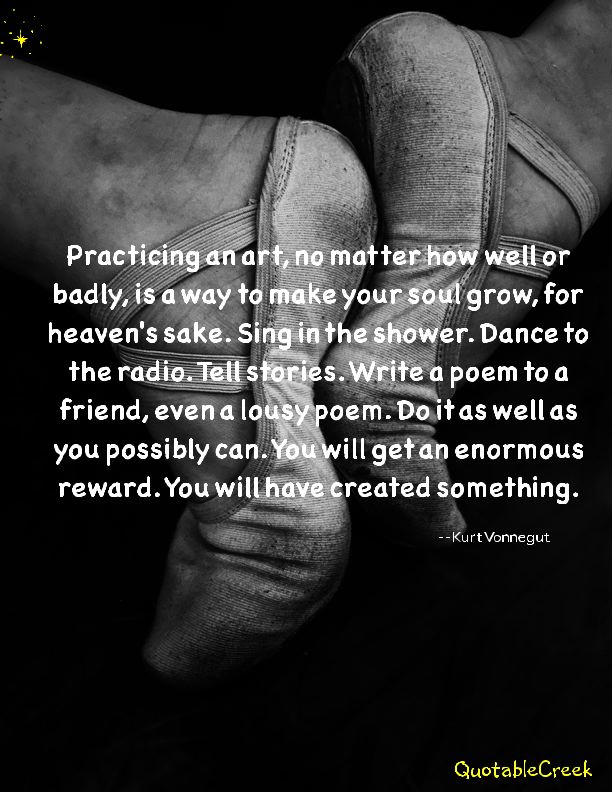
Do you ever feel pulled down by the people who tell you that you can’t do something? You should mouth the words when people are singing because you can’t carry a tune. You shouldn’t dance because your moves are awkward. Don’t write unless you are going to be a best-selling novelist. Don’t take up something in your middle years that you’ve always wanted to do because you might look silly. Don’t, can’t, shouldn’t–those kind of words.

Maybe it is you telling yourself those things, afraid to start something and be a beginner after you’ve spent decades learning how to do other stuff and have gotten quite good, an expert even maybe. We encourage children to try new things–to paint, to skate, to sing, to play. But something happens when we get older. We may even hear ourselves holding someone back, “Are you still doing that? If you’re not [insert adjective here–famous, discovered, wealthy, accomplished] by now, you’re never going to be. You should give up.”

Wouldn’t it be nice to lay down all that judgment and dance again? Or sing your heart out? Or write a love poem? The joy is in the doing, and how lovely it is to remember that and embrace whatever it is that makes your soul sing!

What’s chasing you?

runninginside

We can gussy ourselves up on the outside. Or maybe change jobs or move. Or start over in our relationships. And yet something still eats at us. We have the same insecurities even when we reach our dream weight or buy a stunning outfit. We encounter the same obstacles over and over again, even in different scenarios. In these situations, we need to turn our attention to the inside. We need to consider what is bothering us or holding us back and do the work that needs to be done there.

Rest and be thankful.

rest

Without the rests and pauses, music would just be noise. The pauses add shape and definition to any composition and allow the rise and fall of the melody to stand out. In order to hear the music that is our life, we need to pause. Between tasks, before we react, when others are speaking. We need to rest when we are weary, to conclude that not everything needs to be done today, now, or maybe even at all. Sometimes less is more.

And as we pause, let us give thanks. For this life, these opportunities, these people (including those who vex you), and the abundance of life all around us.

Thanks for it all.

Persist.

persist

Sometimes progress is subtle and slow, born of persistence and endurance. Not everything needs to be solved now, today. But we must persist. We must set our goals and work toward them, cognizant that we may stumble and backtrack along the way.

Yet we push on.

For a lovely example of persistence, consider the story of  Jadev Payeng, a simple man who set out to plant trees in a barren stretch of wasteland where no one believed anything would grow. That was in the 1970s. Now that barren wasteland is a forest home to rhinos, elephants, tigers and more. One man, one mission, plus persistence, and now there is a sanctuary for many wild animals bigger than New York’s Central Park.

For a short video of Payeng story, go here. For a deeper dive, watch National Geographic’s look at this remarkable story.

SaveSaveSaveSave

Consider the potential.

acorn

The potential for a loving relationship is in one embrace. The potential for peace is in forgiveness. The potential for harmony is in stillness. The potential for quality conversation is in listening.

Consider the opportunities you have to make your world and the world a better kinder place with the actions you sow today.

Walk in the direction of your values.

walking

It takes courage to be authentic. It is so easy to stay disconnected from our emotions, afraid to listen to the messages they give us, to put on a happy face, constantly, to be afraid to buck the crowd or disturb the status quo. But the things that upset us are clues, really, to what needs fixing. They are data points that we can take in and consider what needs help–in ourselves, in our relationships, in the world. And tuning in to the full breadth of our emotions juxtaposed against our values can help us discover how we can make contributions in our society–to unmask wrongdoing, to stand up on behalf of the vulnerable, even to advocate on behalf of those society is only too willing to throw away. Authenticity helps us find our voices and the courage even when we are afraid to put on our work boots and start walking in the direction of positive social change.

I know you are, but what am I?

wounding

Angry words. Personal attacks. It seems too common these days for someone to try to win an argument by cutting their opponent down at the knees rather than, for example, by having a good argument. But the personal attacks are just keeping everyone wounded and hurting. No progress is made. Real issues go unaddressed. Everyone suffers.

What if, instead, we try to respond to people without tensing up and bracing for impact, without turning to an angry smear, without trying to wound?

What if, even better, we look for ways to lift each other up?

Do not be afraid to question.

question

What questions do we frame for ourselves at the end of the day? What are the questions that have caused us to soul-search and perhaps take a new path? What questions have forced you to look at something a different way?

Sometimes the questions are more important than the answers. There are some that resonate so deeply with us, we may spend a lifetime trying to answer them. In her piece about the beauty of these profound questions, Karen Horneffer-Ginter identifies some that have been meaningful to her:

When used properly, questions have the potential to connect us to the world of another. A heartfelt “How are you?” or “How was your day?” can become the bridge that keeps us in relationship to the lives of those we love. Sometimes, too, questions create a bridge within ourselves, allowing us to hear what’s going on at a deeper level. We know when we’ve encountered a question that has this potential because it stays with us — maybe for the day, maybe for our whole lives. It taps us on the shoulder to wake us up, or it wiggles its way in more deeply, opening us up to seeing things in a new way.

I still recall first encountering Judith Duerk’s chorus of questions about how my life might have been different if there had been a sacred circle to step into. Mary Oliver asking me about my plans for this one wild and precious life, Oriah Mountain Dreamer wanting to know what I ache for and if I dare to dream of meeting my heart’s longing, and Angeles Arrien reminding me of the questions asked in some indigenous cultures: When did you stop singing? When did you stop dancing? I think of my friend Ming,asking me at lunch one day if I thought writing was my fullest and truest expression. All these questions have remained close companions across the years.

And just the framing of the question can be significant, as she suggests. Consider the difference between ‘What do I have to do today?’ and ‘What do I get to do today?’ That simple shift helps us move from feeling burdened to being grateful for all the opportunities presented by the day.

What are the questions that have been your close companions? What do you get to do today to help answer them?

What seems impossible?

impossible

What seems impossible to you right now?

So much seems out of reach. So many problems have yet to be solved. So many people do not get along. And yet, when we step back and take a long view, so many seemingly impossible things have been accomplished in just a lifetime–anti-biotics, flight, space travel, computers, internet. And though social justice clearly does not move in a straight line, we have seen significant advances in human rights that our great-grandparents may have been unable to predict or even hope for.

So what to make of this? It’s important to keep fighting the good fight even when the odds seem insurmountable. Keep striving for peace, for social justice, for a more equitable world. We may not see the dramatic change now, but when someone looks back at our time here on Earth, they will see we didn’t stop pushing forward and, with that long view, there was continued progress ever forward.

At what price?

priceofanything

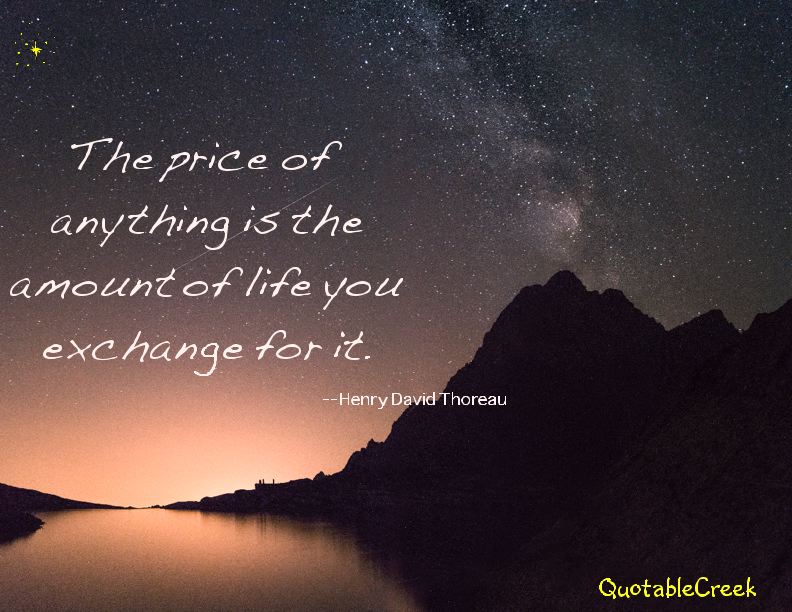
You can’t do everything. You can’t have everything. You must choose.

This is particularly true of how we spend our time. We have a set amount of time, no more. When we decide what we do with our time, we necessarily decide what we don’t do with our time.

Choose wisely. Time, once spent, is lost.