Your love canvas.

artistic

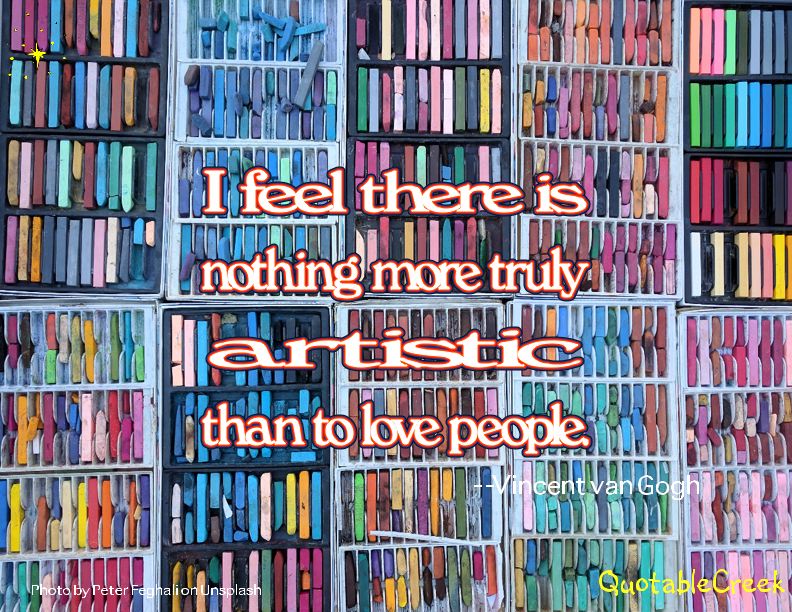
The artist creates something from nothing.  Being artistic requires a commitment to keep working, to keep seeing with fresh eyes, to keep trying. Each individual creation may or may not be beautiful, but the artist keeps creating, for it is how they express their love.

Love creates something from nothing. Where once there were strangers, now people are joined by an invisible bond that has substance if not weight. Maintaining that love requires constant effort. Like the artist, the lovers keep creating, keep striving for something more perfect, keep expressing their love.

Both art and love are expressed in the doing.

Be an encourager.

encourager

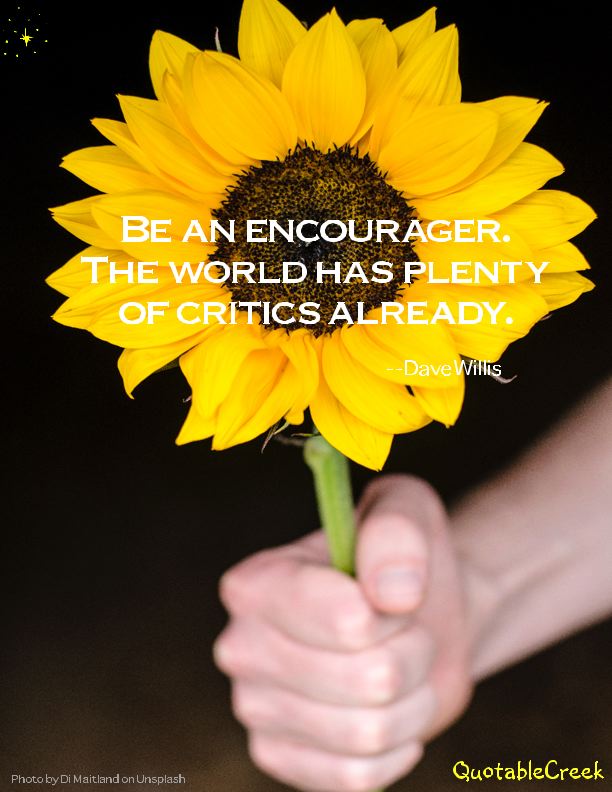
It’s remarkable to realize how much power is in a put-down, how those words stay with us and make us small and afraid, hesitant to speak or step out, content to be less than. But, too, there is much power in a compliment, in noticing someone’s strengths and kindness, in pointing out someone’s promise and achievement. We wield this power every day, with our children, co-workers, family, friends. What are we choosing to do with our words?

In this remarkable video, Lisa Nichols tells of the impact her teacher’s negative words had on her a child, but don’t worry her “story didn’t end there”!


Lisa Nichols is remarkable. She realized that other people’s perceptions of her shouldn’t hold her back, but not everyone is so resilient. We must be careful with our words, to encourage rather than criticize, so that the world can be a brighter place all around!

Happiness around the world.

happy

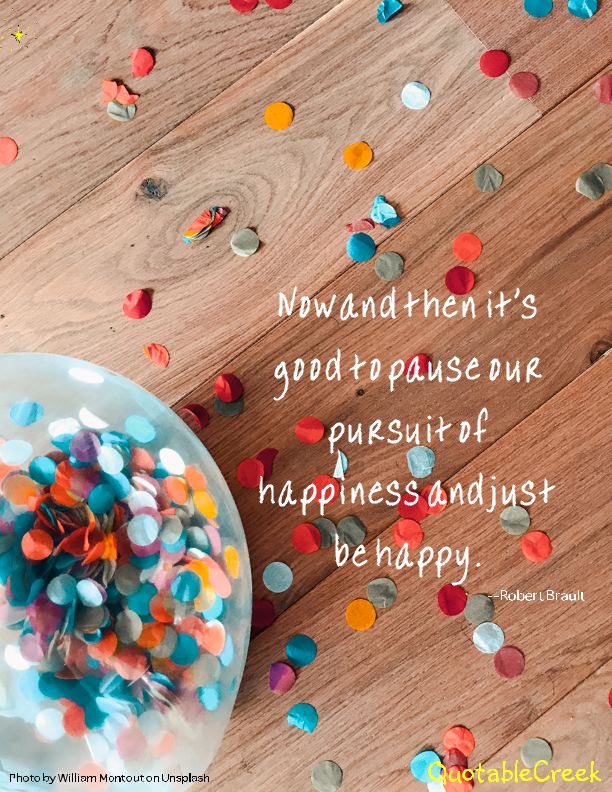
Don’t worry. Be happy. There is so much good still left in the world to be grateful for. For a delightful around-the-world look at the secrets to what makes people happy, check out this wonderful compilation put together by Hometogo.com.

5a37cca17424e.png


From listening to birds sing in the morning to a shared meal and conversation with friends, these secrets to happiness are shared the world over.

What makes you happy?

Facing fear.

thatthing

Standing up to fear changes a person. It helps you to put matters in perspective. Where once fear loomed over you, insurmountable, now you can honor the courage it took to move past it into unfamiliar territory.

Eleanor Roosevelt was a courageous woman. Despite her husband’s attempts to placate the South, she regularly bucked segregation and was a vocal proponent of civil rights. She was able to call out racism and force others to see it for what it was:

By 1939, ER decided to attack the hypocritical way in which the nation dealt with racial injustice. She wanted her fellow citizens to understand how their guilt in “writing and speaking about democracy and the American way without consideration of the imperfections within our system with regard to its treatment . . . of the Negro” encouraged racism. Americans, she told Ralph Bunche in an interview for Gunnar Myrdal’s American Dilemma, wanted to talk “only about the good features of American life and to hide our problems like skeletons in the closet.” Such withdrawal only fueled violent responses; Americans must therefore recognize “the real intensity of feeling” and “the amount of intimidation and terrorization” racism promotes and act against such “ridiculous” behavior.

You can’t clearly see a problem before you if you are too scared to look at it and call it out for what it is.

Let the adventure begin.

adventure

How much of your life is planned and scripted? How much has become routine or ordinary? What if today you venture out into new terrain, take unexpected chances, engage with different people?

What if today is an adventure? You never know what unexpected surprises and delights you’ll discover!

What is your gift to give?

giving

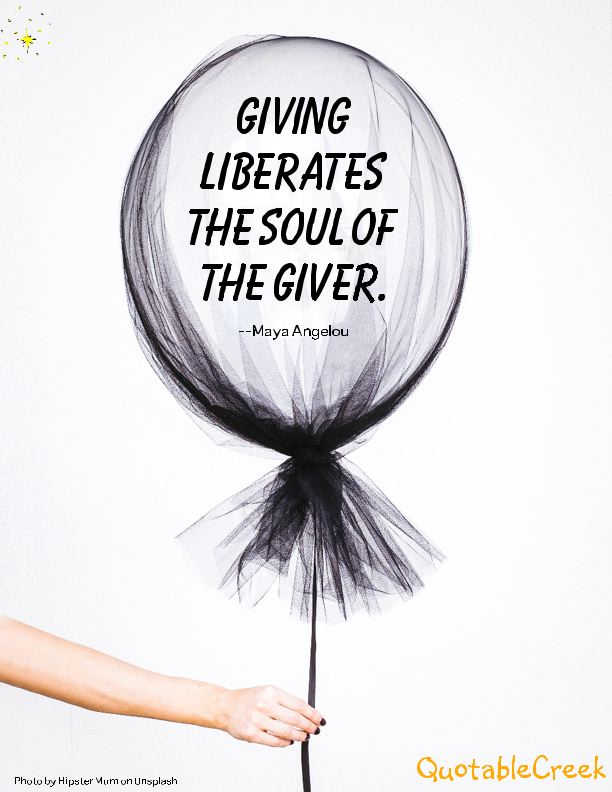
Sure, living generously blesses those who receive your gift. But giving also blesses you as it reminds you that you can make a difference, that you have purpose, and that no one is as equipped to meet the particular challenge in front of you in this place and time, as you.

How you living?

tiptoe

We each were born, and each will die. But in between is where we write the story of our lives. What will we have lived for? What do we care enough to die for? When will we risk, speak out, shine, dare, love, hate? What are the moments of our lives that will define why we are here and why we matter? Where is our passion?

We each write the story of our own lives. Let yours be a page-turner.

As we craft our lives, we can do well to listen to these words about a third-grade drop out:

How you living?

Pause.

awhile

The world these days moves at a breakneck speed. Twitter and social media speed it up even further.

We are tempted to respond to everything and everyone immediately with whatever thought first passes through our minds. But is that always our best thought? Once said, can it be retrieved?

Often, it is far better to pause, to breathe, to contemplate before deciding whether what we have to say can meaningfully add to the conversation or will just contribute to the din.

Embrace the now.

lorde

Life is short. Seize it. Spend it. Enjoy it.

And find time to share little moments together with the people who are on this journey with you. For inspiration, watch this delightful video of a dad beatboxing with his very appreciative baby:


Life’s a schoolroom.

schoolroomJust when we think we get what life is all about, something comes along to knock us upside the head and show us we have it wrong. It forces us to reevaluate our foundational assumptions about the purpose of life and look at things in a whole new way. It’s a paradigm shift.

Stephen Covey tells of a paradigm shift he experienced:

“I remember a mini-Paradigm Shift I experienced one Sunday morning on a subway in New York. People were sitting quietly — some reading newspapers, some lost in thought, some resting with their eyes closed. It was a calm, peaceful scene. Then suddenly, a man and his children entered the subway car. The children were so loud and rambunctious that instantly the whole climate changed.

“The man sat down next to me and closed his eyes, apparently oblivious to the situation. The children were yelling back and forth, throwing things, even grabbing people’s papers. It was very disturbing. And yet, the man sitting next to me did nothing.

“It was difficult not to feel irritated. I could not believe that he could be so insensitive to let his children run wild like that and do nothing about it, taking no responsibility at all. It was easy to see that everyone else on the subway felt irritated, too. So finally, with what I felt was unusual patience and restraint, I turned to him and said, “Sir, your children are really disturbing a lot of people. I wonder if you couldn’t control them a little more?”

“The man lifted his gaze as if to come to a consciousness of the situation for the first time and said softly, ‘Oh, you’re right. I guess I should do something about it. We just came from the hospital where their mother died about an hour ago. I don’t know what to think, and I guess they don’t know how to handle it either.’

“Can you imagine what I felt at that moment? My paradigm shifted. Suddenly I saw things differently, I felt differently, I behaved differently. My irritation vanished. I didn’t have to worry about controlling my attitude or my behavior; my heart was filled with the man’s pain. Feelings of sympathy and compassion flowed freely. “Your wife just died? Oh, I’m so sorry. Can you tell me about it? What can I do to help?” Everything changed in an instant.

“Many people experience a similar fundamental shift in thinking when they face a life-threatening crisis and suddenly see their priorities in a different light, or when they suddenly step into a new role, such as that of husband or wife, parent or grandparent, manager or leader.

“It becomes obvious that if we want to make relatively minor changes in our lives, we can perhaps appropriately focus on our attitudes and behaviors. But if we want to make significant, quantum change, we need to work on our basic paradigms.

“In the words of Thoreau, ‘For every thousand hacking at the leaves of evil, there is one striking at the root.’ We can only achieve quantum improvements in our lives as we quit hacking at the leaves of attitude and behavior and get to work on the root, the paradigms from which our attitudes and behaviors flow.”

(from Stephen Covey’s book, The Seven Habits of Highly Effective People)

Or consider the paradigm shift that Ebenezer Scrooge’s partner, now a ghost, Jacob Marley, recounts to him before the visit of the three Christmas ghosts in Christmas Carol. Both Scrooge and Marley thought they had life figured out–it was all about business and making money, the more the better. But Marley has had a paradigm shift since dying:

“‘But you were always a good man of business, Jacob,’ faltered Scrooge, who now began to apply this to himself.

“‘Business!’ cried the Ghost, wringing its hands again. ‘Mankind was my business; charity, mercy, forbearance, and benevolence, were, all, my business. The deals of my trade were but a drop of water in the comprehensive ocean of my business.’ “

Get ready to get hit upside the head, metaphorically speaking. It may be time for a paradigm shift.