What is it you plan to do with your one wild and precious life?

wild-and-precious

In her poem, The Summer Day, Mary Oliver writes:

The Summer Day

Who made the world?
Who made the swan, and the black bear?
Who made the grasshopper?
This grasshopper, I mean-
the one who has flung herself out of the grass,
the one who is eating sugar out of my hand,
who is moving her jaws back and forth instead of up and down-
who is gazing around with her enormous and complicated eyes.
Now she lifts her pale forearms and thoroughly washes her face.
Now she snaps her wings open, and floats away.
I don't know exactly what a prayer is.
I do know how to pay attention, how to fall down
into the grass, how to kneel down in the grass,
how to be idle and blessed, how to stroll through the fields,
which is what I have been doing all day.
Tell me, what else should I have done?
Doesn't everything die at last, and too soon?
Tell me, what is it you plan to do
with your one wild and precious life?

What does it mean to pray? What exactly is a prayer? Is it reciting certain words in unison at a church on Sundays, or is it also something infinitely more?

Is it noticing the creator in his delicate creation? Is it paying attention? Is it being grateful? Is it flinging yourself down on the grass to contemplate not just the meaning of life, but the meaning of your life?

Yes, life is short, over far too soon. But, while we are here, there is opportunity. To pray, to notice, to attend, to use our lives to make a difference.

What is it you plan to do with your one wild and precious life?

Feel it all

tears

How tiresome it is to be proper.

How droll.

Buttoned up, buckled, hair smoothed down.

Inside, your spirit paces,

back,

forth, and in circumference.

Measuring its quiet confines.

Plotting its escape.

Stranger danger?

StrangersWhen you think of the people you love the most, isn’t it remarkable to believe you were once strangers? Even your parents and siblings were once new to you and vice versa. And, yet, we tend to fear the stranger now. Or maybe we just choose to not engage. How many of us greet people these days and engage a stranger in conversation without looking for anything in return– no directions, no assistance, no advice? Just a chat for the privilege of learning about another person on his or her journey?
And yet there is value in engaging the people about us. Our experience is richer in community when we come out of our bubbles. We learn things we never knew and open ourselves up to new experience. And, if that is not enough, there are many unexpected rewards of talking to strangers.

Today, keep the phone in your pocket and really see all the people about you. Smile, and greet the stranger. You may well make a new friend.

Ugly or beautiful?

beautifulcarrots

What is the yardstick we use to measure something’s beauty? Why do we so often look only to the surface? Would it surprise you that the ugliest fruits and vegetables were the most nutritious? Would it surprise you that a husband treasures his wife’s stretch marks and wrinkles because they tell the story of their life together? Read more about the ugly carrots.  And that sentimental husband who didn’t like photoshopped picture of his wife.

Today, consider the ‘ugly’ things. Do they hold an inner beauty?

What do you know for sure?

olderror

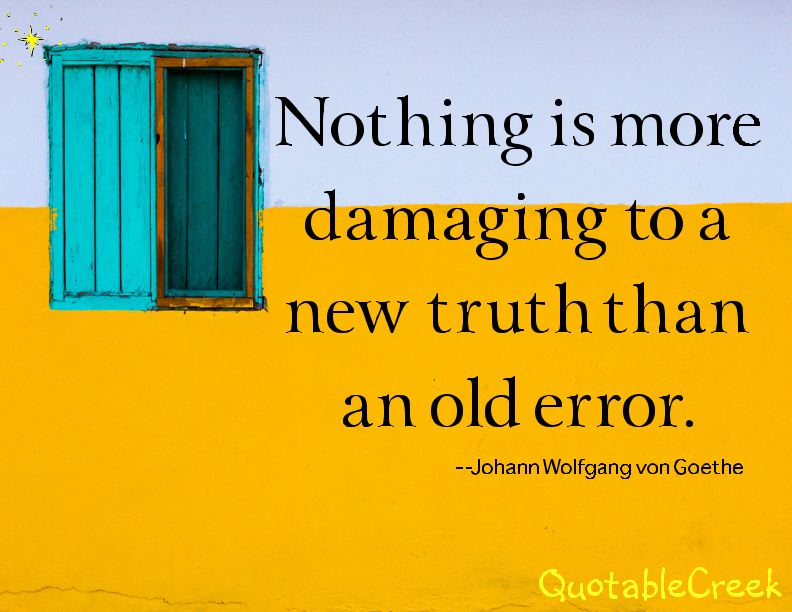
We aim to see the truth. But how do we do that when we are looking at the world through our own perceptions and assumptions? People used to believe that the sun revolved around the earth and ordered up reality with that assumption as foundational—until they discovered they were wrong. (Not, of course, until after convicting Galileo of heresy and excommunicating him.) Perceived reality is tough stuff to shake. Science helps, of course. But even with science many would rather falsify the text books than change their settled views of reality.

And what of the stuff beyond science, points of view, for instance. Is it your perspective versus mine? Or your perspective plus mine? Which is more likely to lead to ‘the truth’? There is a reason there are twelve people on a jury tasked to discover ‘the truth’. One perspective and judgment may not be enough, may be biased, may be limited by its own perceptions.

But still we dig in on our own view of ‘truth’. We embrace stereotypes which makes this an easier task and resist hearing other people’s stories. We simplify things to fit with our beliefs rather than embracing and considering other people’s viewpoints.

Why is it so difficult to accept a new truth?

In his book, The Road Less Traveled, M. Scott Peck suggests that we should be constantly examining ‘the truth’…and ourselves:

What does a life of total dedication to the truth mean? It means, first of all, a life of continuous and never-ending stringent self-examination. We know the world only through our relationship to it. Therefore, to know the world, we must not only examine it but we must simultaneously examine the examiner.

Peck goes on to discuss how we all make maps, world views, really, that organize our understanding of the world we find ourselves in:

Our view of reality is like a map with which to negotiate the terrain of life. If the map is true and accurate, we will generally know where we are, and if we have decided where we want to go, we will generally know how to get there. If the map is false and inaccurate, we generally will be lost.

While this is obvious, it is something that most people to a greater or lesser degree choose to ignore. They ignore it because our route to reality is not easy. First of all, we are not born with maps; we have to make them, and the making requires effort. The more effort we make to appreciate and perceive reality, the larger and more accurate our maps will be. But many do not want to make this effort. Some stop making it by the end of adolescence. Their maps are small and sketchy, their views of the world narrow and misleading. By the end of middle age most people have given up the effort. They feel certain that their maps are complete and the Weltanschauung is correct (indeed, even sacrosanct), and they are no longer interested in new information. It is as if they are tired. Only a relative and fortunate few continue until the moment of death exploring the mystery of reality, ever enlarging and refining and redefining their understanding of the world and what is true.

As you go through your day today, challenge your roadmap. Are those obstacles really insurmountable, or is there a slightly longer path leading to the same destination? Are you trapped, or can you backtrack and try a different fork on the path? Is that person really beyond understanding? Those people beyond hope? That fact established?

Challenging ourselves and our foundational assumptions isn’t dangerous, it’s liberating. What is out there waiting for us to discover if we just take that first step? For a brilliant TED talk on the two types of mindsets, one that leads to more knowledge, and one that, well, doesn’t (“Why You Think You’re Right Even When You’re Wrong”), go here. And for a further discussion of fixed v. growth mindsets, consider this.

Sing your song

singyoursong

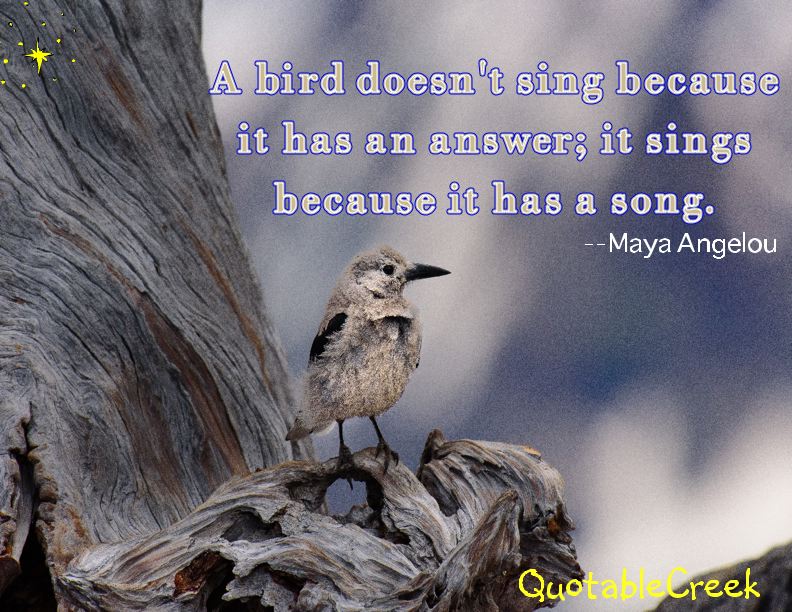
They say there is an African tribe where, when a woman is pregnant, she goes into the jungle with the other women of the village, and together they pray and meditate until they discover that child’s song.When that child is born, the community gathers to sing his song. And at each of the major stages of his life, they will sing his song–as he becomes a man, marries, and finally as he meets death to accompany him on the journey. When that child commits an anti-social act, the community will not focus on or be fooled by the mistakes or the dark, broken or ugly places within him but will gather around him in a circle to sing him his song, for the answer is not punishment but to remind him of his true identity, his unique place in the community.

This is such a lovely picture of service and community and being seen and valued as a unique individual. Many of us long for that place. But in this world in which we find ourselves, often we don’t know our song. Or we sing someone else’s song. Or our song is drowned out. Or we are too busy, distracted, or afraid to sing our song. Or, frankly, we just mouth the words.

Today, make sure to sing your song. It’s not about whether you sing on key or whether your song is ready for a band tour. It’s about authenticity and offering the gifts that you uniquely have to offer. Sing away, little bird.

What is your strength?

strength

Each individual’s gifts and strengths are as unique as a fingerprint. Among us are leaders and creators; thinkers and doers; warriors and nurturers. Finding your strengths and using them in service is one of our life’s challenges. When we remember that there is no one right answer to this question, no shoulds, no musts, but only what is, we can soar.