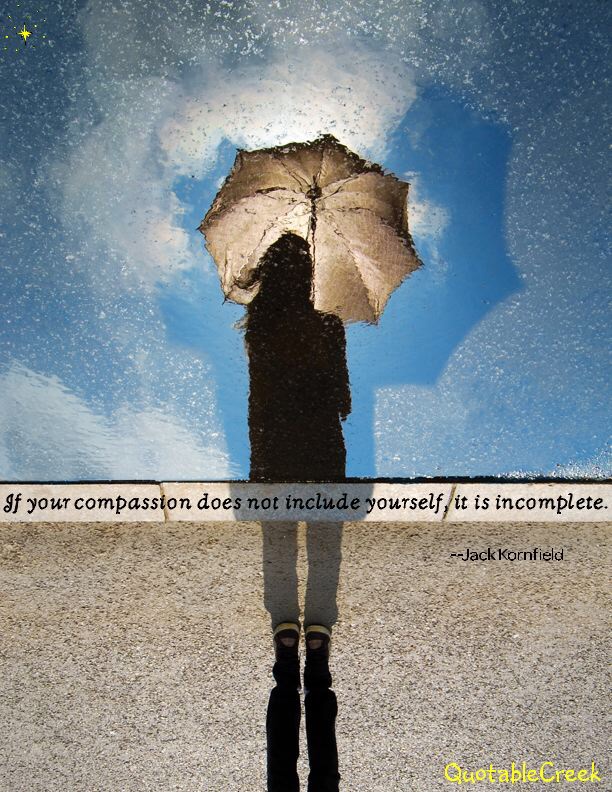
If one of your friends were struggling with the problems you are facing right now, what words would you offer in support? Would you call them names, berate them, remind them of all the other times they messed up just like this and how, honestly, can they ever expect to get anything right, ever?
Probably not. Right? But often this is the way we talk to ourselves. We replay all our other mistakes in our minds, call ourselves stupid, sink into our shells scared to face the world.
But why do we do this? If the words we would offer our friend are what we think would help, why are we so reticent to speak kind encouraging words to ourselves? Maybe today is a good day to try a different approach.
Be a kind friend to yourself. Offer yourself words of support and encouragement. Focus on all the many times you got things right. Tell yourself the truth: you are precious and beloved.
*********************
From Shari: These are hard times. For many of us, these are the hardest times we’ve been through.
What are some of the things that are helping you deal with the stress? What are some ways you’ve been able to help others?
We tend to think of peace as the absence of violence as quiet is the absence of noise, but is it more? Perhaps peace is active. It exists in the kind word offered, the refusal to meet hate with hate, the comfort of following higher principles, the strength of the outstretched hand.
It is so easy to lose, to slip into mirroring the hate and violence we see around us, to sit silent in front of a bully, to trade barbs, to slide down.
Peace is active. We maintain it in our hearts and mind. We breathe deeply to draw us back to that peaceful place.
We remember truth, honor, decency, compassion.
We breathe in the world; we breathe out heaven.
From Shari:
What steps have you taken toward peace today? Have you seen an example of active peace in the news or in your experience?
One of the side-benefits or hardship is cultivating resilience. Learning new things and new ways of doing old things helps sharpen the saw. It also helps us stay engaged and young. In this excellent article, Kerry Hannon argues that learning something new is a key factor in building the resilience we need to weather setbacks and navigate life’s volatility, particularly now.
When you’re in the process of learning, your viewpoint changes, and you spot connections that you never noticed before. “Resilience is about being adaptable in a variety of different circumstances,” said Dorie Clark, who teaches executive education at Duke University’s Fuqua School of Business and is the author of “Reinventing You.” It is a combination of being able to pick yourself up when there are setbacks, but also it is about having the kind of cross-training necessary to be flexible in an uncertain world where we don’t know what is around the corner,” Ms. Clark said.
New York Times, “To Build Emotional Strength, Expand Your Brain,” by Kerry Hannon
Staying curious, intentionally putting yourself in places and situations where you are a beginner, and following passion all contribute to building resilience with a byproduct of satisfaction.
Those who routinely and consciously engage in learning become more confident about their ability to figure things out once a crisis hits, according to Beverly Jones, an executive career coach and author of “Think Like an Entrepreneur, Act Like A CEO.” “Each time they hit a bump, they spend less time lamenting and quickly turn to determining what they must learn in order to climb out of the hole,” she said. Moreover, learners develop a more optimistic mind-set, which helps them jump into action, according to Ms. Jones. “In part, this is because each time you become aware of learning something new it feels like a victory,” Ms. Jones said. “You maintain the positivity that is a key to resilience.”
So, as we continue to adapt to a new normal, now is a good time to seek out new things to learn and new passions to pursue. More than ever, university courses and classes are being offered online, often for free. What is something new for you to pursue? Stay curious; keep your mind young; and follow your passions.
Most of us will not be inventing a vaccine to end this pandemic or donating millions to the research. Most of us will not be heroes in the saving the day sense.
And yet each of us has incredible power to choose how we want to meet each day when life is so stressful. Whether we want to retreat into a cocoon focused only on our own wants and needs or use this as an opportunity to reach out to others. Whether we want to add to someone’s anxiety or be their shelter in the storm. Whether we want to be comforted or to comfort.
And the impetus for any acts of kindness comes from the deep recognition of how important those acts of kindness have been to you when you have despaired. The kind gesture, the comfort of a friend simply abiding with you as you travel a dark path, the reminder that you are precious when you’ve forgotten and can see only your mistakes. These have been your lifeblood. And you can offer that gift to others, particularly now. Take a moment to enjoy this profound poem by Naomi Shihab Nye.
Before you know what kindness really is you must lose things, feel the future dissolve in a moment like salt in a weakened broth. What you held in your hand, what you counted and carefully saved, all this must go so you know how desolate the landscape can be between the regions of kindness. How you ride and ride thinking the bus will never stop, the passengers eating maize and chicken will stare out the window forever.
Before you learn the tender gravity of kindness you must travel where the Indian in a white poncho lies dead by the side of the road. You must see how this could be you, how he too was someone who journeyed through the night with plans and the simple breath that kept him alive.
Before you know kindness as the deepest thing inside, you must know sorrow as the other deepest thing. You must wake up with sorrow. You must speak to it till your voice catches the thread of all sorrows and you see the size of the cloth. Then it is only kindness that makes sense anymore, only kindness that ties your shoes and sends you out into the day to gaze at bread, only kindness that raises its head from the crowd of the world to say It is I you have been looking for, and then goes with you everywhere like a shadow or a friend.
So much of life feels like it is beyond our ability to understand. Philosophers and theologians can argue over how many angels can dance on the head of a pin or whether our futures are predestined. Or, even, whether God is dead, or, for that matter, ever lived, or, if alive, plays any hand in the events of the day.
Where is God when we suffer or when the whole world suffers? Is there any comfort in the argument that suffering happens because God gives us free will so has to let the natural consequences of things we’ve set in motion happen? That just kind of sucks, particularly when we are the well-behaved kids kept in at recess because of the misbehavior of some lone miscreant. What kind of global sense of the divine is that? Where is the comfort?
And, yet, there are moments, aren’t there? Moments when things fall into place, and we see the interconnection of living things, and feel lost in the mystery but at home there, too? Moments that sweep us into awe and gratitude and marvel? Moments where we can see the divine in the creation? In each other? Moments when we wonder how we got so lucky to be here, now, in this place and time, with these former strangers now beloved, with this life to live and all the options that offers?
We can look back at our lives and recognize the little junction points when we took a turn or met someone who became precious to us. A coincidence that we were both there in that same place and time. A coincidence that we got to talking and felt a connection, so kept talking, until that stranger became now a friend. Or a coincidence that led us to make a choice that brought us on a path to greater insight, understanding, and communion. What explains that? Those little coincidences that led us to the lives we have?
Lenny Duncan calls those coincidences ‘God staying anonymous’, and perhaps that is comforting. Perhaps the notion of a benevolent God putting people and experiences in our path to lead us forward gives us a sense of hope. Perhaps that is God working to draw us close. Perhaps it is our job to keep those flames of hope burning.
Duncan explains: “Church, I love you because you are the answer to the question ‘Is God real?’ You are the resounding yes thundering in our hearts. You are the triumphant roar affirming that God is real, powerful, and still able to perform miracles, here and now. In this time in our history, when the world seems like it is on the precipice, you are the gentle hymn that will pull us back from the abyss. You, Church, are the resounding call the entire world is bending its ear to hear as the first straining notes float over the mountaintop. You are slowly beginning to look at these hard truths, more and more each day. You are the dance of providence that lays itself out as series of coincidences, bringing even the least likely into communion with the divine. But we know coincidences are God’s way of staying anonymous. It’s our job to point out that God is the agent of change we all experience.”
And in any crisis, there will be people who step up out of a sense of the greater good and many of those suffering will tell you that God was there with them in that suffering, not from afar as if on a cloud looking down, but right there in their very fiber, in their own breath and the beating of their heart. God with us. Emmanuel. Not just in the coincidences, though certainly there, but in it all. And even when things are well beyond our comprehension and the complexities of the universe and even our own lives confound us, that is comforting. Emmanuel.
It’s easy to be grateful for the good things. But … everything? What about the fear, anxiety, separation, loneliness? What about the loss and persecution? What about the things that challenge our life and morality and soul? What of these?
Yes. All. Even these things that most pain us or make us worry. It is in these times we draw on something deeper than ourselves and grow. These are the times that cause us to reach out to others and embrace community. These are the depths we can survive and use that survival to offer hope to others.
Gratitude forces a perspective shift. From despair to hope. From loss to possibility. From chaos to peace.
In this interview, Brené Brown discusses the complexity of emotions we are experiencing as a result of the pandemic and social isolation. Her words bring comfort and solace to all of us, but particularly those of us raised to believe that only positive emotions should be felt or expressed.
These are tough times. And it’s particularly difficult because this is not an emergency you have to gear up for and get through; it’s a slow burn. As she says:
“Normally, in order to get through a crisis, you know, our bodies are built to respond with a lot of adrenaline, a lot of energy, a lot of super coping surge. And then the waters recede or the fires are out or, you know, the crisis ends and we slog our way through kind of cleanup and trying to find our new normal. But we are not going to be able to depend on the adrenaline surge for this, because it’s going to out- it’s going to outpace us. And I think we are hitting that moment where we are weary in our bones. We are physically tired. We, you know, anxiety, uncertainty take a lot out of us physically. I think, you know, we’re on Zoom calls. I don’t know what happened. Like, I work a lot to begin with, but I feel like I’m on Zoom calls from 6:00 in the morning until midnight. You know, and then we’ve got toddlers crawling up our backs and partners trying to, you know, tell us to be quiet. They’re also are being called. And we’re tired. And I’ll tell you, the other thing that’s exhausting; that we are not acknowledging – again as a collective – is grief.”
And the grief is perhaps more extensive than any we’ve felt before. It’s grieving a loss of everything that was normal to us. Brown explains, “Well, I think it’s a very difficult position we’re in right now because I think we are both grieving the loss of normal and grieving the ordinary moments that make the touchstones for our lives. We’re grieving the loss of those at the very same time we’re having to find and settle into a new normal. And those two things are very difficult to do. At the same time, not mutually exclusive, but as close as it gets without being mutually exclusive. So there’s grief, I think. Grief is the loss of normal.”
And it is ok to experience that grief and mourn those losses. We are vulnerable, and there is no shame in acknowledging that:
“To be alive is to be vulnerable, to be in this pandemic, is to be vulnerable every second of every minute of every day. And the thing about vulnerability is it is difficult, but it’s not weakness. It’s the foundation and the birthplace of courage. There is no courage without risk, uncertainty and exposure. And so, you know, I’ve asked 10000 people that this question, starting with special forces military: give me an example of courage in your life that did not require uncertainty, risk and emotional exposure. And in probably 15 thousand people at this point, not one person has been able to give me an example of courage that did not require vulnerability. So we need to dispel that mess and we need to acknowledge we are in a lot of vulnerability right now. That means we can be our best, bravest selves or we can be our worst selves, and I think the thing about choosing to be our most courageous selves is having to understand this is another method to style that most of us know we’re taught growing up that we’re either brave or afraid, that the truth is we can be brave and afraid at the exact same time. Most of us are in these moments today.”
We can be brave and afraid at the exact same time. We can be strong in our vulnerability. And, even though we are living a new normal, we can choose how we show up there.
Many are on the front lines of this pandemic, either working in health care or in essential jobs to keep the world moving, while others of us are on the sidelines waiting. We worry about ourselves, but also about our friends and family members on the front lines. Will they be safe? What are the right words to encourage them and let them know we love them?
In this interesting article, health care worker Dorothy E. Novick suggests Ring Theory as a way to modulate our expressions of concern. It works like this:
“I came across an article about “Ring Theory,” written by Susan Silk and Barry Goldman. In this construct, we imagine a person who is suffering, like Margi, sitting in a small circle surrounded by concentric rings. Her dearest relatives sit in the circle closest to her. Best friends sit in the next larger circle. More friends and colleagues occupy the next one. And so on.
“According to Ring Theory, a person in any given circle should send love and compassion inward, to those in smaller circles, and process personal grief outward, to those in larger circles. To Margi and her mother, I should have said, “I love you, and I’ll do everything I can to support you.” And only when talking to others should I have said, “Her suffering feels impossible to bear.
“Comfort in, grief out.
“Ring Theory works for supporting health-care providers during the trauma of covid-19. We are grappling with a complex duality of mission plus terror. We are proud of what we can contribute and passionate about our patients’ well-being. But we are frightened — for our safety, for our patients, for the spouses and children we might expose.”
When we speak with people working in positions of danger, practicing Ring Theory makes good sense. Our comfort, praise, and admiration gives those heroes strength and helps them continue. Our hysteria or forwarding doomsday articles simply doesn’t. In all of this, we should strive to do no harm and let our words offer comfort.
Novick relates a message she received that helped give her comfort, a message that gives us a good example for how we can show up for people in dangerous positions right now:
The message read, “I am holding you in my heart being on the front lines of these difficult times. The professional skill, kindness, support and tenacity you give your patients and your medical community I am sure is a comfort in this darkness. Sending much love, appreciation and admiration.
“My heart rate slowed and my skin warmed over as I read the message. Then I pulled my mask over my face and opened the door to the next patient room.”
That, right there, is the power of the right words at the right time. We each have that power to do good right now.
The might have beens are a killer. We each take so many forks in the road, it’s easy to wonder how our lives might be if we had taken a different turn—gone to a different school, chosen a different career, picked a different partner. Those might have beens can keep us up late with longing and despair about the life we currently have. And, more importantly, they can strip those lives, the actual lives we are living, of joy.
Consider this poem by Carl Dennis:
The God Who Loves You
BY CARL DENNIS
It must be troubling for the god who loves you To ponder how much happier you’d be today Had you been able to glimpse your many futures. It must be painful for him to watch you on Friday evenings Driving home from the office, content with your week— Three fine houses sold to deserving families— Knowing as he does exactly what would have happened Had you gone to your second choice for college, Knowing the roommate you’d have been allotted Whose ardent opinions on painting and music Would have kindled in you a lifelong passion. A life thirty points above the life you’re living On any scale of satisfaction. And every point A thorn in the side of the god who loves you. You don’t want that, a large-souled man like you Who tries to withhold from your wife the day’s disappointments So she can save her empathy for the children. And would you want this god to compare your wife With the woman you were destined to meet on the other campus? It hurts you to think of him ranking the conversation You’d have enjoyed over there higher in insight Than the conversation you’re used to. And think how this loving god would feel Knowing that the man next in line for your wife Would have pleased her more than you ever will Even on your best days, when you really try. Can you sleep at night believing a god like that Is pacing his cloudy bedroom, harassed by alternatives You’re spared by ignorance? The difference between what is And what could have been will remain alive for him Even after you cease existing, after you catch a chill Running out in the snow for the morning paper, Losing eleven years that the god who loves you Will feel compelled to imagine scene by scene Unless you come to the rescue by imagining him No wiser than you are, no god at all, only a friend No closer than the actual friend you made at college, The one you haven’t written in months. Sit down tonight And write him about the life you can talk about With a claim to authority, the life you’ve witnessed, Which for all you know is the life you’ve chosen.
We have choice and agency in the life we have. It is there we find meaning and purpose. It is there, in the now, that we can find joy. Embrace that life.
We are grieving, collectively, the world over, all of us. Grieving the past we’ve lost and the loss of the future we expected. Things will be forever different for us. There are stages to this grief, and we will all experience it differently. But it is in acceptance where we will find the ability to process it and move forward into an uncertain future. This is our now. This is what we have to work with.
In this excellent article on grief, David Kessler shares his thoughts on what we are all going through:
“Yes, we’re also feeling anticipatory grief. Anticipatory grief is that feeling we get about what the future holds when we’re uncertain. Usually it centers on death. We feel it when someone gets a dire diagnosis or when we have the normal thought that we’ll lose a parent someday. Anticipatory grief is also more broadly imagined futures. There is a storm coming. There’s something bad out there. With a virus, this kind of grief is so confusing for people. Our primitive mind knows something bad is happening, but you can’t see it. This breaks our sense of safety. We’re feeling that loss of safety. I don’t think we’ve collectively lost our sense of general safety like this. Individually or as smaller groups, people have felt this, but all together this is new. We are grieving on a micro and a macro level.”
The article is well worth a read, as it helps us put the issues we face now in perspective and give voice to our feelings. He states:
“Understanding the stages of grief is a start. But whenever I talk about the stages of grief, I have to remind people that the stages aren’t linear and may not happen in this order. It’s not a map but it provides some scaffolding for this unknown world. There’s denial, which we say a lot of early on: This virus won’t affect us. There’s anger: You’re making me stay home and taking away my activities. There’s bargaining: Okay, if I social distance for two weeks everything will be better, right? There’s sadness: I don’t know when this will end. And finally there’s Acceptance. This is happening; I have to figure out how to proceed.
“Acceptance, as you might imagine, is where the power lies. We find control in acceptance. I can wash my hands. I can keep a safe distance. I can learn how to work virtually.”
Sometimes dealing with a problem begins with naming it. Grief, that’s what it is. Have compassion on yourself and others. This is hard.




 QuotableCreek.com