Balcony people

Are there people in your life who encourage you and make you feel stronger and lifted up? Are there some who drag you down or take the wind out of your sails?  In her book, Balcony People, Joyce Landor Heatherley argues there are two types of people: the evaluators and the affirmers. She suggests:

I am sure, if there were a way to view a movie and see instant replays of all the strategic change points in our lives, that we’d instantly spot the people who either broke our spirits by their critical or judgmental evaluations, or who healed us by their loving, perceptive affirmations.

To be honest, I seem to be able to remember the negative comments of evaluators faster and more clearly than the positive remarks of the affirmers. I’m not alone in this ability to recall the negative….I suspect that not far from anyone’s conscious level of thinking lies the memory of an evaluator who pulled on his or her spiked boots and stomped deliberately over our bare soul and personhood.

Do you have any of these evaluators in your life? Maybe you can recognize the voice in your head that tells you that you can’t do something. In her book The Artist’s Way: A Spiritual Path to Higher Creativity, Julia Cameron calls these the censors. Maybe you have many censors, a rogue’s gallery of them.

So what do we do with these evaluators and censors to keep them from stifling our blossoming with their negative talk or opinions? Heatherley suggests leaving them in the past, even if that past was five minutes ago:

We all have the choice to replay the harmful remarks from evaluators, or we can choose to let them pass on. We can even choose to make allowances for their discouraging, destructive words. But best of all is the choice to willingly focus our minds and hearts on today’s person who is affirming us.

So who are these affirmers in our lives? Think back…

Who by one small sentence or more, has changed and lifted your opinion of yourself? Who was the person early in your life who recognized the first sparks of originality in the labyrinths of your mind and soul and saw what no one else saw? And who is the special affirmer who catches quick glimpses of the flames from the fires of your potential and tells you so? Who, by his or her words, helps you to respect and believe in your own value as a person? And who is the affirmer who encourages you to stretch and dream beyond your self-imposed limits and capabilities?

These affirmers are your Balcony People, cheering you on to blossom and stretch. These are the people whose words you must cling to when working toward your goal. These affirmers see you “by a clearer, truer light. They [are] able to peel back the layers of pretense [you] wear like like costumes for a bad play. Most of the time they [see] through and past the masks [you] hide behind. Then, once having broken through to [you] they’d get on with the business of motivating [you] to be all [you] can be.”

Affirmation is vital to our health and progress:

When others discern the good, the noble, the honorable, and the just tenets of our character (no matter how minuscule they may be) and proceed to tell us how they admire those traits, we feel visible. We begin to ‘see’ ourselves and our worth. We feel nurtured and nourished, but mostly we feel loved.

The Basement People do just the opposite. With their words they cause you to doubt and shrink. They focus on your flaws or failings. They encourage you to not try, to stay where you are, to wallow in the “murky waters of failure and discouragement.” We don’t need to linger on their words.

Who is in your Balcony? Who cheers you on and sees your unique worth? Who do you admire in history for their accomplishments or moral victories?

When you struggle, picture these people, your Balcony People. Remember their words. Let their affirmations encourage and comfort you in defeat and to keep pressing onward in your goals.

You are meant to blossom not wither. You are meant to shine not lurk in the shadows.

You are meant to soar.
Carrying your lost love

How hard it is to lose someone you love. There is so much that seems unseen or unfelt without being shared together. So many visceral, tangible reminders of your loss are everywhere. Sounds, smells, songs, times of day, stories, jokes, and so on. Everywhere you look. There’s no escaping the weight of the loss really.

The only thing that makes it bearable is to consider it not loss, but a gift. Moments shared colored your life and made it brighter and more nuanced. The threads of memories you shared become woven together with threads from all the people you’ve loved and become the tapestry that is your life. And that ever-presence becomes not a stab, but a comfort.

e.e. cummings captured it well:

i carry your heart with me(i carry it in

my heart)i am never without it(anywhere

i go you go,my dear;and whatever is done

by only me is your doing,my darling)

                                                      i fear

no fate(for you are my fate,my sweet)i want

no world(for beautiful you are my world,my true)

and it’s you are whatever a moon has always meant

and whatever a sun will always sing is you

here is the deepest secret nobody knows

(here is the root of the root and the bud of the bud

and the sky of the sky of a tree called life;which grows

higher than soul can hope or mind can hide)

and this is the wonder that’s keeping the stars apart

i carry your heart(i carry it in my heart)

To all those we have loved and miss dearly, let us look back fondly, grateful for all the colors they brought into the tapestry of our lives, and repeat together:

i carry your heart(i carry it in my heart)

The life within

Author Amy Tan shares this remarkable insight: 

“In one of John Muir Laws’s books, I read something profound that changed the way my brain thinks. “As you draw the bird,” he writes, “try to feel the life within it.” So now I look at the bird before me and imagine how it senses the world, how it feels breathing cold air, how it feels to have its feathers ruffling in the wind, how it feels to always have an eye out for possible food and possible predators. The bird sees me and is a nanosecond from flying off, but it stays. Why? By imagining the life within, the bird I am drawing is alive, no longer a shape and its parts, but a thinking, sentient being, always on the brink of doing something. By feeling the life within, I am always conscious that all creatures have personalities, and so do trees and clouds and streams. To feel the life within, I now imagine myself as the bird that is looking at me. I imagine its wariness, the many ways it has almost died in its short life. I worry over its comfort and safety, and whether I will see my little companion the next day, the next year. To feel the life within is to also feel grief in the goneness of a single creature or an entire species. Imagination is where compassion grows. Let us join with children to imagine and wonder, to use curiosity as the guide to miracles in plain sight. Let us enter with them into wild wonder so that we become guardians together of all that is living and all that must be saved.”

From Orion Magazine, “The Life Within”.

I wonder if we can look at each other that way, as something vaster, as thinking sentient beings with worlds of experience, some harsh. Would that help us to treat each other better? In her book, Dead Man Walking, Sister Helen Prejean describes just this sort of thing as she works with a death row inmate, a man who admittedly committed a heinous act, seeing not just the man but also, though covered with tattoos and bathed in bravado, the little wounded child within. That empathy allowed her to see past the crimes to the human and to feel compassion for him.

Perhaps today we can look with new eyes to see each other as a composite of good and bad, but each fully human and fully deserving of respect and compassion. To paraphrase Amy Tan above, when we consider the person, can we try to picture the life within, the challenges and struggles, hopes and triumphs? Can we become, together, ‘guardians of all that is living and must be saved’ in a place where ‘compassion grows’?

Tortoise and the hare

I’ve been watching Lessons in Chemistry, based on a wonderful book. One part stood out for me last night. A dog character, Six Thirty, remembers why his person, Calvin, said he loves running. Calvin said even when it is hard or you don’t think you can go on anymore, you just keep putting one foot in front of the other.

“One foot. One foot. And then sure enough, you’ll be home.”.

Isn’t that profound? In this life, we keep putting one foot in front of the other, until we’re home.

Slow and steady wins the race. We get discouraged and stop, or chase after another enticing goal, or turn back. But, if we stay true, we will make progress. One foot, one foot.

Remember the tortoise and the hare? They had a rematch recently:

This is my yopp.

Sometimes turning off the news is the best form of mental health protection.

But then we remember. In times of darkness, there are always those working to light a path, helping, fighting for the common good, making progress.

And maybe we, too, can help.

Maybe not in large, brokering peace kind of ways. But in small ways that, combined together with the small ways of many, many others, may help to right a wrong or turn a tide.

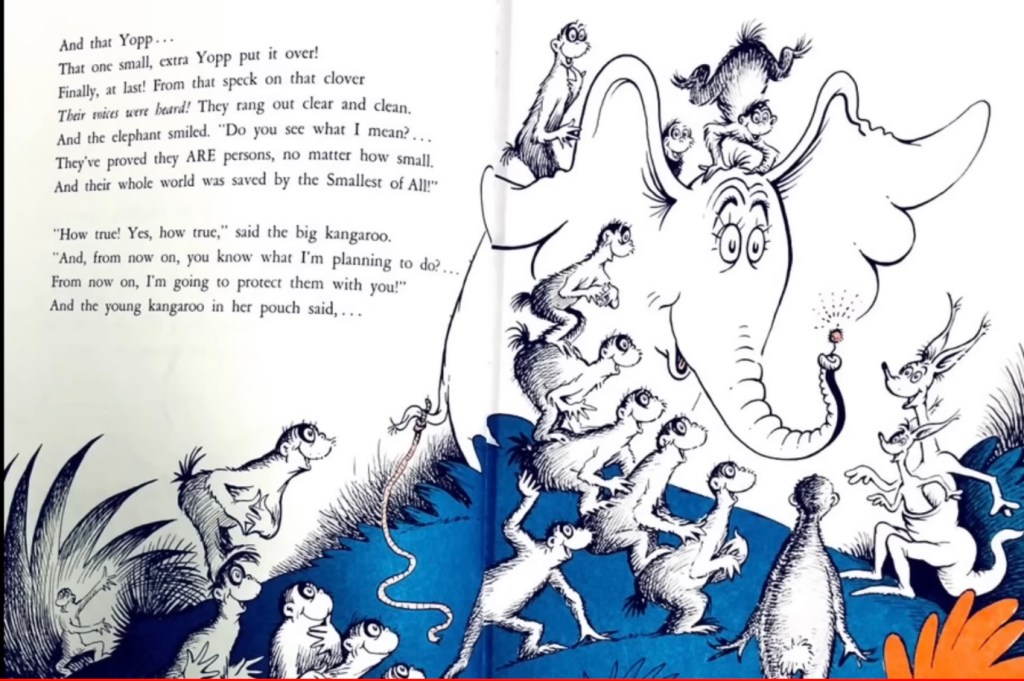
I think of Horton Hears a Who by Dr. Seuss, everyone shouting and banging on pots to be heard, but it is the final Yopp of a child that turns the tide, saving their world.

What is your ‘Yopp’?

Only the lonely

Hindsight often can give context and meaning to our struggles, perhaps no more than when we realize that our lowest times have helped someone else hold on. Some comfort, that.

And maybe, even when we don’t have the benefit of that hindsight, we can believe there is purpose and meaning in our difficulties even if we never do know it. Isn’t that the foundation of faith, that things will work together for good in a big picture way if not perhaps in the personal way? And isn’t that what can give us courage and strength to do our best, to hold on, and to persevere?

As Rainer Maria Rilke said:

Among lonely people there is not a single one who can be sure that in his suffering he might not yet console someone else and that the gestures of his most personal helplessness, like so many cues and signals, might not serve as signs guiding the way in the realm of the unfathomable.

The Poet’s Guide to Life: The Wisdom of Rilke by Rainer Maria Rilke.

The world is a complicated, interconnected place, and we are all in it together.

Praying for peace

We tend to think of peace as the absence of violence as quiet is the absence of noise, but is it more? Perhaps peace is active. It exists in the kind word offered, the refusal to meet hate with hate, the comfort of following higher principles, the strength of the outstretched hand. It is so easy to lose, to slip into mirroring the hate and violence we see around us, to sit silent in front of a bully, to trade barbs, to slide down. Peace is active. We maintain it in our hearts and mind. We breathe deeply to draw us back to that peaceful place. We remember truth, honor, decency, compassion. We breathe in all that is good, we exhale the bad.

Author Shauna Niequist talks about the anxiety we are all experiencing now and suggests breath prayer:

“Christians have been practicing breath prayer since at least the sixth century & there are lots of ways to do it. One way that’s been helping me lately: choose one word to pray as you inhale–what you’re asking God to bring into your life/body/spirit/world, and one word to exhale–what you’re asking God to carry for you, so that you can release it as you breathe out.

Inhale healing/exhale fear.

Inhale peace/exhale anxiety.

Inhale hope/exhale despair.

Inhale hope/exhale chaos.”

As you move forward into your day, remember to take deep breaths, center yourself, and carry on.

Praying with the news.

How do we read the news and not get overwhelmed or angry, disconnected or depressed? How do we keep showing up with compassion and grace in a world where there is so much hate? How do we keep ourselves on the right path through the midst of it all? How do we continue to show up from a place of compassion, forgiveness, and grace? how do we keep our hearts from growing hard?

In this thoughtful letter, Rabbi Yael Levy shares his insights on how to pray with the news:

The 17th of the Hebrew month Tammuz initiates a three-week period of mourning that leads to Tisha b’Av, which is the day that marks the destruction of the Temples in Jerusalem in 586 BCE and 70 CE.

Tradition teaches that the Temple was destroyed because hatred became the operating principle in the community. The scorn, contempt and disdain that characterized daily interactions caused the Divine Presence to flee and leave the Temple vulnerable to attack.

These next three weeks ask us to reflect on the hatred that we allow to take root in our hearts. The wisdom of the tradition acknowledges that hatred can sometimes feel energizing and “so right,” but allowing it to fill our bodies and guide our actions leads to destruction.

Many years ago I was taught the practice of praying with the news. I have shared it over the years and always find myself returning to it during this season.

In this practice, each time we read or listen to a news report that enrages us, we turn our attention to those harmed by what is happening and pray for their healing and well-being. Doing so encourages us to acknowledge feelings of anger, grief and despair, and at the same time it turns our attention toward connection and compassion. Praying with the news can help us learn to bear witness to devastation and mayhem, while keeping our hearts soft, our minds calm, and our actions clear.

I am struggling mightily with this practice these days in the wake of continued violence and oppression in this country and throughout the world. Hatred can sometimes feel like such a welcome harbor. Not only does it feel so right, it can also act as a shield, creating the illusion that I don’t have to acknowledge the grief and heartbreak I am experiencing.

I need practices to help quiet the rage and fear, to loosen the constriction of hatred and to help me be with overwhelming grief. I need practices to help me return to compassion, love, joy and possibility. I find praying with the news both painful and helpful. It keeps me connected, allows sorrow, and grounds me in care and love.

Weekly reading from the Awakin.org newsletter.

Mistake police

In this world of constant scrutiny and omnipresent recordings, mistakes seem to have moved from a necessary part of learning to an instant cause for condemnation.

We can all think back to learning to walk and talk or play a sport where the mistakes were a part of learning. Fear of falling down would keep everyone from walking. In order to learn how to make a basket, lots of shots will bounce off the rim and backboard.

When we moved on to raising children, focusing on the mistakes could cripple a child emotionally. Instead, we celebrated the steps forward, the successes. Noted the progress. We don’t expect a toddler to write a dissertation. We celebrate the milestones as they come.

I wonder if that approach would help move our troubled world forward. Celebrating the progress. Looking for the successes. Embracing the common ground. Letting everyone feel that they can continue to learn from their mistakes, that that is part of being human. A world with a little bit of breathing room. We all will mess up. We can show each other grace when we do.

Strong in the broken places

Life can be tough. Even the most charmed of lives has loss and heartbreak, disillusionment and despair. Everyone hurts. But buried deep under the hurt and pain is the little waif you used to be, full of hope and promise, enthusiasm and excitement.

As Irish poet and philosopher John O’Donohue notes:

Your identity is not equivalent to your biography. There is a place in you where you have never been wounded, where there is still a sureness in you, where there’s a seamlessness in you, and where there is confidence and tranquility in you.

The intention of prayer and spirituality and love is now again to visit that inner kind of sanctuary.

Deep in there, behind the daily worries, aches and pains, hurts and disgruntlements, is your soul. Prayer, staying still and letting your mind clear in meditation, will take you there, again and again, a way to connect with both your own individuality and your place in the awesome collective of it all.