Facing fear

Standing up to fear changes a person. It helps you to put matters in perspective. Where once fear loomed over you, insurmountable, now you can honor the courage it took to move past it into unfamiliar territory.

Eleanor Roosevelt was a courageous woman. Despite her husband’s attempts to placate the South, she regularly bucked segregation and was a vocal proponent of civil rights. She was able to call out racism and force others to see it for what it was:

By 1939, ER decided to attack the hypocritical way in which the nation dealt with racial injustice. She wanted her fellow citizens to understand how their guilt in “writing and speaking about democracy and the American way without consideration of the imperfections within our system with regard to its treatment . . . of the Negro” encouraged racism. Americans, she told Ralph Bunche in an interview for Gunnar Myrdal’s American Dilemma, wanted to talk “only about the good features of American life and to hide our problems like skeletons in the closet.” Such withdrawal only fueled violent responses; Americans must therefore recognize “the real intensity of feeling” and “the amount of intimidation and terrorization” racism promotes and act against such “ridiculous” behavior.

You can’t clearly see a problem before you if you are too scared to look at it and call it out for what it is. Where are the injustices in your immediate orbit? Are there people being treated unfairly? How can you add your voice to help identify the problem and move toward healing? These problems are right here, close to home.

As Eleanor Roosevelt said:

Where after do human rights begin? In small places, close to home– so close and so small that they cannot be seen on any map of the world. Yet they are the world of the individual person: The neighborhood he lives in; the school or college he attends; the factory, farm or office where he works. Such are the places where every man, woman, and child seeks equal justice, equal opportunity, equal dignity without discrimination. Unless these rights have meaning there, they have little meaning anywhere. Without concerted citizen action to uphold them close to home, we shall look in vain for progress in the larger world.

-“Remarks at the United Nations,” March 27, 1958

https://erpapers.columbian.gwu.edu/quotations-eleanor-roosevelt

Fear is a crippler. It keeps you rooted in a course of action you know to be wrong. Focusing on the fear helps it to loom even larger before you. Instead, focus on the better world you are trying to help build. Spreading love and justice is exciting and uplifting. Being part of something bigger than yourself, working for a common goal, in an effort to improve people’s circumstance is rewarding.

You don’t have to see the whole path in front of you. Take, and keep taking, that next step forward.
I’m spring

As I age, I have a new appreciation for those poets like Dylan Thomas raging against mortality. I do not want to go gentle into that good night. I like it here.

Here is a new variation on that theme I enjoyed:

Sorrow Is Not My Name
BY ROSS GAY

—after Gwendolyn Brooks

No matter the pull toward brink. No
matter the florid, deep sleep awaits.
There is a time for everything. Look,
just this morning a vulture
nodded his red, grizzled head at me,
and I looked at him, admiring
the sickle of his beak.
Then the wind kicked up, and,
after arranging that good suit of feathers
he up and took off.
Just like that. And to boot,
there are, on this planet alone, something like two million naturally occurring sweet things,
some with names so generous as to kick
the steel from my knees: agave, persimmon,
stick ball, the purple okra I bought for two bucks
at the market. Think of that. The long night,
the skeleton in the mirror, the man behind me
on the bus taking notes, yeah, yeah.
But look; my niece is running through a field
calling my name. My neighbor sings like an angel
and at the end of my block is a basketball court.
I remember. My color’s green. I’m spring.

Shining light

In all the din, what is one voice more? Why bother speaking up? No one seems to listen to each other anymore anyway.

But inside you is a well spring, and you’re fueled by truth and an honest desire to help others. Your opinion matters.

Consider these words from Marianne Williamson:

“Our deepest fear is not that we are inadequate. Our deepest fear is that we are powerful beyond measure. It is our light, not our darkness that most frightens us. We ask ourselves, ‘Who am I to be brilliant, gorgeous, talented, fabulous?’ Actually, who are you not to be? You are a child of God. Your playing small does not serve the world. There is nothing enlightened about shrinking so that other people won’t feel insecure around you. We are all meant to shine, as children do. We were born to make manifest the glory of God that is within us. It’s not just in some of us; it’s in everyone. And as we let our own light shine, we unconsciously give other people permission to do the same. As we are liberated from our own fear, our presence automatically liberates others.”

Who are you to speak up?

You are a child of God. Let God’s light shine on a dark world through your words.

Breathe in this new day.

When we lose our way or feel overwhelmed, we can return to nature and be renewed. Hear the birds singing their spring song. Watch them collect twigs and bits for their nests. See the long grass ripple in a gentle wind like ocean waves. Breathe in the sweet earthy fragrance of the morning. Feel small and surrounded by an amazing, complicated system that has been pulsating with life for millions of years. That awe is good for us:

“It has long been established that a healthy diet and lots of sleep and exercise bolster the body’s defenses against physical and mental illnesses. But the new study, whose findings were just published in the journal Emotion, is one of the first to look at the role of positive emotions in that arsenal.

“That awe, wonder, and beauty promote healthier levels of cytokines suggests that the things we do to experience these emotions—a walk in nature, losing oneself in music, beholding art—has a direct influence upon health and life expectancy,” says UC Berkeley psychologist Dacher Keltner, a coauthor of the study.” 

Breathe in the day, full of life and possibility. Breathe out the stress, the worry, the defeat. In. Out. In. Out. In.

Difficult people.

Do you  have any difficult people in your life? Chances are you can’t force them to be less toxic, but there are steps you can take to be less bothered by the encounter. In this article by Christine Carter, she suggests, among other things, that showing mercy to this difficult person will rebound to you:

Anne Lamott defines mercy as radical kindness bolstered by forgiveness, and it allows us to alter a communication dynamic, even when we are interacting with someone mired in anger or fear or jealousy. We do this by offering them a gift from our heart. You probably won’t be able to get rid of your negative thoughts about them, and you won’t be able to change them, but you can make an effort to be a loving person. Can you buy them a cup of coffee? Can you hold space for their suffering? Can you send a loving-kindness meditation their way?

Forgiveness takes this kindness to a whole new level. I used to think I couldn’t really forgive someone who’d hurt me until they’d asked for forgiveness, preferably in the form of a moving and remorseful apology letter.

But I’ve learned that to heal ourselves we must forgive whether or not we’re asked for forgiveness, and whether or not the person is still hurting us. When we do, we feel happier and more peaceful. This means that you might need to forgive the other person at the end of every day—or, on bad days, every hour. Forgiveness is an ongoing practice, not a one-time deal.

When we find ways to show mercy to even the person who has cost us sleep and love and even our well-being, something miraculous happens. “When we manage a flash of mercy for someone we don’t like, especially a truly awful person, including ourselves,” Anne Lamott writes, “we experience a great spiritual moment, a new point of view that can make us gasp.”

Here’s the real miracle: Our mercy boomerangs back to us. When we show radical kindness, forgiveness, and acceptance—and when we tell the truth in even the most difficult relationship—we start to show ourselves those things. We realize that we can love and forgive and accept even the most terrible aspects of our own being, even if it is only for a moment. We start to show ourselvesthe truth, and this makes us feel free.

Perhaps you can show that difficult person mercy today.

With whatever I have for as long as I can

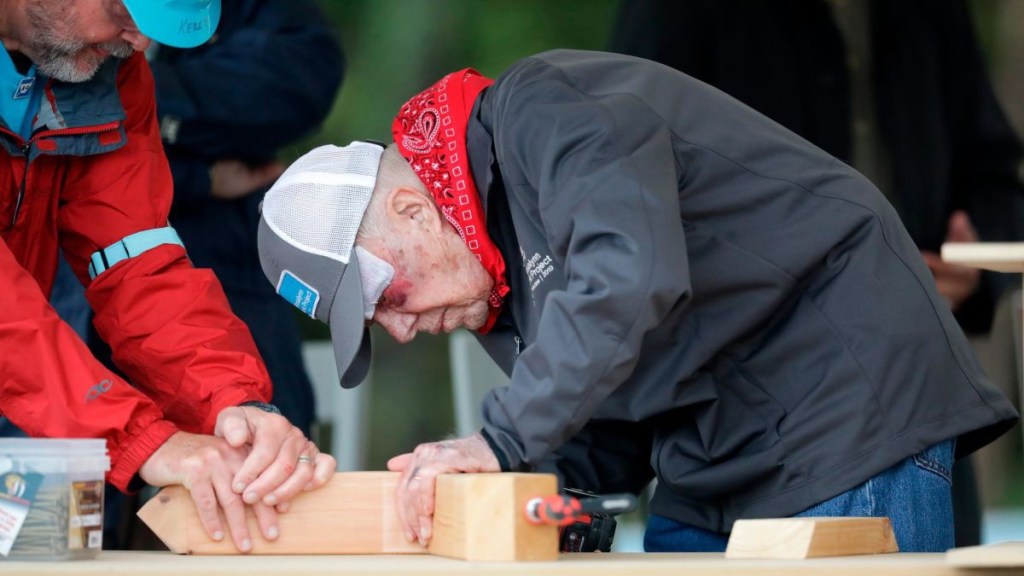
With the news this week that former President Jimmy Carter has entered home hospice care, many people have been sharing stories about his accomplishments in office—his efforts for peace, his push for environmental stewardship, and his efforts toward energy independence, among others.

But his most striking accomplishments perhaps are what he has done since he lost his re-election bid. Rather than retreat to Georgia and exit the public arena, he began building houses for the poor, and working for democracy—a principle he firmly believed in—around the world, and standing up for women’s rights, even when that stand conflicted with his religion, and working to eradicate disease and so on. He has never stopped showing up to make a difference.

In a world that has grown more cynical and jaded since his entry into the public spotlight, he continues to show us what it means to walk the walk, quietly, humbly, and without fanfare. Here, surely, is a good and faithful servant of God.

Being the heroes of our own story

We each decide if we are to be the hero of the story our lives are writing. We each will hear calls to adventure and must decide whether we will rise to the occasion. We each struggle with challenges and learn, or not, from the experience. What will your story be? How will you meet the challenges you encounter?

In this short film, Matthew Winkler outlines Joseph Campbell’s Hero Journey, a path we all must take.

How will we fare?

Celebrating others

Sometimes it feels like such a competitive world. And we develop an either him or me kind of mentality. A zero sum game, where an advantage for one person represents a loss to another. Like pie. more for you, less for me.

But what if it’s not? What if something good for one person, elevates the amount of good in the world for us all? What if the very act of celebrating another person’s success benefits us as well and makes a more positive, harmonious world?

I didn’t watch the Golden Globes, but I was taken with this picture of Jamie Lee Curtis celebrating the success of her co-star Michelle Yeoh:

Fiercely supportive, celebratory, in Yeoh’s corner to the Nth degree. It wasn’t an award for Curtis, but it was a time for her to celebrate her friend. This energy inspires us all, doesn’t it?

The reaction to this now viral moment has surprised Curtis:

“I’m still stunned that a moment of natural exuberance and joy became some sort of a symbol for women supporting other women,” Curtis wrote in the [Instagram] post.

Let’s be there for each other, rejoicing in each other’s successes.

Deep roots

I’ve been thinking these days about roots. Trees are toppling in the recent rains because years of drought have kept their root systems shallow. Aspen trees look like separate trees above ground, but underneath share a complex intermingled root system that gives them extra strength. That root system allows the trees closest to water or minerals to send that sustenance to other struggling trees.

It seems like for many of us, years of pandemic have functioned a bit like drought causing us to disconnect from our social interactions and to pull up many of the roots that kept us grounded. Perhaps our interconnections are weakened.

We need our roots. We need our interconnections, our community, our sense of being part of a greater whole. What can we do to send our roots deeper, even in these unusual times we find ourselves living in?

Slowing down the clock

As we age, time feels like it is moving faster. This makes sense considering the math, perhaps. One year to a 100 year old is just one percent of their life, but to a two year old, it’s 50% more. But scientists are saying there is another reason having to do with the diversity of experiences.

“Our brain encodes new experiences, but not familiar ones, into memory, and our retrospective judgment of time is based on how many new memories we create over a certain period. In other words, the more new memories we build on a weekend getaway, the longer that trip will seem in hindsight.”

And this squares with why we felt that there was more time when we were younger when everything was new, and when our days were filled with varied experiences.

So perhaps there is a way to slow down time: fill it up, stretch your experiences, try new things, explore, savor, forswear the ordinary.

Seize the day.

https://www.scientificamerican.com/article/why-does-time-seem-to-speed-up-with-age/