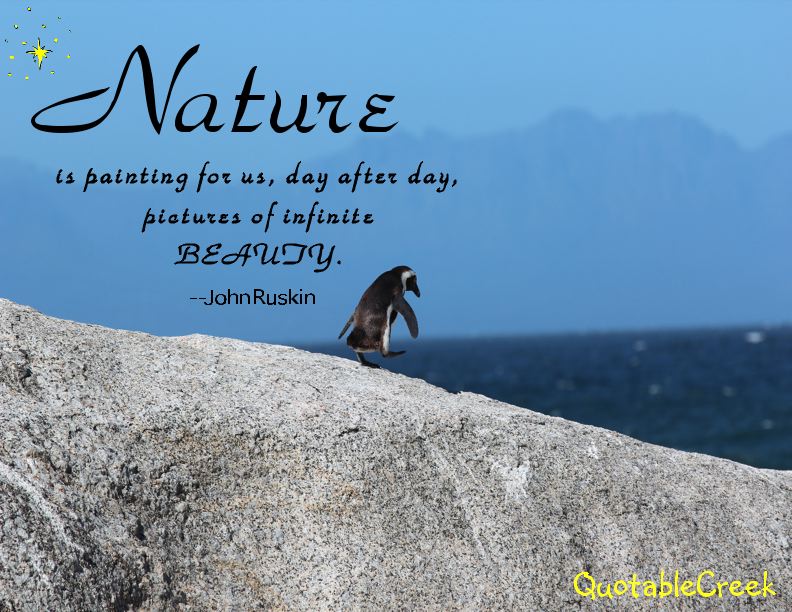
Love nature.

penguin

Once there was a man who found a penguin covered in oil, suffering, unable to move, on a Brazilian beach. He took mercy on the penguin, fed it sardines, cleaned it, and nursed it back to health. And, after 11 months, the little penguin returned to the sea.

But the following year, that penguin, Dindim, came back to the 71 year-old retired brick-layer who had saved him. And Dindim keeps coming back, traveling over eight thousand miles, to visit Mr. De Souza every year since 2011. When Dindim sees Mr. De Souza he wags his little tail and barks like a dog, settling into Mr. De Souza’s lap for cuddles and sardines. Dindim won’t let any other animals near his man.

Every year, while others of his kind are nesting, Dindim returns to Mr. De Souza who thinks of the little penguin as his child.

Every year for six years now.

What kind of miracle is this? An abiding love between a man and a penguin.  A wild animal filled with love and gratitude. Nature more complex and rich and full of mystery than we ever could have imagined.

Beautiful.
What do you know for sure? Are you sure?

doubts

“I don’t know.”

Why does it seem like these are such difficult words to say? With the vastness of the universe and multitude of things to know, why is it surprising that there are things we simply don’t know? Why are people afraid to say these words? More, important, why are people so insistent that they alone have all the answers? Wars are fought, friendships lost, research thwarted because people insist they know and everyone who disagrees doesn’t. Doubt is derided.

Does this make sense?

Even one of the wisest men around, the Dalai Lama, frequently pauses to say, “I don’t know.” It’s refreshing, isn’t it? That frank acknowledgement of the simple reality that there is much we just don’t know.

Not knowing stuff makes us want to learn, to research, to stretch, to consider the opinions of others, especially authorities on the subject. Not knowing is liberating. It sets us free to inquire and learn rather than puffing up in false bravado.

Only when we are free to ask questions and explore can we hope to get answers.


Feel sonder?

sonder

Sonder. A made-up word for a very real emotion. In his Dictionary of Obscure Sorrows, John Koenig defines it: “sonder, n. the realization that each random passerby is living a life as vivid and complex as your own.”

It’s a remarkable realization. We are all the stars of our own lives. We have our supporting casts filled with friends and families, maybe a foe or two, and then a whole world of incidental extras to our story. People behind the lit windows or sitting quiet on a shared bus or in some far off country. When we pause, we realize that they, too, have rich and complex stories filled with their own casts of characters. Their sorrows and joys are as real to them as ours to us.

Koenig has created a remarkable video to illustrate this notion of sonder. And his Dictionary of Obscure Sorrows is well worth your time. It is filled with profound insight and wonder.

But what to do with this realization, this feeling of sonder? It creates more than a passing fancy in us, doesn’t it? It leads to looking others in the eyes with respect rather than dismissing them as somehow lesser. It leads us to want to help ease their pain, as we realize that pain is as deep and biting as any we ourselves have felt, maybe even worse. It leads us to reevaluate our own centrality. Yes, we are central to our own stories, by virtue of our limited perspectives. But we don’t need to be bound in the fetters of our own subjectivity. We are central to our own stories, but not to the whole story, the world’s story, humanity’s story. There we are part of a vast cast of players, each at once both the star of their own story, and an extra in someone else’s.

Spread light.

lightbulb

Have you ever heard of Sybil Ludington?

How about Paul Revere?

In 1777, 16 year-old Sybil rode 40 miles (twice the distance of Revere’s ride) through the raining night to warn the Colonial militia of the advancing British army. She was thanked personally by George Washington for her service and bravery and yet few now know her name.

What’s most important in a war, of course, is who wins, and battlefields are littered with fallen soldiers, some remembered, most forgotten. Behind the scenes are countless more. Some heroic, some cowardly. Some remembered, most forgotten.

Fame is ephemeral. It doesn’t attach itself only to heroes or the deserving. If you chase it, you may well find yourself doing the wrong things for the wrong reasons. And, even then, if you do the things that you think will make you famous, fame could well elude you.

Character, on the other hand, is everything. Doing the right thing regardless of whether you will be remembered for it or get credit always wins. Again, your actions may go unnoticed or unappreciated, but that doesn’t change the inquiry. Doing the right thing is its own reward.

What is the right thing in these morally ambiguous and complicated times? Faith, hope, and love remain. And the greatest is love.

Do the loving thing. Spread light, not darkness. Work for peace, not division. Let your words and actions be gentle and true.

Love each other.

Laugh. :)


vacationNeed to get away?

When cool tropical breezes and the gentle lap of ocean waves beckon but are not part of any realistic plan, try an alternate get-away.

Laugh.

Lose yourself in merriment.

Maybe you can rent a funny movie, or take turns telling the silliest jokes, or play a game that involves some degree of immaturity. Up the zany quotient. Find a way to laugh and lose yourself for a while at least in the funny.

To get you started, a joke:

You know why you never see elephants hiding up in trees?

–Because they’re really good at it.


Say ahhh.

Ahkindness

What if kindness were contagious? Spreading from person to person like the most virulent flu? How might that transform a community or, even, the world?

In this classroom, kindergarteners are spreading kindness all around:

Some people might say that kindness isn’t a characteristic as common to American society as it once was.

Nevertheless, it’s standard procedure for a group of young students in one little corner of Texas County, as Plato Elementary School kindergarten teacher Amy Hathaway leads her class in an ongoing project called the “Kindness Konnection.”

Execution of the idea is three-fold: Kids mail cheerful letters to people all over the U.S., take walks to visit elderly “friends” around the Plato community and pick up trash during their outings. The first two aspects allow the students an unusual opportunity to make peoples’ days better.

“We have heard from many people who said they were having a bad day and got a letter,” Hathaway said. “They ask, ‘why me?’ I say we just do it to be nice.”

These five-year olds are spreading ripples of kindness that are reaching out across the country and making other people’s lives better. Those ripples are causing other people to send out ripples and so on and so on and so on. Their teacher marvels at the results of her little kindness experiment:

“I don’t know how not to any more,” she said. “It’s one of the most fantastic things I’ve ever done in my life. Instead of just teaching the kids to be nice, we’ve learned what friendship really is.

“We can all make a difference in this world; even a small child has the power to influence others. Kids are the greatest thing in the world, and I love sharing them with people.”

We can all send out ripples of kindness into our world. Those ripples may well create a tsunami of kindness.

Choose truth.

truth

We are in the midst of a slander epidemic. In today’s world, someone can publish fake news, and it can go viral, spreading around the world in an instant. People eagerly like and share derogatory information about people they don’t care for or political candidates they oppose. Companies can crumble based on the public’s wrath over a false bit of news. People’s lives can be ruined.

And what of the effect on all of us? It is to the point where we can’t trust much of anything we read unless we do our own diligence with fact checking and research.

What happened to the truth? What happened to accountability?

As with most things, the buck stops with each of us. We can’t control the world, but we can choose whether we want to further lies. Take your time before you believe what you hear. Do your research. And let your words and actions shine with the light of truth.

Camouflage?

camouflage

Are you hiding? Are you like a chameleon that changes colors depending on its surroundings? Is there a real you in there wanting to be seen?

We all play a bit of camouflage, don’t we? We go along with jokes that make us cringe. We dress the part we are expected to play. We let our hair down with some people but stay buttoned up around others. And perhaps some degree of that is necessary to the social fabric.

But there comes a time when we lose ourselves if we stay disguised. And, if we are hidden even from ourselves, that’s too dangerous a game.

What is your lens?

perception

What is your lens?

Do you see the world as friendly or hostile? How many of these biases do we bring to our relationships with each other and strangers?

So much of perception is bias. We see what we expect to see–based on what we think we know.

In this fascinating study, photographers were told different life stories about the man they were about to photograph– a millionaire, a hero, a former inmate, a psychic, a former alcoholic, a fisherman.

The photographers’ feelings about him based on those stories dramatically influenced the resulting portraits. It looked like they had photographed six different people.

How do your biases influence the way you see people? Can you set aside that perception to look a bit deeper?

Are you lonely?

loneliness

Are you lonely? Does your heart long to be heard and understood? For someone to get you? And for you to really hear someone in return? Are you yearning to share your heart’s stories with someone else?

Loneliness has nothing to do, really, with being alone. In fact, the worst way to be lonely might be when you are with someone else but not feeling connected.

Is there a way to ease our heart’s loneliness?

One possibility is to open yourself up. Share your true thoughts and feelings, not the masks you wear in the world, but your true self. And then be a safe place for someone else to be naked emotionally with you. Scary, yes. But what good is it if you’re not being yourself in your own relationships?

To speak to that loneliness in all of us, take a moment to savor this beautiful poem by Mary Oliver and listen for the world calling you into your place in the family of things.

Wild Geese

by Mary Oliver

You do not have to be good.
You do not have to walk on your knees
For a hundred miles through the desert, repenting.
You only have to let the soft animal of your body
love what it loves.
Tell me about despair, yours, and I will tell you mine.
Meanwhile the world goes on.
Meanwhile the sun and the clear pebbles of the rain
are moving across the landscapes,
over the prairies and the deep trees,
the mountains and the rivers.
Meanwhile the wild geese, high in the clean blue air,
are heading home again.
Whoever you are, no matter how lonely,
the world offers itself to your imagination,
calls to you like the wild geese, harsh and exciting —
over and over announcing your place
in the family of things.