What is your lens?

perception

What is your lens?

Do you see the world as friendly or hostile? How many of these biases do we bring to our relationships with each other and strangers?

So much of perception is bias. We see what we expect to see–based on what we think we know.

In this fascinating study, photographers were told different life stories about the man they were about to photograph– a millionaire, a hero, a former inmate, a psychic, a former alcoholic, a fisherman.

The photographers’ feelings about him based on those stories dramatically influenced the resulting portraits. It looked like they had photographed six different people.

How do your biases influence the way you see people? Can you set aside that perception to look a bit deeper?
Are you lonely?

loneliness

Are you lonely? Does your heart long to be heard and understood? For someone to get you? And for you to really hear someone in return? Are you yearning to share your heart’s stories with someone else?

Loneliness has nothing to do, really, with being alone. In fact, the worst way to be lonely might be when you are with someone else but not feeling connected.

Is there a way to ease our heart’s loneliness?

One possibility is to open yourself up. Share your true thoughts and feelings, not the masks you wear in the world, but your true self. And then be a safe place for someone else to be naked emotionally with you. Scary, yes. But what good is it if you’re not being yourself in your own relationships?

To speak to that loneliness in all of us, take a moment to savor this beautiful poem by Mary Oliver and listen for the world calling you into your place in the family of things.

Wild Geese

by Mary Oliver

You do not have to be good.
You do not have to walk on your knees
For a hundred miles through the desert, repenting.
You only have to let the soft animal of your body
love what it loves.
Tell me about despair, yours, and I will tell you mine.
Meanwhile the world goes on.
Meanwhile the sun and the clear pebbles of the rain
are moving across the landscapes,
over the prairies and the deep trees,
the mountains and the rivers.
Meanwhile the wild geese, high in the clean blue air,
are heading home again.
Whoever you are, no matter how lonely,
the world offers itself to your imagination,
calls to you like the wild geese, harsh and exciting —
over and over announcing your place
in the family of things.

Get dirty.


futuregardenThe daffodils are coming. Planted last fall–before the snow, before the holidays, before the divisive American election– they are starting to poke up. Soon they will be blooming everywhere adding cheer to the lives of whomever might see them.
A garden is a microcosm of life. Seasons of vibrance and beauty fall away into a frozen landscape seemingly devoid of color. But then, maybe when you’ve almost forgotten, there is blossoming and rebirth.

Gardeners and children know something that many of us have forgotten: there is joy in the dirt.

Literally.

It turns out, “Prozac may not be the only way to get rid of your serious blues. Soil microbes have been found to have similar effects on the brain and are without side effects and chemical dependency potential.”

Studies show the benefits gardeners and children will swear by of playing in the dirt are actually based on science.

It’s true. Mycobacterium vaccae is the substance under study and has indeed been found to mirror the effect on neurons that drugs like Prozac provide. The bacterium is found in soil and may stimulate serotonin production, which makes you relaxed and happier. Studies were conducted on cancer patients and they reported a better quality of life and less stress. Lack of serotonin has been linked to depression, anxiety, obsessive compulsive disorder and bipolar problems. The bacterium appears to be a natural antidepressant in soil and has no adverse health effects. These antidepressant microbes in soil may be as easy to use as just playing in the dirt.

So go ahead. Get dirty.

Read.

read1

Nowhere can you experience life from someone else’s point of view better than in a book. You can feel what it is like to be another gender, race, lifeform. Time is no limitation–you might experience life now, in the past, in the future. Opening those pages allows you to step inside someone else’s shoes. And that can’t help but change you, stretch your empathy, and expand your experience.

What would it be like if you could talk over things with those characters? Ask them about life in their shoes?

In a very cool project, doing exactly that, library patrons have the chance to check out a human book. Hopefully the human book they check out will be someone with a different life experience and perspective.

So check out a book, or maybe talk with someone as unlike from you as you can find. You’ll be surprised at all the things you have in common.


Welcome home.

ache

Something there is in each of us that yearns for home.  Sometimes we confuse that yearning with a physical place. We travel back to that place and wonder why it feels different. What has changed? Why doesn’t it still feel like home? Sometimes we confuse that yearning with a particular time, a past perhaps that wasn’t complicated with today’s troubles, and lose ourselves in nostalgia. Sometimes we confuse that yearning with a particular person and, if we lose that person, wonder if we will ever feel at home again.

But what if home is not a particular place in time but a feeling we can take steps to cultivate?

What is it, really, that ache for home? Perhaps it is a longing for a time and place when you felt welcome and that someone cared if you were there and was happy to see you. A longing for community, for fitting in. Life is difficult and we are all vulnerable, but that feeling of home makes the burden lighter somehow. Someone cares.

And, while we can’t travel backwards to any particular place or time when we felt at home, we can take steps right now today and every day from now on to be welcoming to others. The people shouting ‘Norm’ felt just as much a part of the community as Norm did when he walked into the bar in the old sitcom Cheers. 

To welcome others and to be welcomed both feel like home. There is as much community in reaching out to others as there is in someone reaching out to you. So consider who may be feeling adrift, in need of a community or a welcoming hand. And then reach out because, when your hands meet, you will both feel a bit more comfortable in this wild unpredictable and often inhospitable world.

Welcome home!

Touch eternity.

eternity

Have you ever stepped out of time? Have you ever looked about and literally seen connections between things– the trees, the grass, the wind, the birds– like a giant web of life, with you right there among it all?

Perhaps you’ve lost yourself in conversation and looked up to realize hours had passed. Perhaps you’ve been enjoying a sunset to blink and realize the night stars were twinkling. Perhaps you’ve been creating or building and felt a life force thrum inside you that felt somehow bigger and more powerful than just your own body and thoughts churning away. Perhaps a baby has curled his tiny hand around your finger.

Perhaps you’ve experienced eternity.

William Blake wrote,

To see a world in a grain of sand

And a heaven in a wild flower,

Hold infinity in the palm of your hand,

and eternity in an hour.

How? How do we do it? How do we step out of the present moment and feel a part of something greater, something infinite? How do we hold infinity in the palm of our hands?

The trick is to let go of the past and future and to focus on the present. The right here and now. Who or what is in front of you right now? Attend to that. Focus there. In the now lies everything.


Pay attention.

attention

Have you ever looked for someone in a crowd? A sea of faces, none the one you’re looking for until…..Pop! She is there- that nose, that hair, those eyes, those mannerisms, that laugh. You would know her anywhere, no matter the size of the crowd. Why is that?

Perhaps it’s because you’ve paid attention to that person. You know her as someone distinct from everyone else. She has become an individual to you. Paying attention, seeing an individual in the midst of the crowd, requires focus. It is easy to look past the individual to see the person before you– even if it is someone in your own family, school, church, city, whatever– as just part of a group. To discover the real person, that individual standing there, you have to zoom in your focus and pay attention.

In this heart-warming video, a teacher greets each of his students with a unique handshake custom-made  for that child. How can the students not see the special place they each have in his heart? What a warm and welcoming classroom that must be!

Zoom in your focus and give generously of your attention.


What’s your story?

pencils

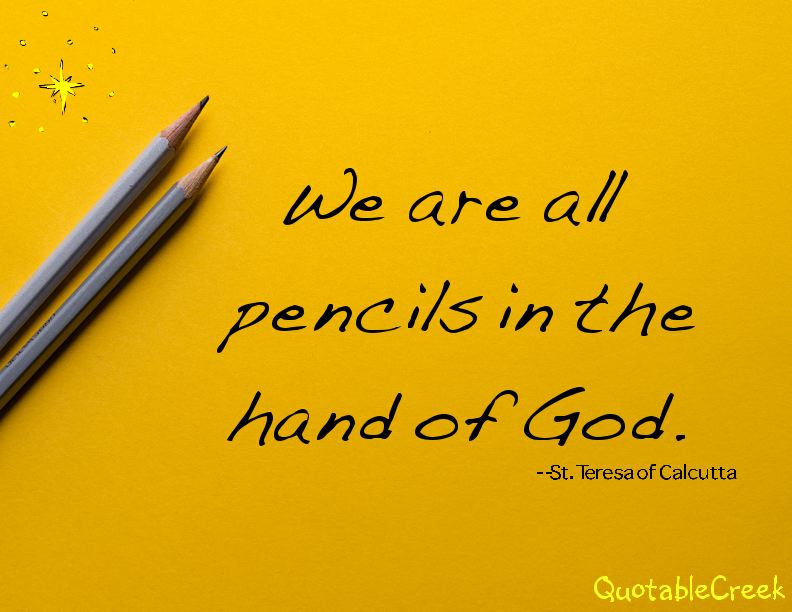
Are you the hero of your own story? What values do you stand for? If you look back at your life, do you see common elements–honesty, maybe, in the face of temptation; loyalty to family and friends, even when they maybe didn’t deserve it, strength of character?

If your life were a novel, what would be the turning points, the challenges? Who or what are the antagonists that fought you? How did you, as the main character, grow? Are you someone a reader would root for if they knew all your inner secrets?

Or, maybe, you’re not a traditional hero at all. Maybe, even, you’re a villain. Do you look back and see deceit, betrayal, unfaithfulness, selfishness?

Be honest here. No one is looking.

It never hurts to take a self-check and make sure you’re on the right trajectory to be the hero of your own story. No matter what, your life is– and don’t forget this– telling a story. Is it the story you were put on this earth to tell, or have you wandered off course?

In the case of St. Teresa quoted above, her life told a story of joy and faithfulness, even in abject poverty and working among the sick and dying. Her life told a story bigger than herself, of hope and meaning beyond the mundane. She was a hero.

What is your story?


All things?

cultivate

It’s easy to be grateful for the good things. But … everything? What about the fear, anxiety, separation, loneliness? What about the loss and persecution? What about the things that challenge our life and morality and soul? What of these?

Yes. All. Even these things that most pain us or make us worry. It is in these times we draw on something deeper than ourselves and grow. These are the times that cause us to reach out to others and embrace community. These are the depths we can survive and use that survival to offer hope to others.

Gratitude forces a perspective shift. From despair to hope. From loss to possibility. From chaos to peace.

Even now, even this, even here. Be grateful.

Look for the good.

flowers

Pessimists and optimists are both right. Technically. The glass is half full and also half empty. But the optimistic way of looking at the world, of looking for the blessings in each situation, can be much better for your health and spirit. Cultivating gratitude for each day, each experience, each person you know will give you new eyes and help you appreciate the life you are actually living.