Count blessings instead of sheep.

sleepless

Are you ever sleepless? Sometimes it’s hard to stop ruminating over things long enough to fall asleep. We replay events of the day, preview possible scenarios for tomorrow, stew over grievances from yesterday. It’s hard to just sink off and get the sleep we need.

In her short story, “The Cure for Sleeplessness“, Maeve Binchy creates a magic cure for sleeplessness:

Molly read the advice slowly. It was a detailed instruction about how the cure would take three weeks and you had to follow every step of it. First you had to buy a big notebook with at least twenty pages in it, and stick a picture on the cover, something connected with flowers. It could be a field of bluebells or a bunch of roses. Then on the night you couldn’t sleep you must get up quietly and dress properly as if you were going out visiting. You had to fix your hair and look your best. Then you made a cup of tea and got out the notebook with the flower on the cover. In your best handwriting you wrote “My Book of Blessings” on it. That first night you chose just one thing that made you happy. No more than one, and choose it carefully. It could be a love, a baby, a house, a sunset, a friend. And you wrote one page, no more, no less, about the happiness that this particular blessing brought you.


Then you spent a whole hour doing something you had meant to do, like polishing silver, or mending torn curtains, or arranging photographs in an album. No matter how tired you felt, you must finish it, then undress carefully and go back to bed….


Every night she wrote about a different blessing.


Things like the night Gerry finally told her he loved her, when his face was white and red alternately, in case she might not love him too.


Like the moment after Billy was born when she held him in her arms.


Like her parents’ silver wedding anniversary, when they had said that they knew their daughters would be as happy as they were and everyone had cried.


Like that time in the advertising agency when the boss said that Molly had saved all their jobs by her quick thinking and they had all raised a glass of Champagne to her for winning the account.

Now most of this advice and all of the examples are pure Binchy, but the gratitude part is backed by science.

A gratitude journal is good for what ails you. As you call to mind your blessings, think about why you are grateful for that particular blessing, the details surrounding it, the sensations associated with it. Write it down somewhere so you can remember. If so inclined, write a thank you note to someone who made a difference in your life. Remember to say thank yous at work, home, and school. If you encounter a problem, try to see if there is an unexpected blessing hidden there somewhere.

And then, tonight, if you should have trouble falling asleep, count your blessings instead of sheep.

Are you keeping up with the Joneses?

the-joneses

Do you find yourself comparing your life with that of your friends or co-workers? Science says that Facebook and other social media can actually make people feel sad rather than connected because it seems like your friends are having a better time than you are. Often that comparison is misleading.

But always that comparison is beside the point. There will always be someone smarter, richer, more accomplished, happier, etc. than you; just like you will be all those things for someone else.

The challenge is to be happy with what you are and have. At times like these, it is comforting to read Saint Teresa of Calcutta’s words:

People are often unreasonable, irrational, and self-centered.  Forgive them anyway.

            If you are kind, people may accuse you of selfish, ulterior motives.  Be kind anyway.

            If you are successful, you will win some unfaithful friends and some genuine enemies. Succeed anyway.

           If you are honest and sincere people may deceive you.  Be honest and sincere anyway.

            What you spend years creating, others could destroy overnight.  Create anyway.

            If you find serenity and happiness, some may be jealous.  Be happy anyway.

            The good you do today, will often be forgotten.  Do good anyway.

         Give the best you have, and it will never be enough.  Give your best anyway.

         In the final analysis, it is between you and God.  It was never between you and them anyway.

Don’t worry about the Joneses. Instead, keep your heart grateful and your actions focussed on making a positive difference in this world.

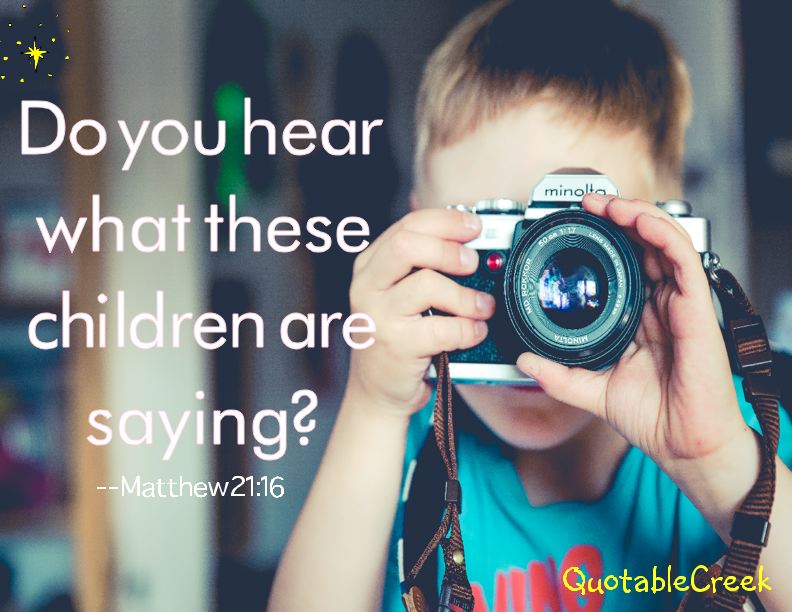
Listen to the children

children

Children have a way of shaking things up. Don’t they? They see things we’ve stopped noticing. They question things we’ve started to take for granted. They cause us to stop and notice. They hold up a giant mirror to us and cause us to do some soul-searching.

That is, if we take the time to listen.

Why is that person asking for money? Why are people starving? Why do some people get treated better? Why do you say one thing in public but do another in private? Is this fair? Does everyone cheat? Does everyone lie?  Is there a better way?

They force us to confront the gap between what we say they should do and what we do, or what society does, or what their friends do. Most adults suffer from some degree of cognitive dissonance: the mental discomfort from holding two or more differing beliefs, ideas or values at the same time. We value honesty but cheat on our taxes. We tell them not to bully others but then bully them or laugh as others are bullied. We tell them never to hit someone else while spanking them. We tell them all children are precious but then harbor racial or gender biases.

They notice.

And they point it out.

For those of us listening, this is a time to ask ourselves what we do, in fact, stand for and then work to align our lives with those values, to be internally and externally consistent.

For an unbelievably uplifting video of a diverse group of kids singing their hearts out, please watch this video. It will start your day off with hope and promise and excitement for the future of our nation and world.

Reach out in love

love

Love is an action verb and it requires an object. X loves Y. A mother loves her child. A man loves his wife. What does that mean to love? While the dictionary may tell you that it means that you have certain feelings for someone, experience tells you that it means acting on those feelings, day in and day out, in the way you treat the one you love. Substitute a different transitive verb in its place, throw, for instance: A boy throws the ball. That throwing, the action, defines the relationship between that boy and the ball. Without the throwing, you just have a ball and a boy sharing space.

Isn’t that true of love, as well? It’s nice that you did things in the past that were loving, or look forward to a happy Valentine’s day or some event in the future. But what are you doing NOW to love someone?

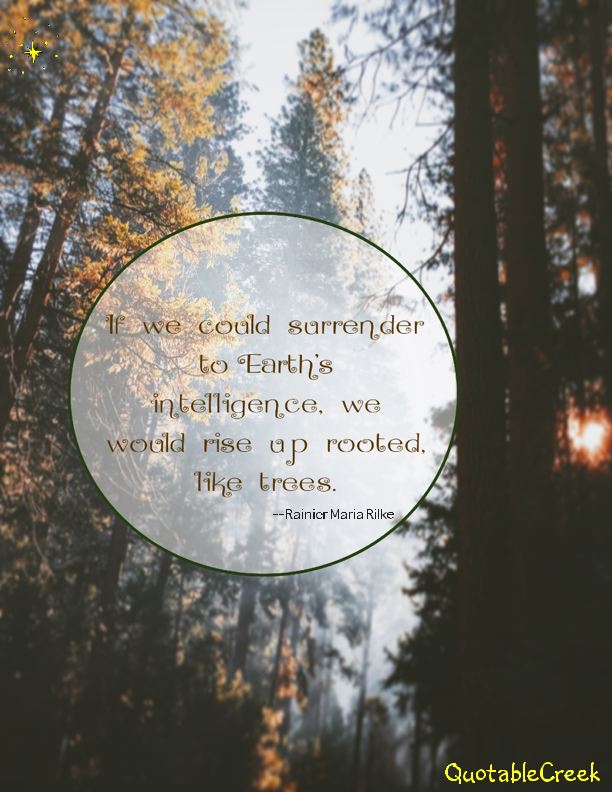
Take root

rootedtrees

Do you ever feel tossed about, disconnected, or alone? Perhaps we can learn something from the trees. Did you know that the giant Quaking Aspen forest is really just basically one tree with a single root system? Each of the trees is identical to the rest DNA-wise, all shooting up (and looking like separate trees) from the same shallow root system. Similarly, the Redwood, among the oldest living things on Earth, shares its relatively shallow root system with other redwoods and other trees. That interconnectedness is its strength and helps the huge trees withstand storms and heavy winds.

We are not meant to be isolated but thrive in community. Like the trees, when we are interconnected with others, we can rely on each other for strength when we are buffeted about by life.

Where can you put down your roots? Find that community–whether it be a group joined by faith, neighborhood, family, interests, or goals. We all need to provide support for and receive support from others.

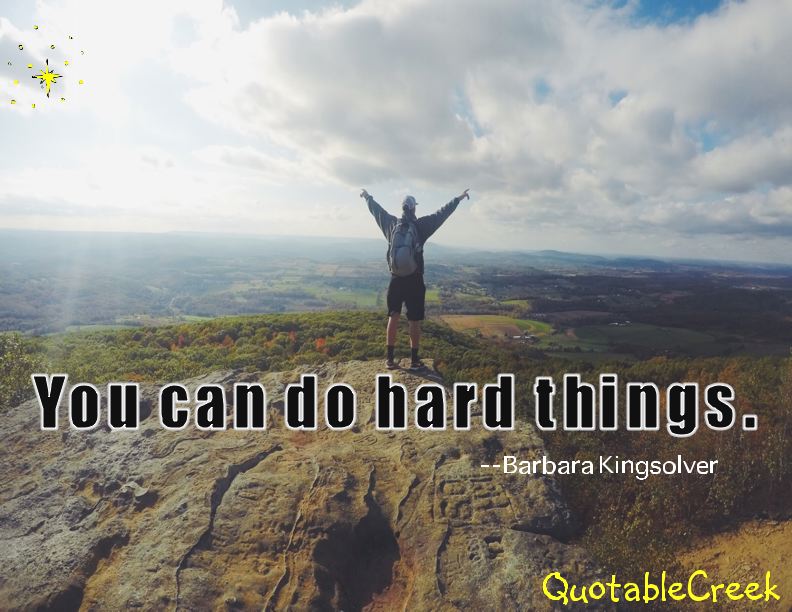
You can!

hardthings

Is there something challenging on your agenda today? Perhaps a difficult task or conversation? It will help if you can take a minute and remember some of the hard things you have accomplished and remind yourself that you can do and have done hard things.

In today’s world, parents often swoop in and rescue their children rather than letting that child struggle. These helicopter parents might actually be preventing their kids from growing stronger. Barbara Kingsolver credits the Montessori preschool she sent her children to with teaching her that struggle, failure, and persistence is ultimately what teaches a child that he can indeed do hard things.

Kids learn self-esteem from mastering difficult tasks.  It’s as simple as that. The Montessori teachers told me to put my two-year-old on a stool and give her the bread, give her the peanut butter, give her the knife — a blunt knife — and let her make that sandwich and get peanut butter all over the place, because when she’s done, she’ll feel like a million bucks.  I thought that was brilliant.  Raising children became mostly a matter of enabling them and standing back and watching.  When a task was difficult, that’s when I would tell them, “You can do hard things.”  Both of them have told me they still say to themselves, “I can do hard things.”  It helps them feel good about who they are, not just after they’ve finished, but while they’re engaged in the process.

Tell yourself again and again, if necessary: You can do hard things! (And then go out and do them!!)

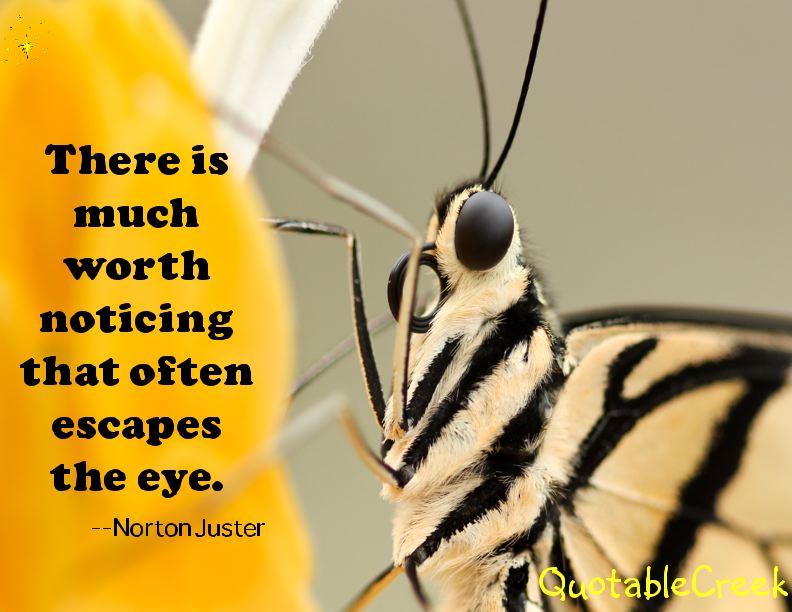
Notice even the tiniest of things

noticing

So it’s a butterfly. We’ve seen thousands of butterflies. They’re pretty, but quick. So even though we notice them often, have we really ever seen one?

That coiled up hose in the center of its face is its proboscis. It uncoils when the butterfly’s feet (yes, its feet– its taste organs are located at the ends of each of its six feet) detect the presence of food stuffs. Some butterflies have sharp proboscises so that they can puncture the skin of fruit to get to the juice inside. (Do you remember seeing a proboscis on a caterpillar? Nope, caterpillars have munchy little mouths.) Those huge compound eyes are great at detecting color and movement. The wings are made up of scales, somewhere between a fish’s scales and bitty hairs, protecting the wing and adding the unique patterns. The fascinating details of butterflies go on and on, and vary among the different types of butterflies.

Pausing to notice the details of the butterfly puts a larger question: How much are we really noticing day to day? What are we missing? What are we glossing over? What assumptions are we making? What are we generalizing about when really we need to go case by case?

What will we see better if we pause to take notice?


Embrace your life

takeflight

Sometimes things don’t go as planned. Divorce, death, job loss, break-ups, illness, insecurity, and anxiety plague us all. These things happen. To the best of people. They do. But even if we planned to stay married to our childhood sweethearts forever, and that we would mature and grow in perfect harmony at the same rate and die in each other’s arms at a ripe old age, sometimes that isn’t the way the story unfolds. Sometimes we get sick in awful, maybe crippling, ways. Sometimes we lose our jobs and are afraid. Sometimes the person we thought was the one breaks our heart.

It is tempting to cling to that perfect vision we had for our lives and get stuck. Instead of gathering ourselves up, we keep trying to perfect the past. We rage; we shut off; we lose ourselves in denial. We go over and over what went wrong and wish and pray for that to change. Somehow. We want to go back to when the hurt was still unknown in our futures rather than spend time where that hurt is all to well-known and debilitating in our presents.

But today is a new day. When we accept the lives we have rather than mourn the ones we hoped for, the promise of that new day whispers all about us. We can gather ourselves up– broken heart, broken wings, and all– and take flight.