What is your first thought in the morning?
friendlyuniverse

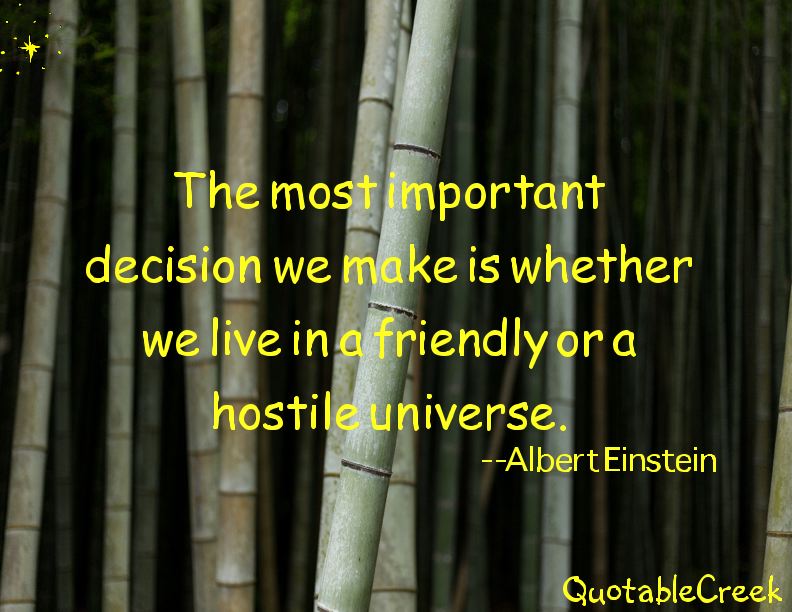
What is your first thought when you wake up? Does your mind move to a To-Do list or worst case scenarios, or do you turn to the things that you are looking forward to–a workplace filled with people to greet, a family to hug before each starts their day, the possibility in the unknowns awaiting you. Albert Einstein considered this the most important question you will ever ask yourself–Is the world you live in hostile or friendly?

Looking for the positive first thing in the morning can start your day off on the right foot and prime you to see the positive things you are looking for:

In other words, the more good you search out in this world, the more good you’ll receive in return.

When you wake up and choose (consciously or unconsciously) to live in a “bad” world, you go through your day much differently. You feel frustrated when you wind up behind somebody who’s walking super slowly or if you get stuck in traffic. Standing in line at the store feels like an eternity and everything you do seems ten times harder.

Nothing works out like it should and you’re constantly waiting for things to go wrong (which they usually will) — things that “prove” that the world is a hostile place.

Having a positive attitude has helped people deal with seemingly insurmountable life circumstances. Anne Frank, for instance, concluded even after spending time in hiding during WWII, “In spite of everything, I still believe that people are really good at heart.”

Some suggestions to start you off in the morning on the happy foot:

  • Choose words and statements that reflect a positive attitude: “I will have a good day” or “I’m excited about what lies ahead today.”

  • Focus on things that make you happy:“I look forward to seeing my kid’s school play tonight” or “I can’t wait to see where this project at work takes me!”

  • Appreciate the good things in your world: “I’m thankful for my health, the fact that I can pay the bills, and that I have such a wonderful family!”

  • Spend more time with positive people, making it easier to be positive yourself!

It’s never going to be 100 percent, but if you focus on the good just a bit more than the bad, you’re making progress. It’s all about baby steps.

So when you wake up tomorrow, ask yourself this question:

“Do I live in a good world or a bad world?”

Here’s hoping you have a positive tomorrow!
Look at your stuff.

stuff

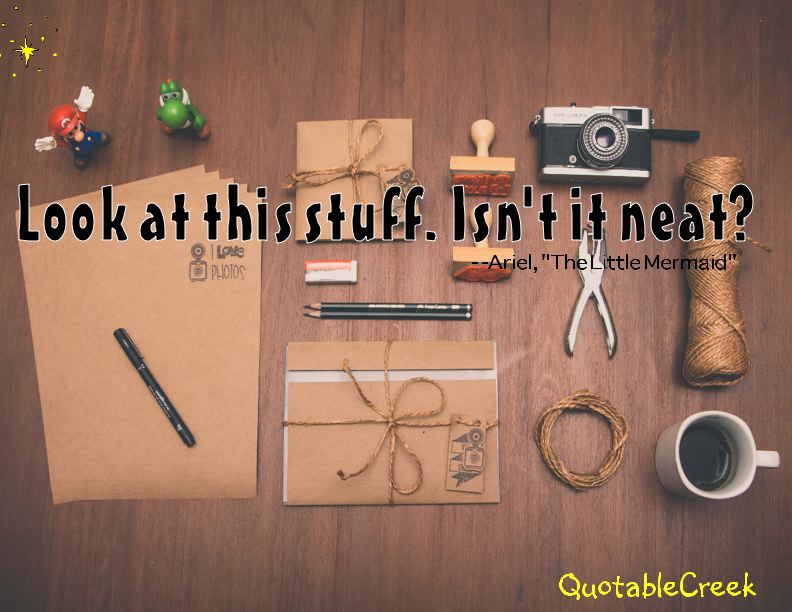
Look at the stuff around you. Isn’t it neat?

Paper milled from trees, decorated, maybe even scented. Ink dispensed evenly and gently maybe with a little roller ball. Books mass printed for everyone. Glasses to help you see.

Look at the little paper clip folded around and again just so. Isn’t that clever? Where did that coffee come from? Maybe from beans grown thousands of miles away. Isn’t that amazing? What about your computer, able to connect you, literally, to any one in the world and even beyond? Maybe you’re reading this right now out and about in the world somewhere.

All these little astonishing things sitting right there on your desk or in your pocket or your glovebox.

Take a minute to be astonished.

And then treat yourself to this 3-year old’s performance of Ariel’s song above and prepare to be filled with joy and even more wonder!

This is today.

yesterday's window

Do not lose heart. The challenges you see today are the ones you must face. You are strong enough to do your part, and you will find allies everywhere you look.

Do not be afraid.

You may feel you are riding on stormy seas, but look around you. In the words of Dr. Clarissa Pinkola Estes:

Look out over the prow; there are millions of boats of righteous souls on the waters with you. Even though your veneers may shiver from every wave in this stormy roil, I assure you that the long timbers composing your prow and rudder come from a greater forest. That long-grained lumber is known to withstand storms, to hold together, to hold its own, and to advance, regardless.

In any dark time, there is a tendency to veer toward fainting over how much is wrong or unmended in the world. Do not focus on that. There is a tendency, too, to fall into being weakened by dwelling on what is outside your reach, by what cannot yet be. Do not focus there. That is spending the wind without raising the sails.

We are needed, that is all we can know. And though we meet resistance, we more so will meet great souls who will hail us, love us and guide us, and we will know them when they appear. Didn’t you say you were a believer? Didn’t you say you pledged to listen to a voice greater? Didn’t you ask for grace? Don’t you remember that to be in grace means to submit to the voice greater?

Ours is not the task of fixing the entire world all at once, but of stretching out to mend the part of the world that is within our reach. Any small, calm thing that one soul can do to help another soul, to assist some portion of this poor suffering world, will help immensely. It is not given to us to know which acts or by whom, will cause the critical mass to tip toward an enduring good.

You do not need to do everything. Do what you can, where you can, with what you can. Your actions combined with actions from millions of like-minded individuals will make a difference for good.

Do not lose heart.

Pay attention.

waterfallattn

What do we miss simply by failing to pay attention? By rushing?

In 2007, in the arcade area of a subway in D.C., over a thousand people missed something spectacular. Joshua Bell, one of today’s foremost classical musicians, played a few pieces by Bach and Mendelssohn, among others, on his multi-million dollar violin. Three days before this, Bell had performed to a filled Symphony Hall in Boston where tickets for average seats went for over $100.

Over a thousand people rushed by on their way to work and failed to notice the free gift. Why?

Was it because of the context? Bell wasn’t in a tuxedo; he had an open violin case in front of him sprinkled with change and a couple bucks; the forum was mundane; Bell looked just like any other street musician.

Why didn’t Bell’s expertise and the difficulty and complexity of the pieces he played transcend the day to day and encourage people to stop and listen?

Perhaps it is because we have become a bit numb to beauty. We don’t look for it in the ordinary places. Maybe we even look away from the ordinary places.

We miss so much when we rush.

Slow down. What amazing thing is right there if only you stop to see?

Against the wind.

againstthewind

Will you go faster walking uphill or downhill, against the wind or with the wind at your back?

But which will make you stronger?

There are times in life when we can coast. And that’s fun, frankly. But when we want to get strong, we need opposition. We use weights to work out; we pick harder puzzles; we challenge better athletes; we set more complex goals; we tackle more difficult projects. This is when we progress.

Even when challenges are involuntary, we can use those opportunities to dig deep and find answers. Sometimes challenges force us to realize that we are all connected and to seek help from others knowing that, one day, we will be the one offering help. There is strength in community.

If you are struggling now, remember those times when you faced a challenge and won. You will get stronger.

Persist.

Are you lonely?

loneliness

Are you lonely? Does your heart long to be heard and understood? For someone to get you? And for you to really hear someone in return? Are you yearning to share your heart’s stories with someone else?

Loneliness has nothing to do, really, with being alone. In fact, the worst way to be lonely might be when you are with someone else but not feeling connected.

Is there a way to ease our heart’s loneliness?

One possibility is to open yourself up. Share your true thoughts and feelings, not the masks you wear in the world, but your true self. And then be a safe place for someone else to be naked emotionally with you. Scary, yes. But what good is it if you’re not being yourself in your own relationships?

To speak to that loneliness in all of us, take a moment to savor this beautiful poem by Mary Oliver and listen for the world calling you into your place in the family of things.

Wild Geese

by Mary Oliver

You do not have to be good.
You do not have to walk on your knees
For a hundred miles through the desert, repenting.
You only have to let the soft animal of your body
love what it loves.
Tell me about despair, yours, and I will tell you mine.
Meanwhile the world goes on.
Meanwhile the sun and the clear pebbles of the rain
are moving across the landscapes,
over the prairies and the deep trees,
the mountains and the rivers.
Meanwhile the wild geese, high in the clean blue air,
are heading home again.
Whoever you are, no matter how lonely,
the world offers itself to your imagination,
calls to you like the wild geese, harsh and exciting —
over and over announcing your place
in the family of things.

Get dirty.


futuregardenThe daffodils are coming. Planted last fall–before the snow, before the holidays, before the divisive American election– they are starting to poke up. Soon they will be blooming everywhere adding cheer to the lives of whomever might see them.
A garden is a microcosm of life. Seasons of vibrance and beauty fall away into a frozen landscape seemingly devoid of color. But then, maybe when you’ve almost forgotten, there is blossoming and rebirth.

Gardeners and children know something that many of us have forgotten: there is joy in the dirt.

Literally.

It turns out, “Prozac may not be the only way to get rid of your serious blues. Soil microbes have been found to have similar effects on the brain and are without side effects and chemical dependency potential.”

Studies show the benefits gardeners and children will swear by of playing in the dirt are actually based on science.

It’s true. Mycobacterium vaccae is the substance under study and has indeed been found to mirror the effect on neurons that drugs like Prozac provide. The bacterium is found in soil and may stimulate serotonin production, which makes you relaxed and happier. Studies were conducted on cancer patients and they reported a better quality of life and less stress. Lack of serotonin has been linked to depression, anxiety, obsessive compulsive disorder and bipolar problems. The bacterium appears to be a natural antidepressant in soil and has no adverse health effects. These antidepressant microbes in soil may be as easy to use as just playing in the dirt.

So go ahead. Get dirty.

Consider the birds.

silence

Consider the birds. They have so much to teach us. They sing; they fly; they soar. When the storm is over, they come out and sing, fly, and soar again. They vary dramatically from the tiny hummingbird to the great bald eagle, but they have so much in common. And, when we are quiet, they remind us to look up, to look to the future and the possibility that lies there. It turns out considering the birds is good for our well-being, keeping depression at bay.

Be still and notice the birds. Do you see the vulture with its huge wings soaring above you? Do you hear the hawk shriek?  Do you see the crows tuck in their wings and dive to open them again and rise only after you gasp, worried?

Watch them bathe in a puddle, delighting in the way the water splashes around them. Listen to them sing.

They sing for you.

Welcome home.

ache

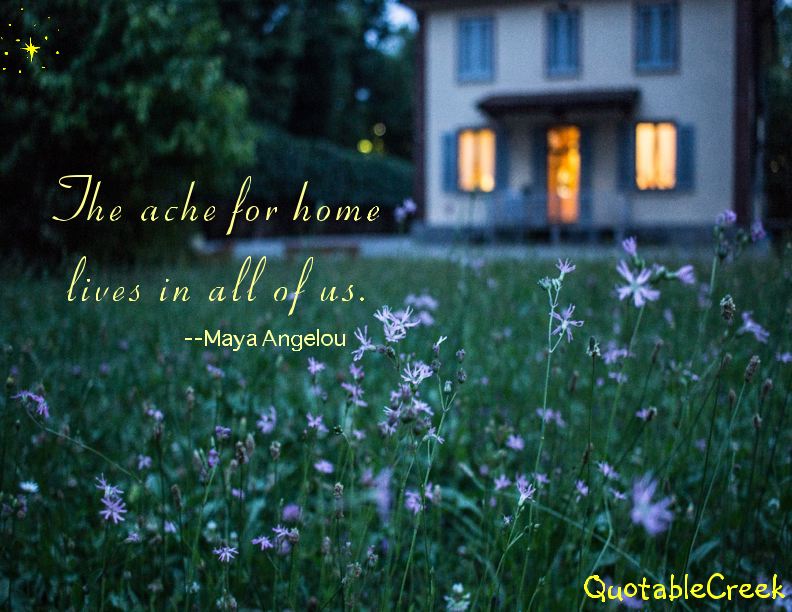
Something there is in each of us that yearns for home.  Sometimes we confuse that yearning with a physical place. We travel back to that place and wonder why it feels different. What has changed? Why doesn’t it still feel like home? Sometimes we confuse that yearning with a particular time, a past perhaps that wasn’t complicated with today’s troubles, and lose ourselves in nostalgia. Sometimes we confuse that yearning with a particular person and, if we lose that person, wonder if we will ever feel at home again.

But what if home is not a particular place in time but a feeling we can take steps to cultivate?

What is it, really, that ache for home? Perhaps it is a longing for a time and place when you felt welcome and that someone cared if you were there and was happy to see you. A longing for community, for fitting in. Life is difficult and we are all vulnerable, but that feeling of home makes the burden lighter somehow. Someone cares.

And, while we can’t travel backwards to any particular place or time when we felt at home, we can take steps right now today and every day from now on to be welcoming to others. The people shouting ‘Norm’ felt just as much a part of the community as Norm did when he walked into the bar in the old sitcom Cheers. 

To welcome others and to be welcomed both feel like home. There is as much community in reaching out to others as there is in someone reaching out to you. So consider who may be feeling adrift, in need of a community or a welcoming hand. And then reach out because, when your hands meet, you will both feel a bit more comfortable in this wild unpredictable and often inhospitable world.

Welcome home!