Be the storm.

storm

Is there a sleeping giant inside of you waiting to wake up and make a difference? Perhaps there is a cause you want to help or a need you see in your community? Are there people who need an ally? What can you do? How can you help?

You are more powerful than you ever dreamed.

Now is the time.


Be kind.

kindness

Kindness isn’t something you ponder in your heart. It is something you do–with your hands, with your words, with your gifts. Person to person, face to face. Lift those who have fallen; feed those who are hungry; speak up for those without a voice; reach out to those who feel alone.

In her song, Hands, Jewel reminds us that even when our hands are small, they are the tools we have to help others and we must use them. That is the way we will use our lives to make a difference for the better in the lives of those around us.

When she was 18, pop singer Jewel lived in a van. One day, she walked into a store to shoplift a dress; but looking at her hands, she realized she controlled them. “I realized I was cheating myself.” Here’s a song titled ‘Hands’ with a beautiful refrain: ‘In the end, only kindness matters.”

Listen to Jewell’s beautiful song here. And, today, contemplate her words:

We will fight, not out of spite
For someone must stand up for what’s right
Cause where there’s a man who has no voice
There ours shall go singing

My hands are small, I know,
But they’re not yours they are my own
And I am never broken

Today, be kind. Look for any and every opportunity to make a difference.


Lead your children well.

children

None of us knows what the future holds. But we do know the values we hold dear–honesty, integrity, love, compassion, empathy, respect, tolerance. As we raise our children, we instill these values. As adults, we model these values whether we win or lose, succeed or fail, sink or swim.  Watching us, they learn, and, as they go forward into their futures, they will bring these values to their own decisions. If each of us does this, we will leave the world a better brighter place for our having been here.

Rise up.

serenity

Life knocks us down. What helps us get back up?

It’s not about how smart we are, or who we know, or what school we went to. It’s about resilience. Our emotional IQs may be just as important, if not more important, than our actual IQs.

Our emotional intelligence is subtle:

Emotional intelligence is the “something” in each of us that is a bit intangible. It affects how we manage behavior, navigate social complexities, and make personal decisions that achieve positive results. Emotional intelligence is made up of four core skills that pair up under two primary competencies: personal competence and social competence.

And, as luck would have it, our emotional intelligence is something we can work to improve:

Unlike your IQ, your EQ is highly malleable. As you train your brain by repeatedly practicing new emotionally intelligent behaviors, your brain builds the pathways needed to make them into habits. Before long, you will begin responding to your surroundings with emotional intelligence without even having to think about it. And as your brain reinforces the use of new behaviors, the connections supporting old, destructive behaviors will die off.

Consider these nine habits of emotionally intelligent people:

1. They’re relentlessly positive. 
2. They have a robust emotional vocabulary.

3. They’re assertive.

4. They’re curious about other people.

5. They forgive, but they don’t forget. 
6. They won’t let anyone limit their joy.

7. They make things fun.

8. They are difficult to offend. 
9. They quash negative self-talk.

Focus on the things you can control. Don’t get lost in the negativity of things beyond your sphere of influence. Remember to stay positive and joyful.

And then get yourself back up!


Chuck the lies.

honesty

Lie? Why not? Everyone does it, don’t they?

We have many words for lies: white lies, fudging, fibs, whoppers, but what is at the heart of each is knowingly substituting a different version of the facts for what we know is the truth. Sometimes, like with Wells Fargo and Bernie Madoff, the lies result in substantial financial gain for the liar and substantial loss for the victim.

What propels someone to lie so extravagantly or, even, at all?

Studies show that the big whoppers evolve from the littlest of lies: our brain changes as we lie, making us more and more willing to tell bigger and bigger lies:

A new study claims to provide the first empirical evidence showing that dishonesty gradually increases over time. By using scans that measured the brain’s response to lying, researchers saw that each new lie resulted in smaller and smaller neurological reactions ― especially in the amygdala, which is the brain’s emotional core.

In effect, each new fib appeared to desensitize the brain, making it easier and easier to tell more lies.

This is alarming, not just because it can lead to widespread fraud but also because a liar begins to live in an alternate reality. Over time, people can begin to believe the lies they tell themselves and others, putting them in a position where their beliefs just don’t square with the world they’re living in. They are constantly confronted with the disconnect between their altered reality and reality itself, leading to greater and greater anger and frustration. Sometimes those lies are self-delusional, leading people to never adequately address and progress beyond their own problems. In short, lies lead to fragmentation, discord, breach of trust, chaos.

Now, truth doesn’t always lead to harmony. Some truths lead to a road of very hard work, reconciliation, and compromise. But at the heart of telling the truth is an increase in trust which is the glue that binds a couple, a family, a community, a country, and is necessary for any true progress.


Color your world!

color

Are you having a basic beige day? A blue day? A red explosion day? Color is surprisingly important behind the scenes to our mood and can affect how you feel.

Some studies have shown that color can have dramatic consequences on behavior:

  • One study found that warm-colored placebo pills were reported as more effective than cool-colored placebo pills.

  • Anecdotal evidence has suggested that installing blue-colored streetlights can lead to reduced crime in those areas.

  • The temperature of the environment might play a role in color preference. People who are warm tend to list cool colors as their favorites, while people who are cold prefer warmer colors.

  • More recently, researchers discovered that the color red causes people to react with greater speed and force, something that might prove useful during athletic activities.

  • One study that looked at historical data found that sports teams dressed in mostly black uniforms are more likely to receive penalties and that students were more likely to associate negative qualities with a player wearing a black uniform.

One study suggests that placing misbehaving children in a pink room can calm them down better than anything else! And that calming effect has been employed in visiting team’s locker room to mellow them out and make them less likely to win a game.  Many things have been written about the use of color in decorating in creating a home that reflects the mood you are after.

So what to make of these interesting tidbits? First, there is so much more going on in our brains with respect to our moods and behaviors than we realize. But, second, why not try a bit of a color experiment on yourself? If you are feeling blue, dress in yellow. If you want some comfort, how about a nurturing tan? If nothing else, it will feel a lot like playing dress up, and we all know how good play is for even the most serious among us.

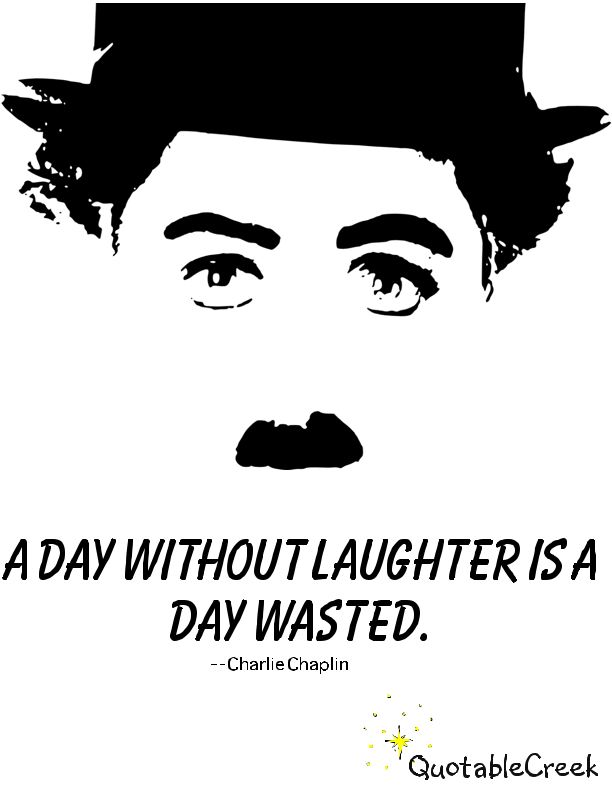
Laugh!!

chaplin

Laughter is good for what ails you. Studies show it improves your immune system, relieves pain, helps you connect with others, and improves your mood. In stressful times, laughter can cut the tension and increase cooperation.

But, make sure what you’re laughing at is good, clean fun. If someone is the butt of the joke, you might just be adding to the stress rather than getting a much-needed break. There is a line where funny videos inspire more concern for a victim than laughter. Racist or sexist jokes may well feel more like a weapon wielded than a funny bone tickled.

So, start with a smile and then, let her rip. Laughing at jokes, a situation, yourself… may just well be what the doctor ordered

Fail again. Fail better.

failure

Fear of failure can keep us from trying something we really, really want to try. And it can keep us from admitting that we have taken a wrong turn and need to reevaluate things. But, at some point, we have to ask ourselves, why? What is so bad about failure?

Thomas Edison famously said, “I have not failed. I’ve just found 10,000 ways that won’t work.” Each experiment that did not succeed helped him move forward on the one path that would ultimately succeed by ruling out the other paths. That attitude helped spur him on because each failed experiment was itself a discovery and taught him something he didn’t know before.

In this remarkable TED talk, Kathryn Schulz, a self-proclaimed wrong-ologist, talks about failure and our responses to it and suggests that it is in these moments of failure, or, as she sees it, moments when reality does not align with our expectations, that the moments of growth, creativity, expansion happen:

So effectively, we all kind of wind up traveling through life, trapped in this little bubble of feeling very right about everything.

I think this is a problem. I think it’s a problem for each of us as individuals, in our personal and professional lives, and I think it’s a problem for all of us collectively as a culture. So what I want to do today is, first of all, talk about why we get stuck inside this feeling of being right. And second, why it’s such a problem. And finally, I want to convince you that it is possible to step outside of that feeling and that if you can do so, it is the single greatest moral, intellectual and creative leap you can make.

So why do we get stuck in this feeling of being right? One reason, actually, has to do with a feeling of being wrong. So let me ask you guys something — or actually, let me ask you guys something, because you’re right here: How does it feel — emotionally — how does it feel to be wrong? Dreadful. Thumbs down. Embarrassing. Okay, wonderful, great. Dreadful, thumbs down, embarrassing — thank you, these are great answers, but they’re answers to a different question. You guys are answering the question: How does it feel to realize you’re wrong? (Laughter) Realizing you’re wrong can feel like all of that and a lot of other things, right? I mean it can be devastating, it can be revelatory, it can actually be quite funny, like my stupid Chinese character mistake. But just being wrong doesn’t feel like anything.

I’ll give you an analogy. Do you remember that Loony Tunes cartoon where there’s this pathetic coyote who’s always chasing and never catching a roadrunner? In pretty much every episode of this cartoon,there’s a moment where the coyote is chasing the roadrunner and the roadrunner runs off a cliff, which is fine — he’s a bird, he can fly. But the thing is, the coyote runs off the cliff right after him. And what’s funny — at least if you’re six years old — is that the coyote’s totally fine too. He just keeps running — right up until the moment that he looks down and realizes that he’s in mid-air. That’s when he falls. When we’re wrong about something — not when we realize it, but before that — we’re like that coyote after he’s gone off the cliff and before he looks down. You know, we’re already wrong, we’re already in trouble, but we feel like we’re on solid ground. So I should actually correct something I said a moment ago. It does feel like something to be wrong; it feels like being right.

We have all been raised to get the right answers on the test, to score a winning shot, to achieve. But reality is more complex than a true-false quiz. No one of us has all the answers. And yet it feels like we do.

Schulz thinks this can be dangerous:

Think for a moment about what it means to feel right. It means that you think that your beliefs just perfectly reflect reality. And when you feel that way, you’ve got a problem to solve, which is, how are you going to explain all of those people who disagree with you? It turns out, most of us explain those people the same way, by resorting to a series of unfortunate assumptions. The first thing we usually do when someone disagrees with us is we just assume they’re ignorant. They don’t have access to the same information that we do, and when we generously share that information with them, they’re going to see the light and come on over to our team. When that doesn’t work, when it turns out those people have all the same facts that we do and they still disagree with us, then we move on to a second assumption,which is that they’re idiots. (Laughter) They have all the right pieces of the puzzle, and they are too moronic to put them together correctly. And when that doesn’t work, when it turns out that people who disagree with us have all the same facts we do and are actually pretty smart, then we move on to a third assumption: they know the truth, and they are deliberately distorting it for their own malevolent purposes. So this is a catastrophe.

This attachment to our own rightness keeps us from preventing mistakes when we absolutely need to and causes us to treat each other terribly. But to me, what’s most baffling and most tragic about this is that it misses the whole point of being human. It’s like we want to imagine that our minds are just these perfectly translucent windows and we just gaze out of them and describe the world as it unfolds. And we want everybody else to gaze out of the same window and see the exact same thing. That is not true, and if it were, life would be incredibly boring. The miracle of your mind isn’t that you can see the world as it is.It’s that you can see the world as it isn’t. We can remember the past, and we can think about the future,and we can imagine what it’s like to be some other person in some other place. And we all do this a little differently, which is why we can all look up at the same night sky and see this and also this and also this.And yeah, it is also why we get things wrong.

We are fallible. We make mistakes, constantly even, and no amount of convincing ourselves otherwise changes this particular reality. Once we accept this, we can soften our edges in the ways we treat each other and ourselves. We can jump into an uncertain future, not knowing what can happen because we realize we ACTUALLY DO NOT KNOW what will happen. That lack of knowledge isn’t something to be ashamed of or to pretend isn’t there like Wile E. Coyote who has just run off a cliff: it’s part of the human condition. We simply do not have all the answers.

Today, embrace the moment and consider each experience a learning opportunity to grow and stretch and learn. To maybe, even, discover you’ve been wrong and to incorporate that new knowledge into your choices going forward.