Notice even the tiniest of things

noticing

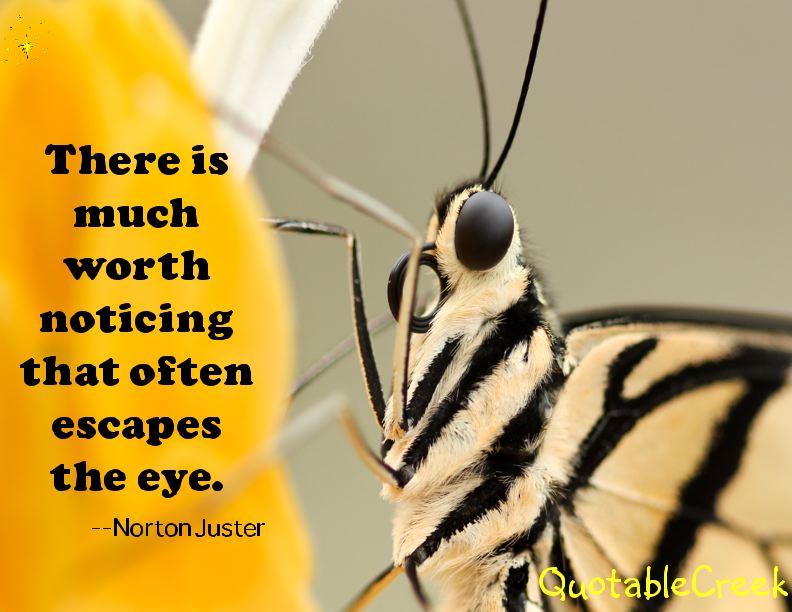
So it’s a butterfly. We’ve seen thousands of butterflies. They’re pretty, but quick. So even though we notice them often, have we really ever seen one?

That coiled up hose in the center of its face is its proboscis. It uncoils when the butterfly’s feet (yes, its feet– its taste organs are located at the ends of each of its six feet) detect the presence of food stuffs. Some butterflies have sharp proboscises so that they can puncture the skin of fruit to get to the juice inside. (Do you remember seeing a proboscis on a caterpillar? Nope, caterpillars have munchy little mouths.) Those huge compound eyes are great at detecting color and movement. The wings are made up of scales, somewhere between a fish’s scales and bitty hairs, protecting the wing and adding the unique patterns. The fascinating details of butterflies go on and on, and vary among the different types of butterflies.

Pausing to notice the details of the butterfly puts a larger question: How much are we really noticing day to day? What are we missing? What are we glossing over? What assumptions are we making? What are we generalizing about when really we need to go case by case?

What will we see better if we pause to take notice?


Embrace your life

takeflight

Sometimes things don’t go as planned. Divorce, death, job loss, break-ups, illness, insecurity, and anxiety plague us all. These things happen. To the best of people. They do. But even if we planned to stay married to our childhood sweethearts forever, and that we would mature and grow in perfect harmony at the same rate and die in each other’s arms at a ripe old age, sometimes that isn’t the way the story unfolds. Sometimes we get sick in awful, maybe crippling, ways. Sometimes we lose our jobs and are afraid. Sometimes the person we thought was the one breaks our heart.

It is tempting to cling to that perfect vision we had for our lives and get stuck. Instead of gathering ourselves up, we keep trying to perfect the past. We rage; we shut off; we lose ourselves in denial. We go over and over what went wrong and wish and pray for that to change. Somehow. We want to go back to when the hurt was still unknown in our futures rather than spend time where that hurt is all to well-known and debilitating in our presents.

But today is a new day. When we accept the lives we have rather than mourn the ones we hoped for, the promise of that new day whispers all about us. We can gather ourselves up– broken heart, broken wings, and all– and take flight.

Relax into a more creative life

echo

What if living a creative life did not necessitate a tortured anguished existence but rather was simply following curiosity into an abundance of ideas and energy swirling about you? What if those ideas were looking for someone, you, perhaps, to give them shape and form, to bring them into being? What if creativity meant elevating curiosity above fear?

“What if”–two of the most powerful words there are.

In her book, Big Magic, Elizabeth Gilbert offers a glimpse into such a world with the remarkable story of one poet, Ruth Stone, catching her poem by the tail and pulling it forcefully into existence:

[Ruth Stone] told me that when she was a child growing up on a farm in rural Virginia, she would be out working in the fields when she would sometimes hear a poem coming toward her -– hear it rushing across the landscape at her, like a galloping horse. Whenever this happened, she knew exactly what she had to do next: she would “run like hell” toward the house, trying to stay ahead of the poem, hoping to get to a piece of paper and a pencil fast enough to catch it. That way, when the poem reached her and passed through her, she would be able to grab it and take dictation, letting the words pour forth onto the page. Sometimes, however, she was too slow, and she couldn’t get to the paper and pencil in time. At those instances, she could feel the poem rushing right through her body and out the other side. It would be in her for a moment, seeking a response, and then it would be gone before she could grasp it –- galloping away across the earth, as she said, “searching for another poet.” But sometimes (and this is the wildest part) she would nearly miss the poem, but not quite. She would just barely catch it, she explained, “by the tail.” Like grabbing a tiger. Then she would almost physically pull the poem back into her with one hand, even as she was taking dictation with the other. In these instances, the poem would appear on the page from the last word to the first -– backward, but otherwise intact.

Even if we are not sensitive enough to hear poems galloping toward us, we may have experienced a moment of feeling like we were a part of something far bigger and more mysterious than ourselves. Of being in the flow where our sense of time stopped and we were caught up in the bliss of creating.  Maybe while writing, drawing, dancing, gardening, cooking, running, skating or whatever it was that made time stop. We each step into this creative swirl differently, but what we encounter there is much the same: joy, transcendence, and mystery.

Lighten up

groucho

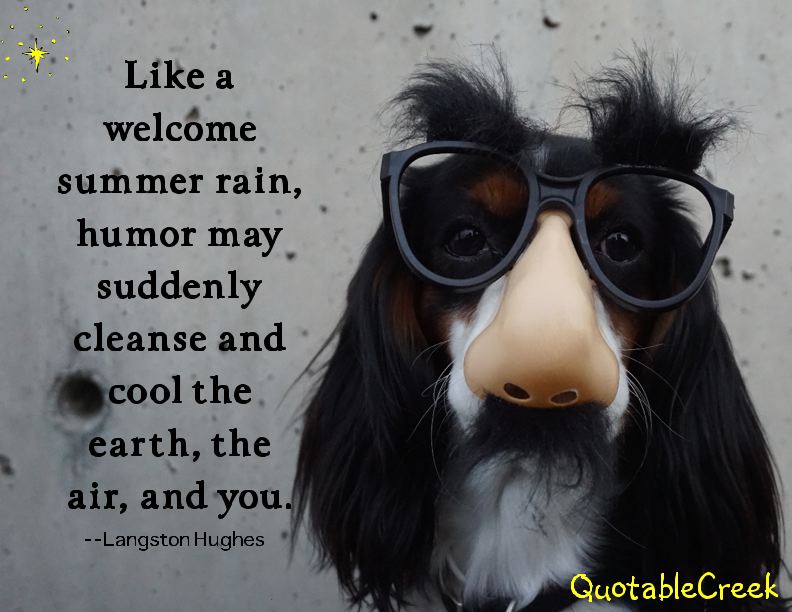
Heard a good joke lately? Watched a funny cat video perhaps? Maybe a picture of a spaniel in a Groucho mask?

Humor is always good for the heart and soul. It can even, maybe, cure what ails you. Dr Cynthia Thaik, a cardiologist, says:

An old Yiddish proverb says, “What soap is to the body, laughter is to the soul.” Everyone knows that laughter makes you feel good and puts you in high spirits, but did you also know that laughter actually causes physiological responses that protect the body from disease and help your vital organs repair themselves? A good laugh can be compared to a mild workout, as it exercises the muscles, gets the blood flowing, decreases blood pressure and stress hormones, improves sleep patterns and boosts the immune system. Furthermore, a study by the John Hopkins University Medical School showed that humor and laughter can also improve memory and mental performance. Yet despite the fact that laughter has so many benefits, far too many of us forget to even crack a smile every once in a while, let alone laugh.

She suggests some ways to lighten up with humor. Finding the humor in a bad situation can make it better. Mirth releases endorphins and is contagious, a twofer! Surrounding yourself with funny people or remembering funny incidents can lift your mood.

Take time to laugh today. If you need help finding your funny, consider this. Or you can always get a dog and put him in a Groucho mask.

Bless the children

swollenheart

In a recent Oprah magazine, Elizabeth Gilbert talks about her Inner Crone — a version of herself old, happy, and well past the point of fear  — that she pictures when she needs a shot of courage. She considers her Inner Crone to be “a badass old lady who already dwells somewhere deep within [her] and whom [she] hope[s] to fully become someday.” Picturing her Inner Crone gives Gilbert gumption.

But she also remembers her Inner Child, and pictures that child particularly when she is feeling depressed or hard on herself:

Many years ago when I was going through a dark season of depression and self-loathing, I taped a sweet photograph of myself at the tender age of 2 on my bathroom mirror. Looking at that photo every day reminded me that I once was this blameless little person, deserving of all tenderness–and that part of me would always be this blameless little person deserving of all tenderness. Meditating upon a smaller and more innocent version of my face helped me to learn to be more compassionate to myself. I was finally able to recognize that any harm I inflicted on me, I was also inflicting on her. And that little kid clearly didn’t deserve to be harmed.

We could all benefit from picturing our Inner Child when we are being hard on ourselves. Would you criticize that little child the way you are criticizing yourself now, or would you be more patient and encouraging? Would you demand perfection from that child, or would you celebrate progress? If you were wounded by adults when you were a child, you now are an adult who can support that little child in a healing way.

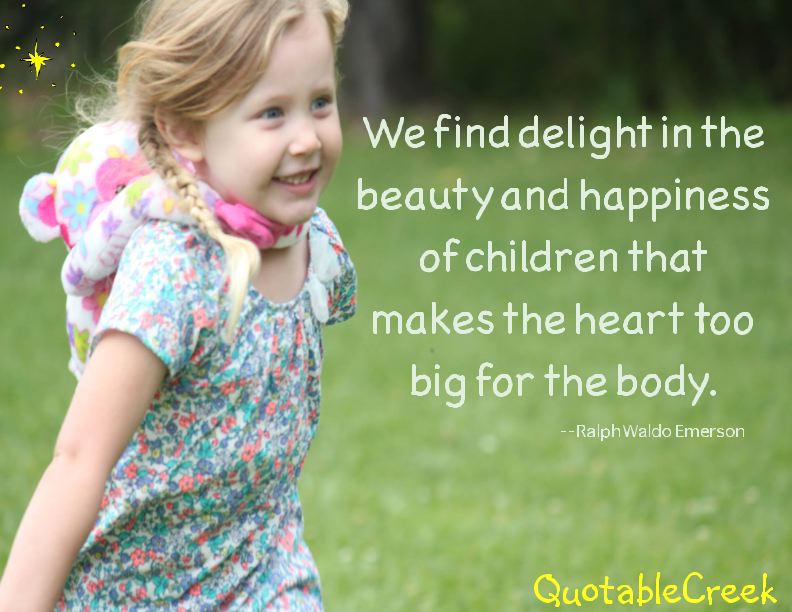
Think back. Can you remember that Inner Child who is still a part of you? The joy and exuberance, enthusiasm and trust, innocence and promise? No matter how far you’ve come from that start, treat yourself with kindness, patience, and compassion. That Inner Child is alive and well…and trusts you.

Patron Saint of Doubters

faithfulness

This week, Pope Francis sainted Mother Teresa. She was a beloved paragon of a selfless life, ministering to the poor and dying, shining a light on the importance of the little things and the love of family. After her death, her diaries showed her struggles with doubt. Once feeling clearly called to her mission, in the last several decades of her life she felt God’s absence. She said,

Lord, my God, who am I that You should forsake me? The Child of your Love–and now become as the most hated one–the one–You have thrown away as unwanted–unloved. I call, I cling, I want–and there is no One to answer–no One on Whom I can cling–no, No One.–Alone … Where is my Faith–even deep down right in there is nothing, but emptiness & darkness–My God–how painful is this unknown pain–I have no Faith–I dare not utter the words & thoughts that crowd in my heart–& make me suffer untold agony.

So many unanswered questions live within me afraid to uncover them–because of the blasphemy–If there be God –please forgive me–When I try to raise my thoughts to Heaven–there is such convicting emptiness that those very thoughts return like sharp knives & hurt my very soul.–I am told God loves me–and yet the reality of darkness & coldness & emptiness is so great that nothing touches my soul. Did I make a mistake in surrendering blindly to the Call of the Sacred Heart?

And on until her death, she felt God’s absence, rather than his presence. And yet she persisted doing the work to which she had been called, living a life of faith.

Some may call her a hypocrite to have an outward smile of peace and an inner crisis of faith, but isn’t her struggle every one’s struggle? Who among us doesn’t struggle with doubt? Don’t we all rely on faith when our paths grow dark and twisting?

St. Teresa of Calcutta inspires us to hang on during the dark nights of the soul, to continue to walk the walk, to be faithful and steadfast, and to shine light in the dark places. She can aptly be considered the Patron Saint of Doubters.


What is it you plan to do with your one wild and precious life?

wild-and-precious

In her poem, The Summer Day, Mary Oliver writes:

The Summer Day

Who made the world?
Who made the swan, and the black bear?
Who made the grasshopper?
This grasshopper, I mean-
the one who has flung herself out of the grass,
the one who is eating sugar out of my hand,
who is moving her jaws back and forth instead of up and down-
who is gazing around with her enormous and complicated eyes.
Now she lifts her pale forearms and thoroughly washes her face.
Now she snaps her wings open, and floats away.
I don't know exactly what a prayer is.
I do know how to pay attention, how to fall down
into the grass, how to kneel down in the grass,
how to be idle and blessed, how to stroll through the fields,
which is what I have been doing all day.
Tell me, what else should I have done?
Doesn't everything die at last, and too soon?
Tell me, what is it you plan to do
with your one wild and precious life?

What does it mean to pray? What exactly is a prayer? Is it reciting certain words in unison at a church on Sundays, or is it also something infinitely more?

Is it noticing the creator in his delicate creation? Is it paying attention? Is it being grateful? Is it flinging yourself down on the grass to contemplate not just the meaning of life, but the meaning of your life?

Yes, life is short, over far too soon. But, while we are here, there is opportunity. To pray, to notice, to attend, to use our lives to make a difference.

What is it you plan to do with your one wild and precious life?

Feel it all

tears

How tiresome it is to be proper.

How droll.

Buttoned up, buckled, hair smoothed down.

Inside, your spirit paces,

back,

forth, and in circumference.

Measuring its quiet confines.

Plotting its escape.

Stranger danger?

StrangersWhen you think of the people you love the most, isn’t it remarkable to believe you were once strangers? Even your parents and siblings were once new to you and vice versa. And, yet, we tend to fear the stranger now. Or maybe we just choose to not engage. How many of us greet people these days and engage a stranger in conversation without looking for anything in return– no directions, no assistance, no advice? Just a chat for the privilege of learning about another person on his or her journey?

And yet there is value in engaging the people about us. Our experience is richer in community when we come out of our bubbles. We learn things we never knew and open ourselves up to new experience. And, if that is not enough, there are many unexpected rewards of talking to strangers.

Today, keep the phone in your pocket and really see all the people about you. Smile, and greet the stranger. You may well make a new friend.

Ugly or beautiful?

beautifulcarrots

What is the yardstick we use to measure something’s beauty? Why do we so often look only to the surface? Would it surprise you that the ugliest fruits and vegetables were the most nutritious? Would it surprise you that a husband treasures his wife’s stretch marks and wrinkles because they tell the story of their life together? Read more about the ugly carrots.  And that sentimental husband who didn’t like photoshopped picture of his wife.

Today, consider the ‘ugly’ things. Do they hold an inner beauty?